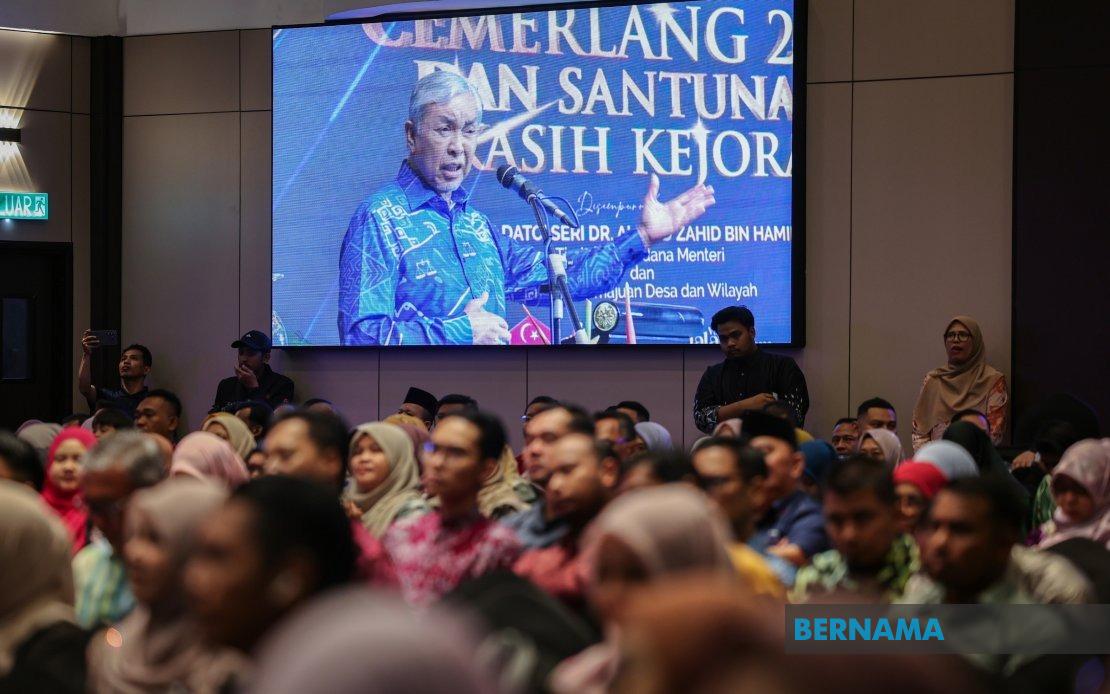
The Barisan Nasional coalition is pushing back against assertions that its campaign for the Johor state election lacks vigour, with party chairman Datuk Seri Dr Ahmad Zahid Hamidi characterising such claims as subjective political commentary rather than accurate reflections of ground conditions. Speaking in Kota Tinggi after inaugurating the Southeast Johor Development Authority's Excellent Service Awards 2025, Zahid indicated that rival coalitions were welcome to their own assessments, but BN's machinery remained engaged and mobilised across the state's 56 contested seats.
Zahid's remarks came as the coalition faces a multi-cornered contest in the 16th Johor state election, with Pakatan Harapan fielding candidates in all state seats, Perikatan Nasional running 33 nominees, and smaller parties including Bersama, MUDA, Parti Orang Asli Malaysia, Parti Sosialis Malaysia, and independent candidates also contesting. The breadth of the field reflects deepening fragmentation in Malaysian politics, where the comfortable two-coalition dominance of previous decades has given way to a more complex electoral landscape that tests voter cohesion and party machinery effectiveness.
One recurring concern in Johor's campaign has been whether the cooperation between BN and Pakatan Harapan at the federal level through the Unity Government framework might confuse voters accustomed to viewing these coalitions as adversaries. This anxiety reflects a genuine tension in contemporary Malaysian politics: state-level contests are no longer hermetically sealed from national political dynamics, yet the local context can differ substantially. Zahid addressed this directly, noting that Johor presents a distinctive situation because the state government predates the federal Unity Government arrangement, thereby avoiding the appearance of a complete political realignment at odds with voter expectations.
The Deputy Prime Minister's framing of federal-state cooperation as professional rather than problematic appears designed to reassure traditional BN voters that supporting the coalition in Johor need not signal approval of Putrajaya's broader political architecture. This messaging discipline reflects BN's recognition that while the Unity Government has stabilised Malaysia's national governance, it remains politically contentious in certain quarters, particularly among voters who view cooperation with Pakatan Harapan as a betrayal of BN's historical identity. By emphasising Johor's autonomy and strong local governance, BN seeks to anchor its campaign in tangible state-level accomplishments rather than federal coalition politics.
Zahid highlighted the financial performance of the Johor government under Menteri Besar Datuk Onn Hafiz Ghazi as a cornerstone of the coalition's re-election pitch, noting that the state recorded RM2.26 billion in revenue last year—the highest figure among Peninsular Malaysian states. This statistic, if accurate, suggests efficient revenue collection and fiscal management, though Malaysian state finances remain constrained by limited revenue-raising powers and dependence on federal allocations. Nevertheless, the metric serves BN's narrative that state-level governance matters tangibly to residents through infrastructure development, social services, and economic activity.
The coalition's emphasis on administrative continuity and development agenda implementation reflects a campaign strategy centred on performance-based appeal rather than ideological differentiation. In an era of voter fatigue with political scandals and governance questions, incumbent parties across the region increasingly rely on demonstrable developmental outcomes to justify re-election. For BN in Johor, this approach leverages Onn Hafiz's reputation as a relatively clean administrator and the visible infrastructure improvements attributed to his tenure, attempting to inoculate the coalition against broader national narratives about corruption or institutional weakness.
Zahid's response to PAS president Tan Sri Abdul Hadi Awang's call for voters to reject Pakatan Harapan entirely—even in straight fights where BN competes—illustrates the delicate calibration required in Malaysia's fractious political environment. Rather than reciprocating Hadi's aggressive stance, Zahid adopted a measured tone, suggesting BN would welcome any voter support while maintaining professional campaign conduct. This restraint likely reflects strategic calculations about which voter segments BN needs to retain; openly embracing PAS's anti-PH messaging might alienate urban voters and non-Muslim constituencies concerned about religious politics, even as it energises conservative Malay-Muslim voters.
The broader context of the Johor election involves not merely which coalition governs the state, but how Malaysian politics continues to evolve in response to voter demands for competent administration and reduced polarisation. Johor, as Malaysia's second-largest state by population and a crucial economic engine, carries outsized importance for national political trajectories. A decisive BN victory would reinforce the coalition's argument that it remains electorally viable despite historical liabilities; conversely, significant gains by PH or PN would suggest voters are receptive to alternatives or that localised grievances override national coalition loyalties.
The multiplicity of candidates and parties contesting—with early voting scheduled for July 7 and main polling on July 11—means that vote-splitting remains a genuine possibility in several constituencies. Smaller parties including MUDA, with its appeal to younger urban voters seeking reform-minded alternatives, and PSM, representing socialist politics, could accumulate sufficient votes to alter seat distributions without necessarily winning outright. These dynamics underscore how Malaysian state elections have become laboratories for testing political fragmentation patterns observable elsewhere in Southeast Asia, where traditional two-party or two-coalition systems face sustained pressure from single-issue and identity-based competitors.
Zahid's confidence regarding electoral outcome appears calibrated to project unity and momentum within BN ranks while avoiding overconfidence that might demobilise supporter turnout. The messaging emphasises that a "resounding victory" would strengthen the state government's mandate to pursue its five-year development agenda, subtly implying that anything less than a clear majority would represent underperformance. This framing places stakes on seat tallies rather than merely retaining government, reflecting BN's interest in establishing a strong negotiating position for any future configurations at state or national level.
For Malaysian political observers and regional analysts tracking the health of incumbent coalitions across Southeast Asia, the Johor election offers insights into how established parties respond to sustained electoral competition and evolving voter expectations. The result will illuminate whether BN's federal reforms and positioning within the Unity Government genuinely resonate with voters, or whether local dissatisfaction, generational change, and multi-polar competition continue eroding the coalition's traditional electoral dominance. The outcome will reverberate beyond Johor's borders, influencing calculations about Malaysia's political direction and potentially setting expectations for future state and national electoral contests.

