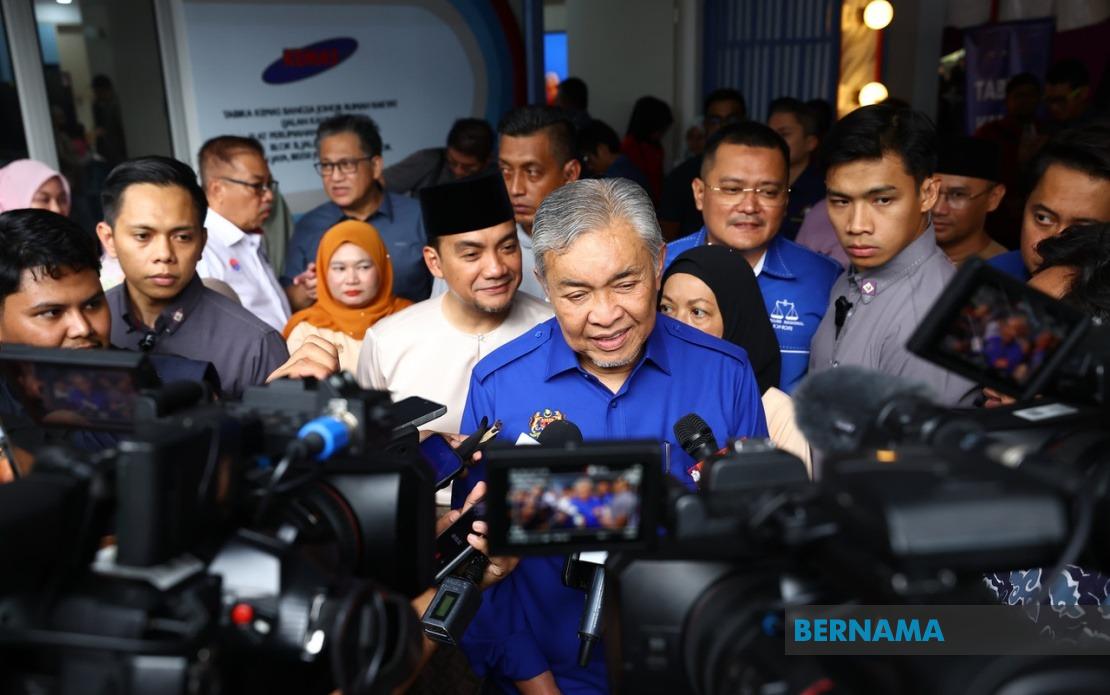
Barisan Nasional's leadership has signalled political maturity by acknowledging Pakatan Harapan's policy platform for the Johor state election, even as the ruling coalition campaigns on the strength of its demonstrated governance record. BN Chairman Datuk Seri Dr Ahmad Zahid Hamidi, who holds the concurrent portfolios of Deputy Prime Minister and Rural and Regional Development Minister, made the remarks during a community engagement event in Johor Bahru on July 3, suggesting that despite fierce electoral competition, Malaysia's major coalitions can afford mutual respect in their democratic contest.
Ahmad Zahid's conciliatory approach reflects a broader institutional confidence within BN, which controls both federal and state levers of power. By welcoming PH's proposals rather than dismissing them outright, BN projects an image of a governing force secure enough to acknowledge opposition ideas while remaining convinced of its own superiority in execution. The party chairman framed this openness within the context of democratic norms, positioning BN as a coalition that embraces constructive competition rather than zero-sum antagonism.
PH's manifesto for the Johor contest, unveiled the same day, contains ten specific commitments addressing healthcare, housing affordability, youth empowerment, and education. The package includes a dedicated Johor Health Scheme, financial assistance for first-time property purchasers, and a RM500 million allocation earmarked for youth development programmes. These proposals target tangible pain points for voters across different life stages and socioeconomic brackets, suggesting PH's strategy focuses on bread-and-butter issues rather than ideological appeals.
BN's counter-positioning centres on demonstrated achievement rather than future promises. Ahmad Zahid emphasised that BN fulfilled over 90 per cent of its manifesto commitments during the previous governing term in Johor, a statistic designed to inoculate voters against scepticism about political pledges. This emphasis on track record represents BN's strategic advantage as the incumbent administration, allowing the coalition to argue that its promises carry the weight of proven implementation capability.
The ruling coalition's manifesto itself targets comprehensive population coverage, spanning expectant mothers through pensioners and widowed parents. Ahmad Zahid articulated BN's approach as universalistic rather than sectarian, emphasising that benefits accrue to anyone residing in Johor regardless of ethnic or social background. This framing responds implicitly to longstanding criticism that BN governance has historically favoured particular communities, instead positioning the coalition as the guardian of inclusive development.
The invocation of "Bangsa Johor"—a concept that transcends ethnic particularism in favour of statewide identity—reflects an evolving rhetorical strategy within Malaysian politics. By asserting that all Johor residents qualify as members of a singular state community deserving equal entitlements, BN attempts to recast itself as a post-communal political force. For Malaysian voters weary of identity-based competition, such messaging carries tangible appeal, though its implementation remains subject to scrutiny.
Ahmad Zahid's assurance of continued federal support for Johor's development through his Rural and Regional Development portfolio signals that BN intends to leverage its control of national resources to bolster its state-level campaign. This interplay between federal and state party machinery represents a structural advantage that opposition coalitions struggle to replicate. The capacity to channel central government funds toward state priorities creates a powerful incentive for voters concerned with concrete developmental outcomes.
The Johor election itself involves considerable scale, with 172 candidates contesting 56 state assembly seats across two voting phases: early voting on July 7 and election day on July 11. This electoral machinery test will provide insight into voter sentiment across multiple constituencies and demographic segments. Johor's political complexion holds significance beyond the state itself, as the country's most populous state after Selangor carries implications for national coalition stability and inter-coalition dynamics.
For Southeast Asian observers, the Johor contest illustrates patterns of institutionalised political competition increasingly characteristic of the region's mature democracies. Rather than descending into confrontational zero-sum contests, Malaysia's major coalitions demonstrate capacity for procedural respect alongside substantive competition. Ahmad Zahid's acknowledgement of PH's manifesto, coupled with confidence in BN's implementation record, exemplifies a political system confident enough to compete on policy substance rather than merely on control of state apparatus.
The election represents a test of voter priorities in an era of economic uncertainty and rising cost-of-living pressures. Both BN and PH calibrated their manifestos toward immediate material concerns—healthcare access, housing affordability, youth opportunity—suggesting that abstract ideological appeals command less traction than concrete service delivery. For Malaysian and regional policymakers, the outcome will signal whether voters reward continuity and demonstrated competence or demand change and new policy directions.
Looking forward to the July 11 polling date, both coalitions will invest substantially in ground operations, media campaigns, and targeted messaging. The Johor result will provide crucial data about whether BN's strategy of emphasising proven delivery and inclusive governance messaging can overcome any voter fatigue with long-standing incumbency, or whether opposition momentum and PH's youthful energy proposition might reshape the electoral landscape in a strategically important state.

