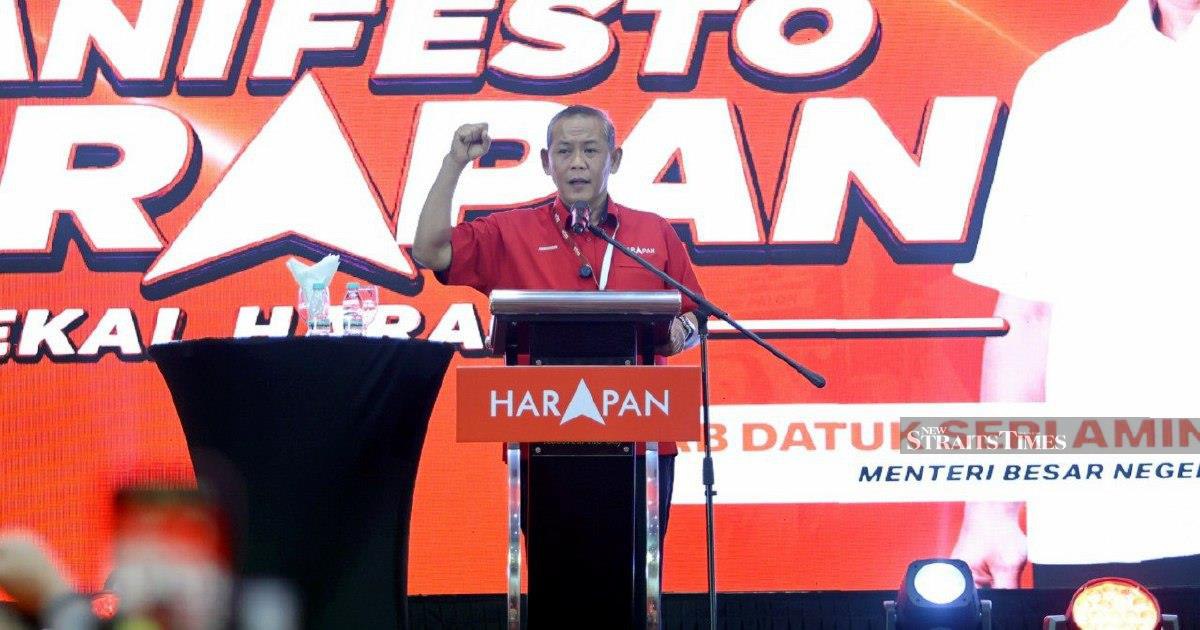
Datuk Seri Aminuddin Harun has taken aim at the Barisan Nasional's campaign platform for the forthcoming Negri Sembilan election, asserting that its proposed policies are substantially drawn from programmes previously established and executed by the Pakatan Harapan state government during his tenure as chief minister. The accusation represents a significant escalation in the rhetorical battle between the two political coalitions ahead of the state polls, with the PH leader arguing that the BN blueprint lacks originality and effectively borrows from the groundwork laid by his administration.
The timing of these allegations carries particular weight as both coalitions enter the final phase of campaigning in Negri Sembilan. Aminuddin's charge that BN has engaged in what amounts to policy plagiarism cuts to the heart of how voters should evaluate the competing visions being presented to them. Rather than offering fresh directions or innovative approaches, the PH leader contends that BN is essentially promising to continue a trajectory that the ruling coalition already initiated. This dynamic sets up a critical question for the electorate: whether voters will credit the coalition that originated these initiatives or the one seeking to perpetuate them.
The substance of Aminuddin's complaint extends beyond mere accusation. During his stewardship of the state, the PH administration implemented various development projects, social programmes, and governance reforms that have become fixtures in Negri Sembilan's political landscape. When BN incorporated similar proposals into its election manifesto, it raised questions about whether the opposition coalition is genuinely committed to advancing the state or simply repackaging existing successes to appear credible. The distinction matters considerably in Malaysian electoral politics, where claims of developmental achievement heavily influence voter behaviour.
This type of manifestogate incident occurs with regularity in Malaysian politics, yet it demonstrates persistent tensions about political ownership and credit-taking. Opposition parties frequently must navigate the awkward reality that sitting governments have already begun implementing many popular policies, leaving challengers to explain why voters should switch allegiances. BN's incorporation of PH's programmes into its own manifesto suggests the coalition recognised their popularity with constituents but created vulnerability to precisely the kind of criticism now being levelled.
For Negri Sembilan voters, the unfolding controversy illuminates important questions about electoral choice. If BN plans to largely maintain existing policies, voters must decide whether they prefer the incumbent coalition that designed these initiatives or a rival promising continuity under new leadership. This framing fundamentally alters the campaign's central narrative from one focused on forward progress to one centred on which coalition deserves credit and trust for ongoing implementation.
The accusation also carries implications beyond this single state election. Malaysia's political landscape has grown increasingly competitive, with coalitions regularly trading power at federal and state levels. When a coalition in opposition adopts the sitting government's policies, it reflects the political consensus around certain priorities—a phenomenon that can benefit voters through policy continuity but complicates the task of providing genuine electoral choice. Aminuddin's criticism implicitly suggests that BN should be held accountable for appearing to follow rather than lead.
Regionally, the Negri Sembilan contest reflects broader Southeast Asian patterns where populist and incumbent governments struggle to maintain clear policy differentiation from challengers. As administrative efficiency and social programme delivery become the dominant electoral currency, opposition parties find themselves pressured to adopt similar platforms, creating convergence that can confuse voters about substantive differences between competing coalitions.
The response from BN to these accusations will significantly shape the remainder of the campaign. The coalition could defend its manifesto by arguing that effective policies should be preserved regardless of their origin, and that proven programmes deserve continuation. Alternatively, BN might argue that it plans to improve upon existing initiatives or implement them more efficiently—a repositioning that would address the originality concern while maintaining credibility.
For political observers, the Negri Sembilan election increasingly resembles a referendum on incumbent performance rather than a choice between genuinely alternative visions. Voters must ultimately decide whether they believe PH deserves continuation for launching these programmes, or whether BN merits an opportunity to administer them. This distinction shapes how the manifesto copying allegations will resonate with the electorate in the final weeks of campaigning.
The controversy also underscores the challenge facing Malaysian opposition parties more broadly. Having spent years in the wilderness, coalitions like BN must credibly explain how they will govern differently while simultaneously adopting policies that constituencies have come to expect. Aminuddin's attack highlights this fundamental tension, suggesting that BN's path to power may require offering more than policy continuity to convince voters that change represents improvement rather than mere recalibration.

