Wimbledon stands as one of sport's great paradoxes: a tournament steeped in British social custom and carefully preserved tradition, yet home to some of tennis's most visceral moments of triumph and heartbreak. The 149-year-old All England Club zealously guards its heritage, from the immaculate perennial ryegrass courts to the strict all-white dress code and the seemingly obligatory strawberries and cream. Spectators arrive in elaborate hats, royal family members grace the boxes, and the entire event unfolds like a carefully choreographed dance between old-world elegance and modern sporting excellence. Yet beneath this refined exterior lies an intensely competitive arena where the world's best players wage psychological and physical battles for the sport's most prestigious title.
The contrast between Wimbledon's visual presentation and the FIFA World Cup it coincided with this year was unmistakable. Where football's global showcase revels in colourful kits, passionate displays, and unbridled celebration, Wimbledon maintains its reserved demeanour—yet the competitive stakes prove equally high. The tournament features approximately 675 matches across all categories, each one a potential platform for drama, elation, and crushing disappointment. What photographers documented across the two-week event revealed a sporting soul that transcends the tournament's famous traditions, capturing instead the fundamental human struggle at the heart of elite competition.
These visual narratives unfolded in countless small moments: the silence before a crucial serve, the steely concentration etched across a player's face during a pivotal volley, the fleeting expressions of relief when victory becomes certain, and the devastating reality of defeat settling in. Each photograph functioned as a window into Wimbledon's true character—not the pageantry, but the grit beneath it. Photographers positioned themselves to document not the winners' celebrations or the comfortable moments, but rather the raw humanity of athletes pushed to their limits.
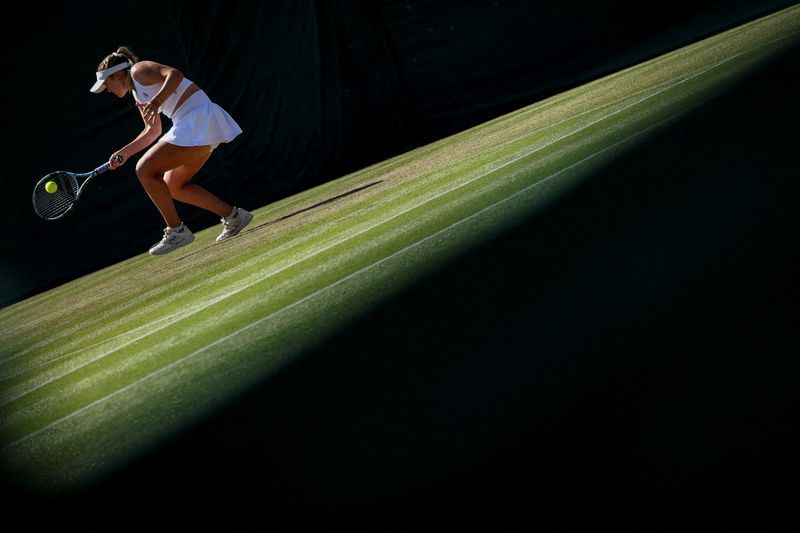
Alexandra Eala's encounter with third seed Iga Swiatek exemplified this hidden narrative. The 21-year-old Filipino player, facing a six-time major champion, fell while attempting a forehand return. In that moment, her gritted teeth and fallen body told a story of determination against overwhelming odds. Photographer Toby Melville had positioned himself to capture a celebration of Eala's victory, but the unexpected tumble created an even more compelling frame—one that captured the fierce will to compete that defines Wimbledon's soul. Melville managed to fit both Eala's entire body and the ball into a single upright frame just as her fall created a natural landscape composition, inadvertently capturing one of the tournament's most memorable competitive moments.
Equal drama emerged in moments of frustration and despair. Otto Virtanen's first-round match proved a gruelling affair, and during a particularly intense passage, the player walked toward a courtside barrier, his body language suggesting an almost primal desire to escape the pressure of the moment. Photographer Jaimi Joy captured this instant of raw emotion—the kind that spectators rarely see beneath Wimbledon's composed surface. These images revealed that even within the tournament's famously restrained environment, players experience the same emotional extremes as athletes in more visibly passionate sports.
Naomi Osaka's campaign provided contrasting imagery, with photographer Marko Djurica capturing the two-time major winner striding across Centre Court in her striking kimono-inspired dress. This photograph seemed to encapsulate Osaka's fearless approach as she reached the quarter-finals for the first time, projecting confidence and composure against Wimbledon's storied backdrop. Her presence exemplified how modern players navigate and transform the tournament's traditions while maintaining their individual identities.
Yet it was the interplay of light and shadow that perhaps most eloquently conveyed Wimbledon's dual nature. Melville's image of men's champion Jannik Sinner mid-air during the final against Alexander Zverev showed the Italian stretched to impossible limits, his long shadow dramatically extending across the grass—a visual metaphor for the immense effort required to claim the title. The shadow appeared to stretch even further than his reaching arm, suggesting the psychological and emotional toll alongside the physical exertion.
Djurica captured another shadow moment of profound significance: winners Guo Hanyu and Kristina Mladenovic embracing after claiming the women's doubles title, their combined shadow cast upon the grass creating an optical illusion of a solitary figure with fist raised triumphantly. This accidental composition perfectly captured the essence of Wimbledon—where individual achievement and collective emotion blur together, where preparation and spontaneity converge, and where the manicured traditions provide merely the stage for authentic human drama.
As the tournament concluded and spectators filed out from the stands, the real testimony to Wimbledon's intensity remained etched into the venue itself. The grass courts bore visible scars from two weeks of relentless competition—worn patches marking where players' feet had pounded during crucial points and match-deciding moments. Andy Couldridge's time-lapse photography of Centre Court documented this transformation, showing how the passage of countless shoes gradually degraded the grass, a living record of the tournament's competitive soul written directly onto its most hallowed ground.
These photographic records collectively reveal Wimbledon's essential truth: beneath the ceremony, tradition, and refined aesthetics lies sport in its rawest form. The all-white dress codes, strawberries and cream, and royal attendance remain important elements of Wimbledon's identity, but they represent merely the tournament's surface. The actual spirit—the competitive fire, the psychological battles, the moments of human vulnerability and triumph—burns just as intensely here as anywhere else in professional tennis. Wimbledon's genius lies in maintaining both simultaneously: preserving tradition while hosting cutting-edge sporting drama, hosting pageantry while showcasing ferocious competition. For those who look beyond the polished presentation, the photographs serve as crucial reminders that Wimbledon's greatest treasure lies not in its history or customs, but in the eternal human drive to compete, to strive, and to triumph.

