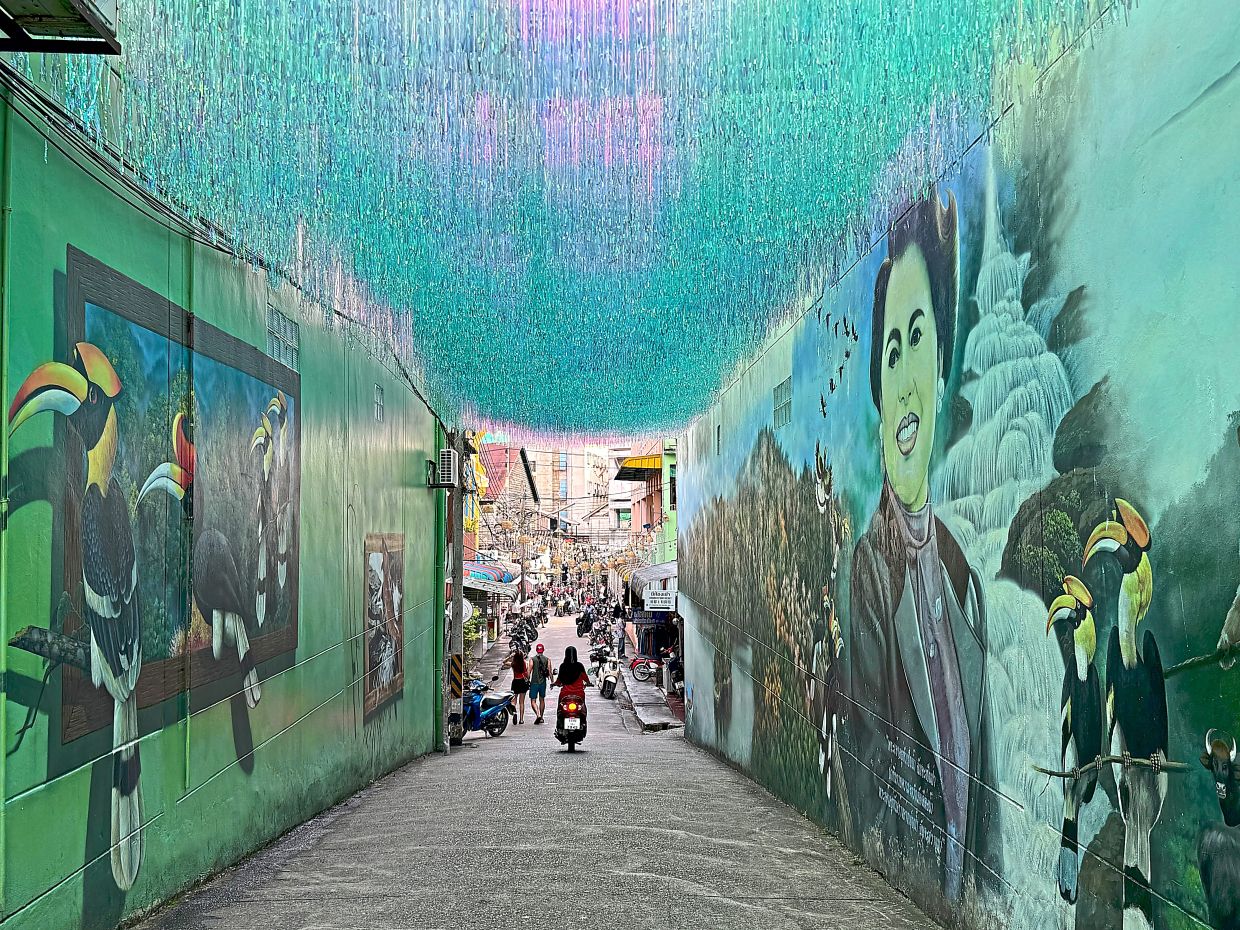
Betong, a modest settlement perched near Thailand's southern border with Malaysia, initially presents itself as an unassuming destination. Yet this five-hour drive from Kuala Lumpur—roughly 380 kilometres distant—conceals a tapestry of historical intrigue, architectural oddities, and cultural identity that rewards curious travellers willing to venture beyond first impressions. What begins as casual roadside observation evolves into genuine discovery when visitors pause long enough to understand the stories embedded in the town's distinctive attractions.
The town's most obvious symbol, the Betong chicken, dominates the local landscape and cuisine. Giant statues dedicated to this prized local breed punctuate the streetscape, appearing on lamp posts and prominent intersections throughout town. Rather than serving merely as kitsch decorations, these monuments represent genuine cultural pride—the Betong chicken holds significant economic and historical importance for the community. This singular focus has transformed the culinary scene, with establishments throughout town specialising in chicken preparations: crispy pork rice served alongside chicken offerings, chicken porridge prepared to regional specifications, and countless variations on poultry-based regional dishes. The consistency of this thematic branding suggests deliberate tourism development rather than accidental quirk.
Betong's accessibility from Malaysia has positioned it as an increasingly popular destination for cross-border daytrippers and weekend adventurers. The journey from Kuala Lumpur remains manageable, making it practical for those seeking a quick escape into Thailand's southern provinces. This proximity explains the town's growing infrastructure development and its careful cultivation of tourism attractions aimed squarely at Malaysian visitors familiar with the region's geography and cultural contexts.
The Mongkollit Tunnel, constructed in 2001 and recognised by the Tourism Authority of Thailand as the nation's first mountain tunnel, initially disappoints daytime visitors with its utilitarian appearance. However, evening transformation renders it genuinely spectacular. Brilliant blue illumination bathes the tunnel's interior, creating an atmospheric passage that draws crowds of photographers and casual visitors to the pedestrian walkways flanking the vehicular lanes. This deliberate lighting scheme represents thoughtful investment in visitor experience, converting functional infrastructure into an evening attraction that justifies the journey.
More historically substantial is the Piyamit Tunnel, located approximately 15 kilometres from the town centre. Constructed during the late 1970s, this 1-kilometre-long passage once served a radically different purpose than contemporary recreation. The tunnel functioned as a Communist Party of Malaya operational base, housing sleeping quarters, meeting rooms, communication stations, and storage facilities concealed within the jungle. The engineering reflects genuine military necessity—multiple entrances and exits, though some now sealed for safety, enabled rapid dispersal when confronted with government forces. An ingeniously designed cooking stove channelled charcoal smoke underground, rendering the camp virtually undetectable to aerial reconnaissance or ground-based observation.
The visitor experience at Piyamit involves a contemplative 15-minute approach along a covered pathway before reaching the tunnel entrance. A small museum adjacent to the site documents this insurgency period through historical photographs and artefacts, while the physical space itself—now stripped of its clandestine function—allows visitors to mentally reconstruct the lives of the fighters who inhabited this subterranean compound. This transformation of conflict infrastructure into educational tourism represents a broader regional pattern of processing Cold War history through visitor engagement rather than suppression or forgetting.
For those seeking deeper contextual understanding, Chulabhorn Phatthana Village 9 in Mae Wat, situated approximately 120 kilometres distant, offers an unconventional perspective. This settlement, established by former Communist Party members who emerged from the conflict, now functions as a cultural heritage site where visitors encounter former combatants who eventually accepted government amnesty and reintegrated into civilian society. The village complicates simplistic historical narratives, demonstrating how individual lives continued after dramatic political conclusions.
Betong's pedestrian-friendly layout rewards those who abandon vehicular exploration in favour of walking. Most significant attractions cluster within reasonable walking distance of the old town centre, rendering the occasional parking frustration manageable. Locals employ a straightforward colour-coded kerb system—black and white indicating permissible parking, red and white denoting restrictions—a practical convention that gradually becomes intuitive to visitors.
Route 410, designated the Pattani-Betong Highway, stretches approximately 160 kilometres through mountainous terrain renowned among motorcycle enthusiasts for its technical demands. The winding path, steep elevation changes, and dramatic curves have established this route as a destination in itself for regional bikers seeking challenging riding conditions. Commercial establishments catering to this demographic, including Betong Route 410 with its merchandise celebrating the highway culture, have emerged along the corridor. Nearby Wat Phutiwhat, featuring a towering bronze Buddha statue overlooking the town and housing significant relics, attracts devotional visitors alongside casual tourists, though early-morning visits prove advisable to avoid afternoon congestion.
Among Betong's most peculiar attractions stand two oversized mailboxes that have acquired landmark status through sheer audacity of scale. The original structure, towering 3.2 metres in height and dating to 1924, stands near the Betong Clock Tower. This functional historical artefact originally broadcast government announcements through integrated loudspeaker technology, serving communication purposes beyond postal delivery. Remarkably, it continues receiving mail today, representing an unlikely continuity of civic infrastructure across a century of dramatic regional transformation. A nine-metre replica, constructed explicitly as a tourist attraction, now dominates the area outside the City Convention Hall along Sukyang Road, serving primarily photographic purposes while the original maintains its utilitarian function.
Betong ultimately rewards unstructured exploration over rigid itinerary adherence. The town's character emerges not from singular monumental attractions but from accumulated small surprises—the chicken symbolism, historical complexity, technical road conditions, architectural peculiarities, and the casual hospitality of residents accustomed to cross-border visitors. For Malaysian travellers, Betong represents accessible cultural immersion requiring minimal travel commitment while delivering genuine discovery potential, a rare combination in contemporary Southeast Asian tourism.

