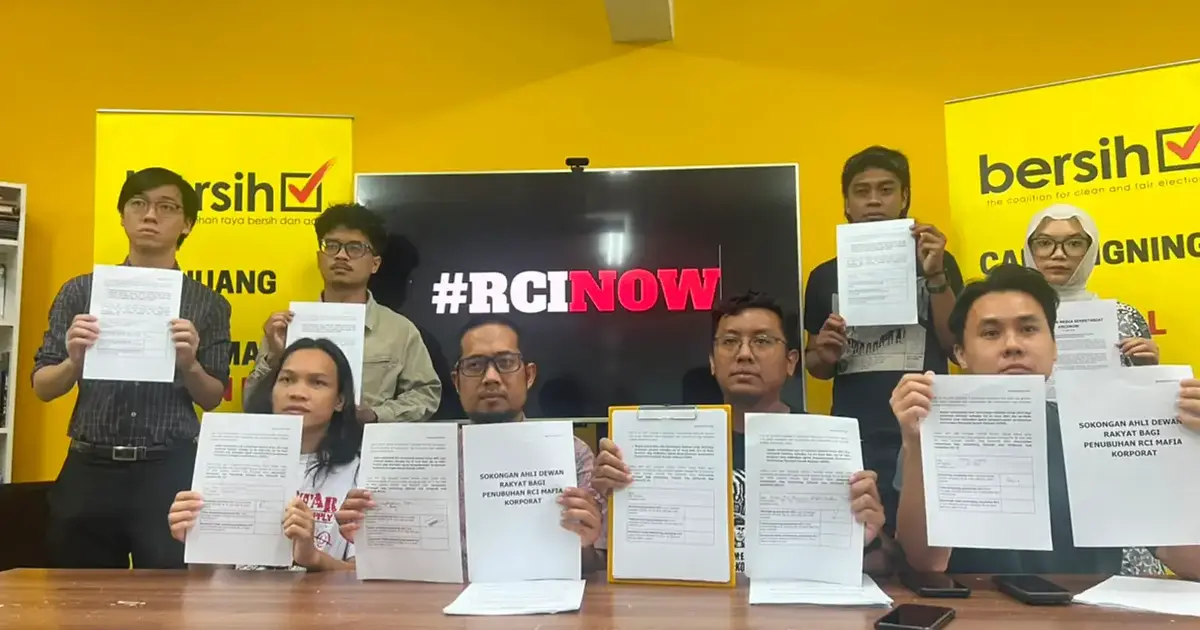
The electoral reform coalition Bersih announced on Tuesday that 34 members of parliament have endorsed its proposal for a Royal Commission of Inquiry to investigate what the watchdog characterises as a "corporate mafia" operating within Malaysia's economic and political spheres. According to Bersih, the cross-party backing signals growing concern among legislators about the influence and activities of concentrated corporate interests that the group says operate outside normal regulatory frameworks.
The 34 MPs who have declared support represent a notable spectrum of Malaysia's parliamentary landscape, drawing members from PKR, PAS, DAP, and Umno. This alignment across ideological lines—spanning Islamist, progressive, and establishment conservative blocs—suggests that concerns about unchecked corporate power transcend the typical divisions that characterise Malaysian party politics. The breadth of support indicates that the issue may resonate across constituencies regardless of partisan affiliation, touching on fundamental anxieties about how business influence shapes governance and policy outcomes.
Bersih's characterisation of a "corporate mafia" refers to what the watchdog perceives as networks of well-connected business entities that allegedly exert disproportionate influence over government decisions, procurement processes, and regulatory bodies. The group contends that such networks operate with sufficient coordination and mutual benefit that they warrant investigation through a high-level institutional mechanism. A Royal Commission of Inquiry represents Malaysia's most formal investigative apparatus, typically reserved for matters of national importance or systemic concern.
The timing of Bersih's announcement carries significance in Malaysia's current political climate. The country has experienced several transitions of governmental power in recent years, and persistent public discourse centres on governance standards, accountability mechanisms, and the relationship between business and politics. By securing apparent support from multiple parties, Bersih positions the corporate mafia investigation as a non-partisan governance issue rather than a politically motivated attack on any single administration.
PAS's participation in the supporting coalition is particularly noteworthy given the party's recent prominence in Malaysian politics and its role in several state and federal governments. The Islamist party's willingness to endorse an RCI on corporate influence suggests that the issue crosses religious and ideological boundaries. Similarly, DAP's backing reflects the opposition coalition's interest in accountability mechanisms, while PKR and Umno support underscores that even within government, legislators perceive value in investigating corporate networks.
The mechanics of establishing a Royal Commission of Inquiry typically require formal governmental action and prime ministerial involvement. While parliamentary backing is politically significant, it does not automatically result in the commission's establishment. Bersih's announcement therefore represents a bid to build pressure on the executive branch to initiate such an investigation. The 34-MP threshold may be intended to demonstrate sufficient legislative will that the government would face political consequences for ignoring the proposal.
For Malaysian businesses and investors, the proposal carries implications regarding the regulatory environment and expectations around corporate governance. A comprehensive RCI into corporate mafia activities could lead to recommendations for stricter enforcement of competition law, enhanced transparency requirements, or restructuring of sectors deemed to suffer from excessive concentration of economic power. International investors watching Malaysia's regulatory trajectory would likely monitor developments closely, as institutional investigations of this magnitude can reshape business operating assumptions.
The corporate mafia concept as employed by Bersih reflects growing regional and global concern about the capture of state institutions by private interests. Southeast Asia has experienced multiple instances where concentrated wealth translates into disproportionate policy influence, and Malaysia's relatively developed economy and sophisticated business sector make it a testing ground for how democracies address such imbalances. An RCI could either validate concerns about systemic capture or alternatively provide findings that reassure stakeholders about the independence of Malaysia's regulatory bodies.
Civil society organisations in Malaysia have increasingly focused on governance and institutional integrity as central to national development. Bersih's push for an RCI aligns with this broader movement to strengthen accountability mechanisms and subject powerful entities to scrutiny. The electoral watchdog's role monitoring campaign financing and political spending puts it in a position to observe potential connections between corporate interests and political behaviour, lending credibility to its assertions about corporate influence networks.
The 34-MP endorsement, while significant, may represent only preliminary support for the concept. Implementation of a Royal Commission requires sustained political will and the willingness of the ruling coalition to allocate resources and prime ministerial credibility to such an investigation. The government's response to Bersih's announcement will indicate whether corporate governance reform ranks among the administration's priorities or whether other concerns take precedence in the current political cycle.
Governance experts in the region will observe whether Malaysia's multiparty parliament can translate concern about corporate influence into concrete institutional reform. The Bersih announcement demonstrates that the issue enjoys cross-party recognition, a necessary precondition for addressing systemic problems that no single party can resolve independently. The pathway from parliamentary endorsement to operational RCI remains contingent on executive action.

