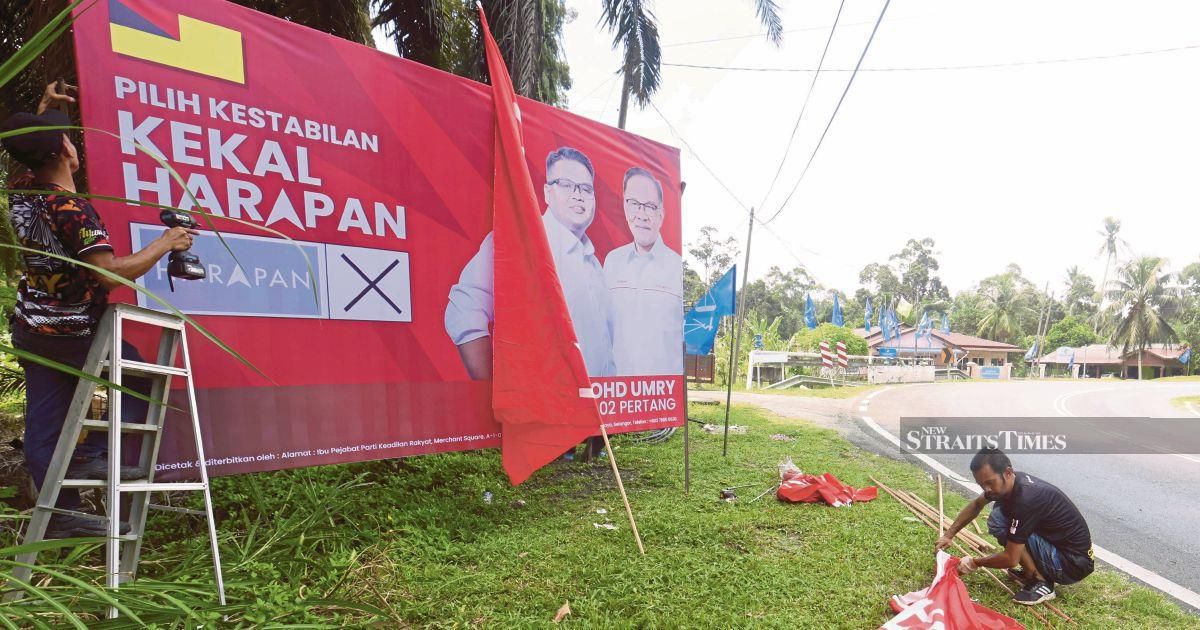
The Negri Sembilan state election has arrived at a critical juncture, with 103 candidates contending for 36 assembly seats in what observers regard as a bellwether contest for Malaysia's shifting political alliances. The electoral contest represents far more than a routine state poll—it serves as a referendum on Bersatu's standing within the broader coalition framework, particularly as Barisan Nasional and Perikatan Nasional navigate an increasingly complex partnership at federal and state levels.
Bersatu's participation in this election encapsulates the broader strategic dilemma facing the party in contemporary Malaysian politics. Founded by former Prime Minister Mahathir Mohamad and once positioned as a reformist force, the party has oscillated between alignment with different political blocs over recent years. The Negri Sembilan contest forces Bersatu to clarify its political identity and viability as an independent actor or subordinate partner within the BN-PN arrangement. The party's performance will reverberate across other state elections and federal dynamics, particularly as various coalitions prepare for eventual general elections.
The institutional structure of the race itself reflects Malaysia's intricate federal political system. With 36 seats distributed across Negri Sembilan's municipalities, the competition for seats remains mathematically tight, meaning even marginal shifts in voter sentiment can determine control of the state assembly. The presence of 103 candidates suggests robust competition rather than uncontested arrangements, indicating that multiple parties view this election as winnable and significant. This competitive density contrasts with elections in some other states where certain blocs have achieved near-monopolistic control.
Bersatu's positioning within Negri Sembilan must be understood against the backdrop of its evolving relationship with both Barisan Nasional and Perikatan Nasional. The party emerged from UMNO dissidence but has since developed an identity rooted in concerns about UMNO's political dominance and the composition of federal governance. However, its options for independent growth have become increasingly constrained as larger parties have consolidated power. The cooperation framework with BN and PN represents both opportunity and subordination—gaining access to larger party machinery while risking absorption or marginalization in seat allocations.
For Malaysian observers, particularly those in states with fluid political compositions, the Negri Sembilan election signals how post-2022 political realignment continues to reshape state-level governance. The traditional three-cornered contest between UMNO-led BN, the opposition PKR-DAP alliance, and various Islamist or reformist parties has fragmented into more complex configurations. Negri Sembilan's outcome will demonstrate whether these new arrangements produce stable governance or merely complicate electoral competition without genuine policy differentiation.
The coalition mechanics at play in Negri Sembilan carry particular significance for the Klang Valley and Selangor region. As a state bordering Selangor, Negri Sembilan's political complexion influences regional dynamics and voter migration patterns. Many Negri Sembilan residents work in Selangor and vice versa, meaning electoral outcomes in one state resonate across state boundaries. A decisive BN-PN performance could strengthen these coalitions' claims to regional authority, while a fragmented result might embolden opposition attempts to consolidate support across the broader area.
Bersatu's specific challenge involves demonstrating relevance in a political ecosystem where UMNO and PKR command significantly larger organizational resources and grassroots networks. The party must compete credibly in Negri Sembilan without cannibalizing BN-PN unity, a delicate balance complicated by coalition agreements that typically allocate seats hierarchically. If Bersatu receives minimal seat allocations in competitive constituencies, its candidates face near-impossible odds against better-resourced UMNO competitors. Conversely, allocating Bersatu to winnable seats risks provoking UMNO grievances about unequal resource distribution within the coalition.
The electoral architecture of Negri Sembilan, with its mix of urban constituencies around Seremban and Nilai alongside rural seats in districts like Kuala Pilah and Jelebu, tests different party strengths. Urban areas tend to favour parties presenting modernization and anti-corruption narratives, while rural constituencies often respond to service provision and traditional patronage networks. Bersatu's rural roots and anti-UMNO positioning could appeal in certain demographics, yet the party's reduced ground machinery compared to UMNO limits its capacity to execute sophisticated microtargeted campaigns.
The broader Malaysian political context adds layers of complexity to this state election. Federal-level tensions between BN and PN, despite their nominal cooperation, frequently manifest in state elections where local power struggles intersect with national factional competitions. Some BN or PN members may view Negri Sembilan as an opportunity to enhance their influence within coalition hierarchies, potentially leading to internal conflicts disguised as electoral competition. Voters, meanwhile, must navigate messaging that simultaneously promotes coalition unity and individual party advantage.
For opposition parties contesting Negri Sembilan, the election presents both opportunity and constraint. The fragmentation of the ruling coalition potentially creates openings, yet consolidated opposition mobilization requires bridging ideological gaps between PKR, DAP, and potentially other opposition-aligned forces. The opposition's capacity to capitalize on BN-PN internal tensions depends on organizational coherence and message clarity that extends beyond anti-ruling coalition sentiment.
The international dimension of Malaysian electoral politics, while often overlooked, also merits attention. Foreign investors and trading partners monitor state elections as indicators of political stability and governance quality. An election producing clear, decisive outcomes with legitimacy acceptance reinforces Malaysia's image as a functioning democracy. Conversely, disputed results or widespread perceptions of unfair competition could undermine investor confidence and regional stability assessments. Negri Sembilan, as a developing state with manufacturing interests, carries economic significance beyond its relatively modest population.
Ultimately, the Negri Sembilan election represents a testing ground for whether Malaysia's post-2022 political realignment has produced sustainable governing arrangements or merely deferred fundamental questions about political competition and coalition viability. Bersatu's performance will clarify whether the party represents a durable political force capable of independent mobilization or merely a junior partner dependent on larger parties' sufferance. The results will inform calculations across Malaysian political landscapes regarding coalition formation, seat negotiations, and electoral strategies for subsequent contests at state and federal levels.

