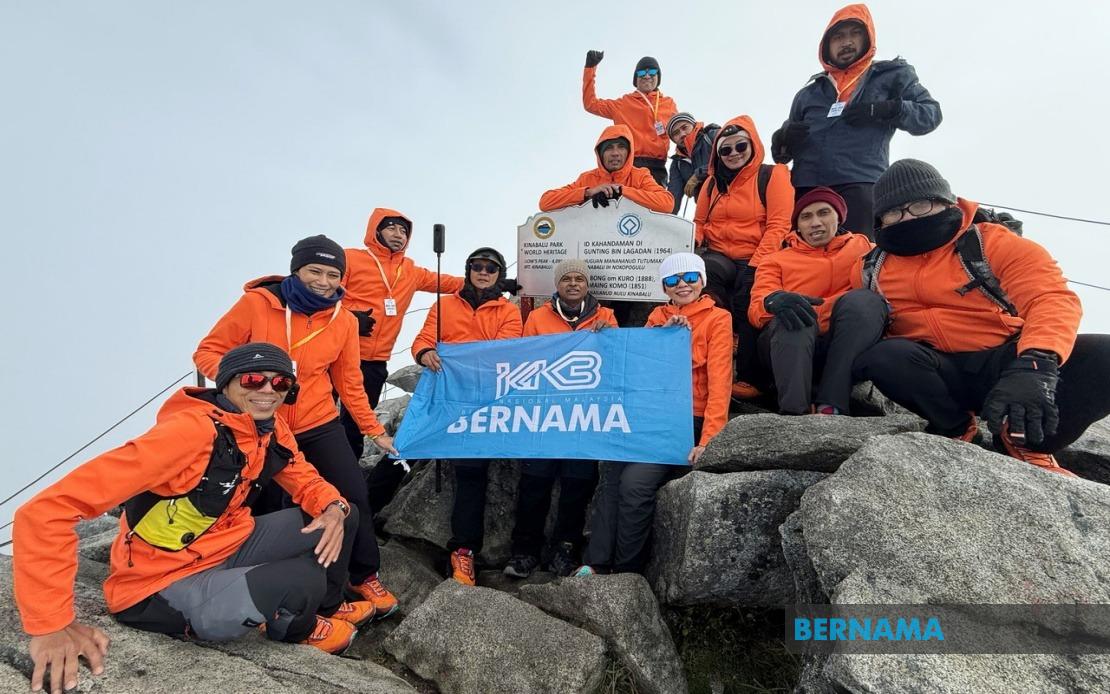
The Malaysian National News Agency (Bernama) achieved a significant milestone on July 1 when 23 of its personnel successfully summited Mount Kinabalu, Southeast Asia's tallest peak, as part of a special climbing expedition commemorating National Journalists' Day (HAWANA) 2026. The expedition, spearheaded by Bernama Editor-in-Chief Arul Rajoo Durar Raj, represents both an institutional achievement and a strategic attempt to establish two records with the Malaysia Book of Records (MBR)—recognising the climb as the largest group from a single media organisation and the first media organisation to produce multilingual news coverage from the mountain's summit.
The climbing party represented the full spectrum of Bernama's workforce, drawing participants from editorial departments, photojournalism units, broadcast television operations, and administrative divisions. This cross-departmental composition transformed the expedition beyond a mere physical challenge into a demonstration of organisational unity and shared purpose. The deliberate inclusion of staff across all functional areas underscores how Malaysian media institutions view such endeavours as opportunities for institution-building and internal cohesion, a consideration increasingly important as media companies navigate evolving technological and economic pressures.
The ascent itself proved demanding under adverse conditions. The team initiated their climb at 10 am on June 30 from Timpohon Gate, the primary entry point for most commercial expeditions on the mountain. After establishing overnight camp at Panalaban—a critical waystation at approximately 3,270 metres where climbers acclimatise before the final push—the group resumed their ascent at 2:30 am on July 1. The pre-dawn departure is standard mountaineering practice, designed to maximise daylight hours for the final kilometres and minimise exposure to unpredictable afternoon weather systems. The team successfully reached the summit at approximately 7:20 am, navigating through rain, dense fog, and strong winds—hazardous conditions that underscore the genuine physical and technical demands of the 4,095.2-metre peak.
The accomplishment carries particular significance for Arul Rajoo, whose successful ascent makes him the first Editor-in-Chief of Bernama to reach Mount Kinabalu's summit. This personal achievement adds symbolic weight to the institutional undertaking, positioning the expedition as leadership-led rather than delegated, a distinction that matters in Southeast Asian organisational cultures where hierarchical example carries substantial motivational force.
Beyond the immediate climbing objective, the expedition was conceived and organised by the Bernama Staff Club (KKB) to serve multiple strategic purposes within the HAWANA 2026 observance. The Malaysia Book of Records pursuits are notable: establishing Bernama's climb as the largest single-organisation media group ascent and as the first media institution to generate news content in four languages from the summit demonstrates institutional innovation in combining traditional journalistic practice with experiential storytelling. This multilingual reporting capacity—likely encompassing Malay, English, and possibly Mandarin and Iban—reflects Malaysia's demographic complexity and Bernama's positioning as a truly national agency.
The expedition also explicitly aimed to strengthen internal organisational culture through team cohesion exercises, physical and psychological resilience development, and promotion of wellness practices among staff. Such initiatives address documented concerns about journalist wellbeing in Southeast Asia, where demanding news cycles, economic pressures on media organisations, and exposure to traumatic content create cumulative workplace stress. Positioning Mount Kinabalu as a wellness and team-building venue transforms the mountain into an institutional asset for staff development.
The logistical undertaking required substantial corporate and commercial support, reflecting contemporary media practice where news organisations increasingly operate through sponsorship and partnership networks rather than relying solely on institutional resources. Strategic partners included international sportswear manufacturer BMAI, Malaysian airline Batik Air, and beverage brand 100PLUS, alongside logistics providers including Malaysia Airports, food suppliers EHH Food Industry Sdn Bhd and Saloma Bistro, and the event management involvement of Sabah Parks and Marathon Baker. Malaysia Insight's participation suggests documentary intentions, possibly capturing content for broader distribution. This ecosystem of support illustrates how major organisational projects in Malaysia's media landscape operate through collaborative commercial frameworks.
Mount Kinabalu itself, towering at 4,095.2 metres above sea level and situated within the 754-square-kilometre Kinabalu Park, represents one of Southeast Asia's most significant natural and cultural landmarks. Its designation as a UNESCO World Heritage Site and core component of the Kinabalu UNESCO Global Geopark (KUGGp) elevates any successful expedition beyond personal achievement into participation in environmental stewardship and global conservation narratives. For Bernama, an expedition to such a site carries implicit statements about the agency's commitment to documenting Malaysia's natural heritage and its global significance.
The expedition's timing within HAWANA 2026, Malaysia's national journalists' day observance, positions media professionals as active participants in national life rather than passive chroniclers. By scaling a national iconic mountain, Bernama staff visibly embody values of perseverance, teamwork, and national pride—messages that resonate within professional circles and broader public discourse about journalism's role in Malaysian society. The combination of adventurous physical challenge with journalistic productivity creates a distinctive narrative about contemporary Malaysian media practice.
For regional observers, the expedition demonstrates how Southeast Asian media organisations are innovating beyond traditional news gathering, developing cultural and experiential dimensions that strengthen institutional identity and staff commitment. The pursuit of Malaysia Book of Records recognition indicates growing awareness among regional media institutions that institutional achievements deserve formal recognition and documentation. The Bernama expedition suggests a broader pattern: in an era of digital disruption and economic uncertainty in legacy media, organisations are investing in activities that reinforce internal culture, demonstrate innovation, and generate distinctive content opportunities—essentially creating media narratives about their own institutional resilience and capability.

