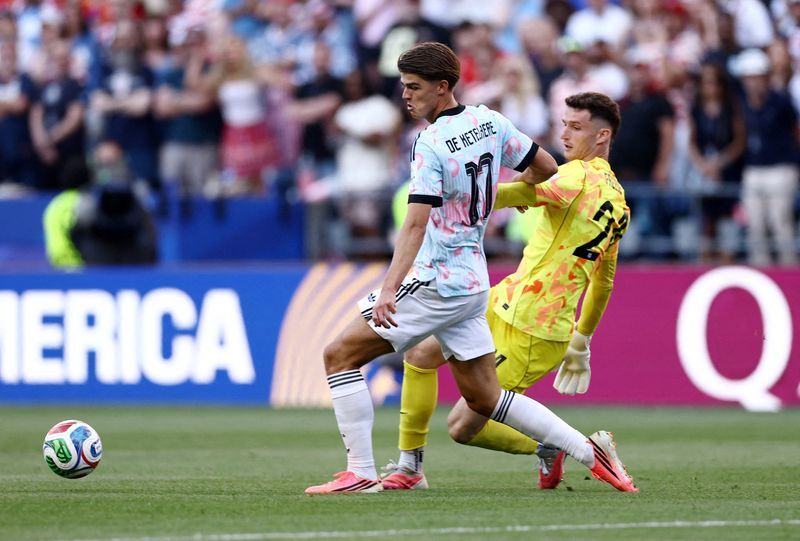
Belgium have discovered a winning formula at the World Cup after dismantling co-hosts the United States 4-1 on Monday in Atlanta, with coach Rudi Garcia's bold tactical revision suggesting the team may have finally found their most potent playing style in the tournament. The stunning performance masks a journey marked by earlier struggles and narrow escapes, raising intriguing questions about what might have been had Garcia identified this approach sooner, and what it means for their prospects in the knockout stages ahead.
The path to this dominant display was hardly assured. Belgium arrived at the round-of-16 encounter having scraped through their opening phase with considerable difficulty, drawing their first two group matches before needing a comprehensive 5-1 victory over New Zealand to progress atop their section. More perilously, they nearly exited at the first knockout opportunity against Senegal, finding themselves two goals in arrears with just five minutes remaining before mounting an improbable comeback to win through a late penalty in extra time. That reprieve offered Garcia the opportunity to recalibrate his approach fundamentally.
The Belgian coach's response was to overturn conventional wisdom by making sweeping changes to the starting eleven that had battled to that point. Kevin De Bruyne, long regarded as the team's creative heartbeat and orchestrating force, was dropped entirely to the bench and did not feature at all in the Seattle encounter. Alongside him, Jeremy Doku and Romelu Lukaku—key attacking contributors throughout their World Cup campaign—were also benched, a decision that represented a significant statement about Garcia's willingness to deviate from relying on established names and reputations.
The replacements brought fresh energy and tactical balance to proceedings. Nicolas Raskin, Amadou Onana and Dodi Lukebakio were ushered into the midfield and attacking third, while Charles De Ketelaere shifted to a centre-forward position that he exploited with immediate and decisive impact, netting twice in the opening half to set Belgium's trajectory toward a lopsided victory. The restructured team found rhythm quickly, suggesting that Garcia's selection adjustments were rooted in meticulous preparation rather than experimentation for its own sake.
Garcia justified his selections before the match began by pointing to training-ground form and tactical alignment, emphasizing that his decisions were grounded in logical evaluation of how each player fitted the system he intended to deploy. More revealing was his post-match explanation of his thinking, which disclosed that he remained undecided about his lineup until mere hours before kickoff, yet possessed absolute clarity about the style of football he wished to impose. This distinction between selection uncertainty and tactical certainty proved crucial to execution, as Belgium demonstrated the kind of coordinated, structured attacking football that had eluded them throughout earlier stages.
The midfield reconfiguration delivered the most visible transformation. Youri Tielemans, retaining the captaincy, pushed higher up the pitch with greater frequency and aggression than in previous matches, enabling Belgium's revised midfield to dominate the battle for loose balls and regain possession with impressive efficiency. Rather than concentrating solely on buildup play through the center, the team methodically exploited the wider areas, stretching a United States defence that appeared brittle and strategically static, unable to adjust to the pace and positioning of Belgium's movement.
Even when adversity struck mid-match, the system proved resilient. Onana's departure through knee injury in the first half appeared potentially disruptive, yet Hans Vanaken seamlessly absorbed his responsibilities in front of the three-defender line, demonstrating the structural soundness of Garcia's setup. Vanaken's performance held particular significance for Garcia, who took evident satisfaction in seeing the 33-year-old contribute a goal at a World Cup finals, especially given his inconsistent international selection history prior to this tournament.
Garcia's reasoning for not deploying De Bruyne despite his availability revealed the coach's confidence in the tactical shape itself. Explaining that the initial game plan envisioned bringing De Bruyne into proceedings only should circumstances demand it, Garcia noted that once Belgium established their scoring advantage, the need evaporated entirely. This reasoning suggested that the new system did not require De Bruyne's creative genius to function effectively, a potentially troubling sign for the midfielder's future role but a testament to the system's self-sufficiency.
The vindication of Garcia's approach arrives at a critical juncture for Belgian football. The coach had endured sustained criticism within Belgium throughout the opening phase as the team struggled to establish authority against less prestigious opponents. The narrative of decline had threatened to overwhelm the squad, built around ageing stars who had promised much in previous tournaments but delivered inconsistently. Garcia's tactical reinvention offers an alternative story—that the problem lay not with the individual talents available but with how they were assembled and deployed.
Belgium now enter Friday's quarter-final encounter against Spain in Los Angeles with fundamentally altered momentum and self-belief. Spain represent formidable opposition, possessing their own sophisticated attacking architecture and midfield superiority. Yet Belgium arrive no longer as a team in managed decline, deploying familiar names in hopes of recapturing past glories, but rather as a revitalized outfit discovering unexpected balance through fresh combinations and tactical clarity. The manner of their destruction of the USA demonstrated that Garcia may have unlocked something previously hidden, offering Belgium a genuine pathway through the tournament's latter stages despite the sidelining of their most celebrated individuals.

