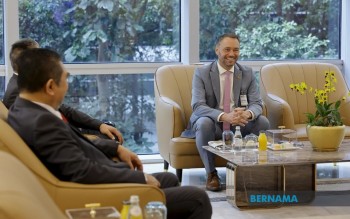
Belgium is banking on the successful conclusion of the Malaysia-European Union Free Trade Agreement to unlock a fresh wave of commercial opportunities and reinvigorate economic expansion across both regions. During a visit to Kuala Lumpur, Belgium's Deputy Prime Minister and Minister of Foreign Affairs, European Affairs and Development Cooperation, Maxime Prévot, underscored his government's commitment to finalising the deal, describing it as a shared priority for Brussels and the EU bloc. The agreement, he suggested, would fundamentally reshape trade dynamics by opening new avenues for bilateral commerce whilst bolstering the economic trajectories of Malaysia and the European Union member states.
PreVot's remarks reflect a broader European strategic interest in deepening ties with Southeast Asia's largest economy at a time when trade relationships are being recalibrated globally. The Belgium official stressed that concluding the MEUFTA framework would facilitate increased commercial exchanges while simultaneously fostering sustainable development across both the Malaysian and European regions. For a small nation of 11.77 million people, Belgium has cultivated an outsized economic footprint through trade integration, with exports representing approximately 85 per cent of its gross domestic product. This export-dependent model positions Belgium as a natural champion for liberalised trade arrangements, and the enthusiasm it brings to the Malaysia negotiations reflects the potential Antwerp and other commercial hubs see in expanded Asian market access.
The timing of Prévot's maiden visit to Malaysia since assuming office in February last year carries symbolic weight, signalling that bilateral relations merit high-level attention from Brussels. His two-day working visit places the MEUFTA squarely within a broader context of deepening institutional engagement between the two nations. The deputy prime minister is scheduled to hold substantive discussions with Malaysia's Deputy Prime Minister Datuk Seri Fadillah Yusof, who also holds the Energy Transition and Water Transformation portfolio. These conversations will extend beyond trade mechanics to encompass emerging industrial priorities, reflecting how modern free trade agreements operate as platforms for coordinated industrial strategy rather than mere tariff-cutting exercises.
The agenda for talks between Prévot and Fadillah encompasses cooperation on renewable energy development, rare earth elements processing, and the halal industry—sectors that represent both competitive advantage and complementarity between the two economies. Malaysia's mineral wealth and processing capabilities align with European decarbonisation objectives, whilst the kingdom's established position as a global halal certification and product development hub offers Belgium and other EU members pathways into Islamic consumer markets worth trillions of dollars. The inclusion of regional geopolitical developments in the discussion framework indicates that trade negotiations are increasingly enmeshed with broader strategic competition and cooperation frameworks in the Indo-Pacific region.
Existing bilateral commercial ties already demonstrate substantial momentum. Malaysia and Belgium conducted trade valued at RM9.74 billion in 2025, with Malaysian exporters capturing RM6.85 billion of the total whilst Belgian suppliers contributed RM2.89 billion in imports. The bilateral trade composition reflects Malaysia's traditional strengths in manufactured goods and commodities, whilst Belgian expertise concentrates in specialised industrial products, chemicals, and high-value added services. This complementarity underpins negotiators' confidence that removing remaining tariff and non-tariff barriers would generate reciprocal benefits rather than winner-take-all outcomes that often complicate trade diplomacy.
Beyond the current trade figures lies substantial Belgian investment presence within Malaysia's economic structure. Through 2025, Belgian enterprises or joint ventures had secured approval for 67 projects totalling RM5.1 billion in committed capital investment. These ventures are projected to generate 4,605 employment opportunities across manufacturing, services, and emerging technology sectors. The scale of this investment footprint suggests that Belgian multinational corporations already view Malaysia as a strategic manufacturing and distribution hub within Southeast Asia, and a completed MEUFTA would likely catalyse further investment by reducing regulatory uncertainty and harmonising standards across the bilateral relationship.
Negotiators on both sides have indicated that the MEUFTA framework should be concluded within the next few months or by the end of the current calendar year, though such timelines in complex trade negotiations frequently slide. The European Union's approach to bilateral trade agreements has evolved considerably since the CETA model established with Canada, incorporating sustainability commitments, digital trade provisions, and intellectual property frameworks that extend far beyond traditional merchandise tariff schedules. Malaysia, as a middle-income developing nation, has shown willingness to engage on these contemporary trade architecture components whilst seeking flexibility on transition periods and capacity-building support.
For Malaysian policymakers, the MEUFTA represents an opportunity to diversify export markets beyond the United States, China, and intra-ASEAN partners at a moment when supply chain fragmentation is creating new competitive openings. European consumers' growing preference for ethically produced and sustainably sourced goods aligns with Malaysia's positioning on environmental governance and social responsibility, though differences on deforestation and labour standards remain contentious negotiating points. A successful conclusion would signal Malaysia's ability to navigate complex, high-standard trade diplomacy in an era when free trade agreements increasingly serve as vehicles for regulatory influence and standards-setting rather than simple market access transactions.
From Brussels' perspective, the Malaysia agreement forms part of a broader European strategy to strengthen economic partnerships with Indo-Pacific nations as a counterweight to China's expanding commercial influence. The EU has recently concluded trade negotiations with Singapore, Indonesia, and Vietnam, and is pursuing similar frameworks with Thailand, the Philippines, and other regional economies. By securing substantial deals with ASEAN's economic anchors, the European Union aims to embed itself within regional value chains and cement partnerships with democracies and mixed governance systems that share normative commitments to rules-based international order, albeit with varying degrees of consistency.
The halal industry dimension warrants particular attention for Malaysian stakeholders, as it represents a sector where the country enjoys near-monopolistic market access advantages within the Muslim world and increasingly among non-Muslim consumers in Europe and North America. Belgian participation in halal certification, product development, and distribution could unlock significant revenue opportunities for Malaysian standards bodies and enterprises whilst positioning European companies as intermediaries serving the global Islamic economy. This specialised sectoral focus illustrates how modern trade agreements transcend simple commodity exchanges to encompass knowledge transfer, regulatory harmonisation, and the creation of integrated supply networks serving global niche markets.
The renewable energy cooperation component reflects both parties' commitment to climate transition pathways and decarbonisation timelines. Malaysia's abundance of solar potential and regional manufacturing expertise in renewable energy equipment positions it as a logical hub for European companies seeking to establish Asian-Pacific production and distribution bases. Conversely, Belgian technical expertise in grid integration, energy storage, and offshore wind technology could accelerate Malaysia's transition away from fossil fuel dependency. Trade agreements increasingly function as mechanisms for coordinating industrial transformation across borders, and the MEUFTA framework would crystallise these energy sector partnerships within a formal institutional structure.
Rare earth elements represent perhaps the most strategically consequential cooperation dimension, given Europe's vulnerability to supply chain disruption and its dependence on processing infrastructure concentrated in China. Malaysia's mineral endowments and existing refining capacity position it as a potential alternative source and processing centre for rare earth materials essential to renewable energy, defence, and advanced manufacturing sectors. A completed MEUFTA could include provisions facilitating joint ventures, technology transfer, and long-term supply contracts that reduce European exposure to geopolitical coercion through rare earth supply manipulation, whilst generating substantial export and foreign direct investment revenues for Malaysia.
The broader context surrounding these bilateral negotiations includes the European Union's own strategic autonomy agenda and its determination to reduce dependencies on any single trading partner. Malaysia, similarly, has articulated interest in maintaining equidistant relationships with global powers whilst extracting maximum developmental benefit from engagement with multiple economic blocs. The MEUFTA thus represents not merely a commercial arrangement but a manifestation of Malaysia's strategic positioning within an increasingly multipolar global economy. Successful conclusion would enhance Malaysia's credibility as a partner capable of managing sophisticated trade relationships with sophisticated economies, potentially strengthening the country's negotiating position in concurrent discussions with other major trading partners and regional arrangements.

