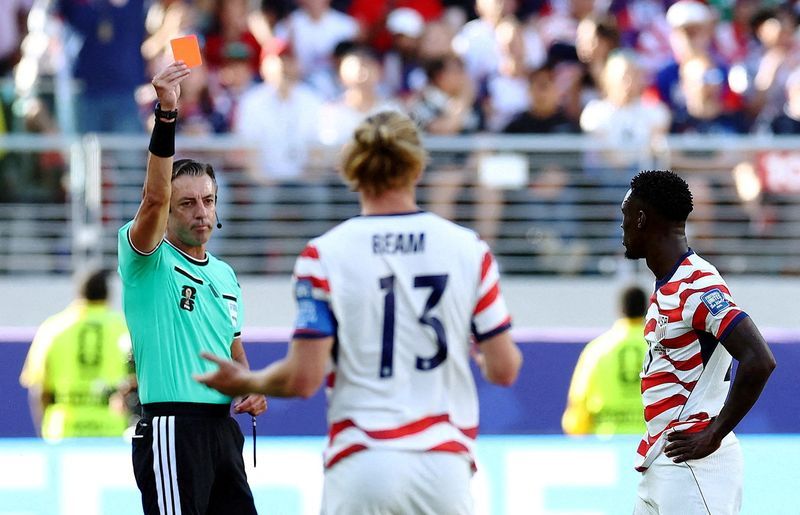
The integrity of FIFA's disciplinary framework has come under intense scrutiny following the governing body's controversial decision to lift a red-card suspension affecting a key United States player just days before the knockout phase match against Belgium. The reversal, which occurred after President Donald Trump personally lobbied FIFA President Gianni Infantino to reconsider the case, has triggered a wave of criticism from Belgian officials, public figures, and ordinary citizens who view the move as an unprecedented breach of sporting impartiality. The clash, scheduled for Seattle on Monday, now carries the added weight of controversy that threatens to overshadow what should be a straightforward competition between two rival nations.
The decision to restore the American striker's eligibility stands as a stark departure from FIFA's established protocols governing player discipline. Under normal circumstances, red-card suspensions represent the sport's most serious in-match penalty, imposed by referees for conduct deemed dangerous or violent. The theoretical foundation behind such measures rests on the principle that consequences for transgression must be swift, certain, and uniform across all competitors. When a ban is handed down, the expectation among players, coaches, and fans alike is that it will be upheld unless extraordinary circumstances emerge—such as clear evidence of mistaken identity or a fundamental error in application of the rules. The suspension's reversal after presidential intervention creates an uncomfortable precedent that muddies these waters considerably.
Belgian sentiment on the matter has crystallized into something approaching collective indignation. Therese Kpooubie, a Brussels resident, articulated the logical inconsistency at the heart of many Belgians' objections. She questioned the fundamental purpose of red-card discipline, noting that such cards exist precisely because players have committed serious errors requiring removal from play. If referees are not making mistakes in their on-field judgments, she reasoned, then the card cannot simply be erased retrospectively without calling into question the entire disciplinary system. Her frustration reflects a broader concern that external political pressure—rather than objective sporting criteria—has influenced the outcome. The prospect that national borders or diplomatic relationships might affect how rules are applied strikes many as corrosive to sport's moral authority.
Belgium's Deputy Prime Minister Maxime Prevot voiced official government concern about the incident, suggesting that if Trump's intervention truly precipitated the reversal, then football's fundamental principles would be compromised. His statement carries particular weight as it moves the debate beyond fan commentary into the realm of state-level diplomatic concern. For a sitting government official to question FIFA's integrity is unusual and reflects the seriousness with which the matter is being taken in Brussels. Prevot's carefully worded assertion—employing a conditional structure while avoiding direct accusation—nonetheless sends a clear message that Belgium views the decision as troubling and potentially damaging to international sporting governance.
The United States Ambassador to Belgium, Bill White, moved quickly to deny any improper interference, posting on Instagram that President Trump had merely thanked FIFA after learning of the decision rather than pressuring the organization beforehand. This statement, however, does little to address the substance of Belgian concerns. The sequence of events as reported—Trump personally urging Infantino to review the case, followed by the reversal—suggests a causal relationship regardless of whether Trump characterized his action as pressure or a polite suggestion. Ambassadorial denials cannot alter the apparent timeline or the exceptional nature of a president of a major power directly contacting FIFA leadership about an active disciplinary matter.
Some Belgian voices have sought to channel frustration into competitive motivation. Bastien Noel, another Brussels resident, suggested that rather than allowing the controversy to distract the national team, Belgium should view the situation as additional incentive to win convincingly on the pitch. This perspective reflects a pragmatic approach: whatever FIFA's decision-making process, only actual victory can provide genuine validation. If Belgium's footballers perform at their peak, they can prove through sport itself that such administrative controversies need not determine outcomes. This framing transforms potential victimhood into agency, suggesting that the Red Devils possess the capability to demonstrate their superiority regardless of off-field machinations.
The incident illuminates broader structural vulnerabilities within FIFA's governance architecture. Sports organizations worldwide operate on the assumption that competitive integrity depends upon clear, consistent application of rules according to neutral criteria. When political figures at the presidential level insert themselves into specific disciplinary cases, they undermine this foundational premise. The precedent established here—that sufficiently prominent political intervention can overturn established penalties—threatens to invite similar attempts at influence from other nations' leaders in future tournaments. Malaysia and other Southeast Asian football nations competing on the world stage should regard this development with concern, as it suggests that smaller nations without direct access to powerful political figures may find themselves at a systematic disadvantage in FIFA's decision-making processes.
The timing of this controversy adds another layer of complication to an already contentious situation. The World Cup's knockout phase demands maximum credibility from governing bodies precisely because stakes are highest and margins of victory narrowest. Disputes over disciplinary interpretations can carry consequences far beyond individual matches, potentially determining which nations advance and which are eliminated. For Belgium, already facing a formidable American side, the knowledge that a key opponent will field a player who might otherwise have been unavailable creates a sense of unfair disadvantage that no amount of diplomatic explanation can entirely dispel. The emotional impact on the Belgian squad cannot be ignored; players and coaching staff must now operate under the knowledge that their competitive environment has been altered by forces entirely beyond the football pitch.
FIFA's credibility as an impartial global governing body has faced sustained criticism in recent years over corruption allegations, bribery scandals in host-nation selection, and inconsistent application of rules. This decision to reverse a disciplinary penalty following direct presidential intervention represents precisely the type of governance failure that fuels such skepticism. The organization has already struggled to maintain public confidence; actions that appear to validate accusations of bias toward wealthy or politically connected nations only deepen the reputational damage. For international football to flourish as a genuinely global sport in which outcomes are determined purely by athletic performance, governing structures must demonstrate independence from political pressure and commitment to consistent rule application.
Looking forward, this incident may ultimately prove significant not for its immediate impact on one match, but for what it reveals about the vulnerabilities in international sports governance structures. The fact that a sitting head of state felt emboldened to personally contact FIFA leadership regarding a specific player's eligibility suggests either that such informal influence is more common than publicly acknowledged or that Trump believed this instance would be too minor to generate serious controversy. Both possibilities should concern those invested in maintaining sport as a realm distinct from political manipulation. Belgium's vocal resistance to the decision represents an important assertion of principle—the notion that football deserves to operate according to its own rules rather than those of international power politics.

