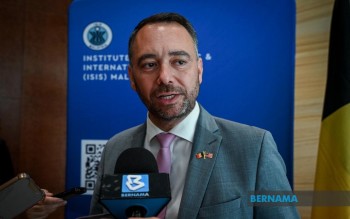
Belgium is positioning itself as a strategic partner for Malaysia's renewable energy expansion, with Deputy Prime Minister Maxime Prévot outlining concrete opportunities for offshore wind collaboration during his inaugural visit to the country this week. Speaking at the 39th Asia-Pacific Roundtable in Kuala Lumpur, Prévot articulated a vision of deepening bilateral ties that extends well beyond energy, encompassing semiconductors, logistics, clinical trials, and pharmaceutical development—sectors where both nations see mutual advantage. The offshore energy pitch, however, commands particular urgency as Malaysia grapples with balancing rapid industrial growth against climate commitments and renewable energy targets.
Belgium's credentials in offshore wind technology present a compelling case study for Malaysian policymakers weighing infrastructure investments. Despite possessing only 60 kilometres of coastline—a constraint that renders its achievements all the more remarkable—Belgium has engineered offshore wind farms currently generating two gigawatts of electricity. Prévot articulated an ambitious expansion trajectory, with plans to increase capacity to between six and seven gigawatts within coming years, equivalent to the output of five to seven nuclear power plants. This operational efficiency achieved within geographic limitations offers valuable lessons for Malaysia, which possesses substantially greater maritime resources but has traditionally lagged in harnessing offshore renewable capacity at scale.
The Belgian minister framed offshore wind expansion not merely as environmental stewardship but as essential infrastructure for energy security and decarbonisation—concerns that resonate sharply across Southeast Asia. European dependence on energy imports, exacerbated by geopolitical tensions, has accelerated the continent's pivot toward renewables. Malaysia faces analogous pressures, including volatile fuel costs and the imperative to meet increasingly stringent carbon reduction commitments under regional and global accords. Belgium's demonstrated ability to develop dual-purpose offshore installations that simultaneously address energy security and emissions reduction provides a technological and operational template worth serious examination.
Underpinning these bilateral discussions sits a broader European strategy toward Southeast Asia. The European Union has committed €10 billion under its Global Gateway Strategy specifically to bolster the ASEAN Power Grid and catalyse regional energy transition. This substantial financial commitment signals Europe's determination to establish itself as a development partner of choice in the region, competing implicitly with other global powers for influence and market access. For Malaysia, positioned as a regional economic hub and potential energy hub, such investment flows represent significant opportunities to upgrade grid infrastructure, facilitate interconnection with neighbouring states, and create employment across manufacturing and installation sectors.
The ASEAN Power Grid initiative itself carries profound implications for Malaysia and its neighbours. Enhanced regional power interconnection promises to optimise generation capacity, reduce individual nations' reliance on fossil fuels, and facilitate more efficient distribution of renewable energy across borders. Malaysia's geographic and infrastructural position makes it a natural node within such a network, potentially allowing it to serve as a conduit for power transfers between larger production zones and demand centres. Prévot's emphasis on aligning European and ASEAN strategies suggests a recognition that decarbonisation at scale requires supranational coordination and infrastructure investment that transcends individual national capacity.
Belgium's broader investment footprint in Malaysia already demonstrates substantive engagement with the economy. As of 2025, 67 projects involving Belgian investment have received regulatory approval, representing cumulative committed capital of RM5.1 billion and projected job creation of 4,605 positions. Bilateral trade reached RM9.74 billion in 2025, with Malaysian exports comprising RM6.85 billion against imports of RM2.89 billion. These figures, while modest compared to Malaysia's trade with major partners, reflect significant historical growth and indicate receptiveness on both sides to deepening commercial relations.
PreVot's visit, his first since assuming the foreign affairs portfolio in February 2025, carries symbolic weight as Belgium signals renewed institutional attention toward Malaysia and Southeast Asia. The timing proves fortuitous, coinciding with Malaysia's own strategic recalibration toward renewable energy infrastructure and decarbonisation. The government has articulated ambitious targets for renewable capacity addition, and offshore wind represents a relatively underdeveloped avenue despite the country's substantial maritime exclusive economic zone. Belgian expertise and European financing could catalyse acceleration of Malaysia's offshore wind programme.
The clean energy cooperation agenda proposed by Belgium aligns with Malaysia's obligations under the Paris Agreement and commitments made within ASEAN frameworks regarding emissions reduction and energy security. However, translating bilateral interest into operational projects requires navigating regulatory harmonisation, technical standards alignment, and financing mechanisms that accommodate both parties' economic structures. Belgium's experience navigating EU directives on renewable energy integration and grid management could inform Malaysia's development of domestic regulatory frameworks governing offshore wind development.
Looking ahead, the durability of Belgium-Malaysia cooperation in offshore energy will depend substantially on whether preliminary expressions of interest crystallise into tangible joint ventures, technology transfer agreements, or financing partnerships. The European Union's €10 billion Global Gateway commitment creates financial infrastructure supporting such projects, yet Malaysia must ensure that its own institutional capacity for project implementation keeps pace with capital availability. Competitive dynamics also merit attention—China, Japan, and South Korea possess substantial offshore wind portfolios and development expertise, meaning Belgium must differentiate its offering through superior technical standards, flexible financing, or enhanced technology transfer provisions.
The offshore energy dialogue exemplifies a broader pattern wherein European nations seek to position themselves within Southeast Asian energy transitions, recognising both genuine commercial opportunity and the imperative to influence regional decarbonisation pathways. For Malaysia, engaging multiple international partners in offshore wind development permits technology competition, cost optimisation, and reduced dependence on any single supplier of expertise or capital. The Belgian initiative thus warrants serious evaluation not as an alternative to other partnerships but as a complementary avenue for accelerating Malaysia's renewable energy ambitions whilst strengthening bilateral relations with an economically advanced European nation.

