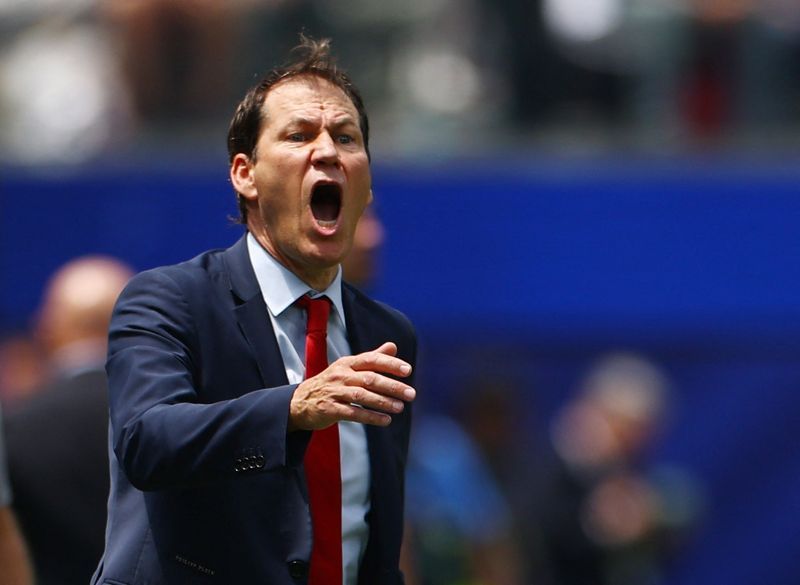
Belgium coach Rudi Garcia found himself at the centre of a major controversy after substituting first-choice goalkeeper Thibaut Courtois in the team's World Cup quarter-final encounter against Spain on Friday, a decision that ultimately contributed to their elimination. The incident has raised fresh questions about the 62-year-old Frenchman's future with the Belgian federation as they contemplate contract renewal negotiations scheduled for later this month.
The substitution occurred with Belgium still in contention at the 71-minute mark when Garcia withdrew Courtois, who had signalled willingness to continue playing despite experiencing a minor leg concern. Garcia maintained that the goalkeeper was not at full fitness and therefore did not meet his established fitness criteria for competition. Senne Lammens, brought on as replacement, was unable to inspire confidence as his performance directly contributed to Spain's winning goal when he fumbled a low effort from Pau Cubarsi in the 86th minute, with substitute Mikel Merino capitalising to seal a 2-1 victory.
The decision triggered considerable backlash from Belgian football analysts and media figures. Prominent commentator Peter Vandenbempt articulated the frustration widely felt among observers, questioning Garcia's judgment in removing what many consider one of the world's elite goalkeepers during such a critical match. Vandenbempt's criticism centred on the apparent rigidity of Garcia's approach, suggesting that a player of Courtois' calibre should possess sufficient self-awareness regarding his physical capabilities without requiring managerial intervention.
Garcia responded to the mounting criticism by reiterating his consistent philosophy throughout the tournament, emphasizing his unwillingness to field players operating below peak physical condition. He pointed to specific tactical reasons for Courtois' importance, highlighting the goalkeeper's long-range distribution to attacking players Charles De Ketelaere and Romelu Lukaku as integral to Belgium's attacking strategy. The coach framed his decision as protective, suggesting that maintaining Courtois' long-term fitness took precedence over the immediate demands of a single match.
The controversy arrives at a particularly delicate juncture for Garcia's tenure. Appointed at the beginning of 2025, his primary mandate involved revitalizing a squad that had experienced considerable turbulence under his predecessor Domenico Tedesco, whose regime was widely characterized within Belgian football circles as toxic and demoralizing. Garcia's initial objectives included securing Nations League top-tier status and World Cup qualification, both successfully accomplished, with the additional benchmark of reaching the quarter-finals now also technically achieved despite the disappointing exit.
Garcia's competitive record in 20 international matches stands at 12 victories, six draws, and two defeats—a respectable return that masks underlying concerns about his tactical approach and substitution patterns. His management style has attracted consistent scrutiny throughout the tournament, particularly regarding his willingness to make bold tactical changes during crucial moments. These questions extend beyond the Courtois incident to encompass broader strategic decisions that have characterized Belgium's unpredictable World Cup campaign.
Belgium's path to the quarter-finals demonstrated significant vulnerability in several matches, with the team requiring comebacks and benefiting from opposition errors. Their group stage included draws against Egypt and Iran before defeating New Zealand, a sequence suggesting inconsistency rather than dominance. The remarkable recovery against Senegal in the knockout stage, after trailing 2-0, reflected either Garcia's tactical acumen or Senegal's defensive collapse—interpretations that remain contested among observers. These performances collectively raise legitimate questions about whether Belgium's advancement resulted from coherent planning or fortunate circumstances.
Countering this criticism, Garcia can reference genuine highlights from the tournament that demonstrate positive development within the squad. Belgium's comprehensive 4-1 victory over co-hosts the United States provided evidence of attacking potential when circumstances aligned favourably. Additionally, the emergence of younger players such as Nathan Ngoy and Nicolas Raskin provided optimism for future campaigns, suggesting that Garcia's tenure has contributed to generational transition within Belgian football.
The federation's deliberations regarding Garcia's future must balance his tournament achievements against persistent tactical concerns and the disappointment of the Spanish elimination. Belgium's long-term ambitions centre on contending credibly for the 2028 European Championship, a target requiring sustained investment in a clear tactical vision and organizational coherence. Garcia's rigid adherence to fitness criteria, while defensible in principle, has become emblematic of broader questions about whether his inflexible management style can unlock the potential within a squad containing world-class talent.
The timing of contract negotiations adds pressure to what might otherwise be a period of post-tournament reflection. Belgian federation officials must decide whether they perceive Garcia as the architect of necessary rebuilding or as an interim figure whose management approach will ultimately constrain the team's development. The Courtois substitution, though a single incident, has crystallized broader doubts about his judgment during high-pressure situations where tactical flexibility and intuitive decision-making may prove more valuable than rigid adherence to pre-established principles.

