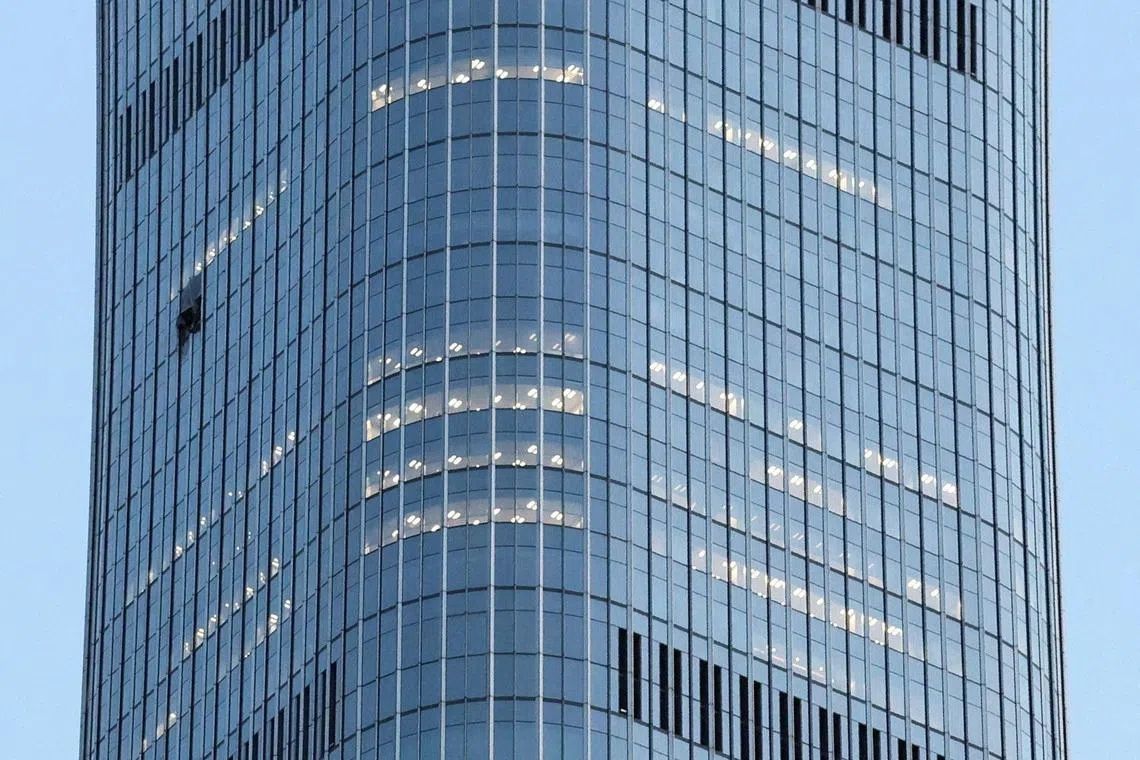
A 66-year-old pilot who died after steering a light aircraft into Beijing's CITIC Tower, China's tallest building, had battled mental illness and left written records of suicidal ideation, according to statements released by city authorities on Thursday. The crash on June 26, which left 13 people injured and punched a visible hole through the building's upper floors, has forced uncomfortable scrutiny of aviation security in one of the world's most tightly controlled airspaces. The Chaoyang district government's disclosure of the pilot's psychological struggles appears designed to frame the incident as a tragedy rooted in personal despair rather than any systemic failure in Beijing's vaunted defence infrastructure.
The pilot, identified by the surname Liu, was a 66-year-old divorced man living alone in the capital who worked as a freelancer in aviation. According to authorities, Liu had endured chronic insomnia and anxiety for an extended period, conditions documented across multiple pages of his personal diary where he repeatedly contemplated taking his own life. He obtained his sport pilot license in 2021 and earned a private pilot license just months before the tragedy in early 2024, authorising him to operate general aviation aircraft independently. The two-seat propeller-driven plane he flew, registered as B-12PP, departed from a general aviation facility in suburban Pinggu district on the afternoon of the incident after Liu completed both a supervised flight and a solo flight.
During that final solo flight, the trajectory deviated sharply from the authorised flight path, and Liu ceased all radio contact with the airport—a critical breach in aviation protocol. Minutes later, the aircraft struck the 528-metre CITIC Tower in Beijing's Central Business District at 5.55 p.m. local time. The tower's location at seven kilometres from Zhongnanhai, the fortified compound housing China's senior political leadership including President Xi Jinping, makes the breach particularly sensitive and embarrassing for state security agencies. Witnesses described hearing a loud impact followed by a small fire at the base of the building, while photographs captured the jagged aperture left by the collision in the gleaming glass facade of the nation's most prominent corporate headquarters.
The revelation of Liu's mental health struggles serves an important explanatory function for Chinese officials confronting questions about how an aircraft penetrated one of the most restricted airspaces on earth. Obtaining a private pilot license in China ordinarily mandates passing rigorous medical examinations and demonstrating psychological fitness, raising uncomfortable questions about how someone with documented suicidal thoughts obtained certification. A pilot qualified to operate in China, speaking on condition of anonymity owing to the sensitivity of the matter, confirmed that such evaluations should theoretically screen out individuals with serious mental health concerns. Yet Liu's case suggests either significant gaps in medical screening procedures or possible failures in monitoring licensed pilots' ongoing psychological condition after certification.
The larger security puzzle, however, extends far beyond one individual's mental state. China's civil aviation regulations demand that all flights—including private general aviation operations—receive explicit advance approval from flight-control authorities, with detailed flight plans submitted before 3 p.m. the day prior to takeoff. Flying over urban areas is broadly prohibited under national aviation law, making Liu's trajectory toward central Beijing's densest commercial district a categorical violation of established rules. Yet the fact that he managed to deviate from his approved flight plan, lose radio contact, and then penetrate restricted airspace without triggering immediate military or civilian interception raises uncomfortable questions about the effectiveness of monitoring systems that are supposedly impenetrable.
The proximity of the incident to Beijing Capital Airport, one of the city's two principal aviation hubs handling numerous international and domestic commercial flights daily, compounds concerns about airspace management. The restricted zones surrounding major airports are theoretically among the most heavily defended airspace in any nation, monitored by sophisticated radar and staffed by armed air-defence personnel. That a small propeller aircraft managed to enter this environment without documented intervention before impact suggests either significant blind spots in detection systems or delayed response procedures that proved fatally inadequate. Military and civil aviation authorities have not publicly addressed how long the deviation went undetected or why no warning was issued to the aircraft.
The incident occurred merely days before the Chinese Communist Party's 105th anniversary celebrations, scheduled for July 1 at the Great Hall of the People adjacent to Tiananmen Square, mere kilometres from the crash site. The timing heightened political sensitivities, and within hours of the crash, Chinese social media platforms had systematically scrubbed photographs, videos, and user discussions of the incident. Police at the scene prevented journalists and bystanders from documenting the damage or gathering additional reporting, a pattern consistent with how Beijing typically controls narratives around sensitive incidents. Despite authorities' attempts to suppress public discourse, internet users circulated pointed questions about security failures before those posts too were deleted from platforms.
China maintains among the world's most stringent airspace controls and security protocols, ostensibly impenetrable especially in the capital region. The government's framing of the crash as a suicide-motivated incident attempts to position it as an anomalous tragedy rather than evidence of systemic weakness. However, the sequence of events—a licensed pilot obtaining medical clearance despite documented mental illness, deviating from an approved flight plan without immediate detection, losing radio contact, and penetrating restricted airspace—suggests multiple points where standard procedures either failed or proved insufficient. The authorities' emphasis on Liu's personal struggles, while factually relevant, does not adequately address how such significant lapses in aviation oversight and airspace security could occur in Beijing.
For Malaysia and other Southeast Asian nations, the incident offers sobering lessons about the limits of even highly restrictive aviation control regimes. Many countries in the region maintain similar prohibitions on general aviation in urban areas and over government installations, yet the Beijing case demonstrates that motivated individuals with legitimate pilot credentials can still circumvent these restrictions. Southeast Asian capitals hosting government compounds, military installations, and corporate headquarters in close proximity to general aviation facilities face similar vulnerabilities. The incident underscores the need for continuous reassessment of surveillance technologies, emergency response protocols, and medical screening procedures, even in jurisdictions with ostensibly world-class security infrastructure.
The Chinese government's handling of the aftermath—rapid media suppression, restricted access for journalists, and delayed disclosure of investigative findings—has reinforced international perceptions of Beijing's tendency to prioritise controlling information over addressing systemic vulnerabilities. The narrative that mental illness alone caused the crash, while containing elements of truth, conveniently deflects attention from what may have been multiple institutional failures in aviation oversight. As countries throughout Asia modernise their airspace management systems and general aviation infrastructure, the CITIC Tower incident serves as a cautionary tale about the importance of maintaining robust safety protocols, transparent investigative processes, and honest assessment of security vulnerabilities, rather than simply restricting public discussion when incidents occur.

