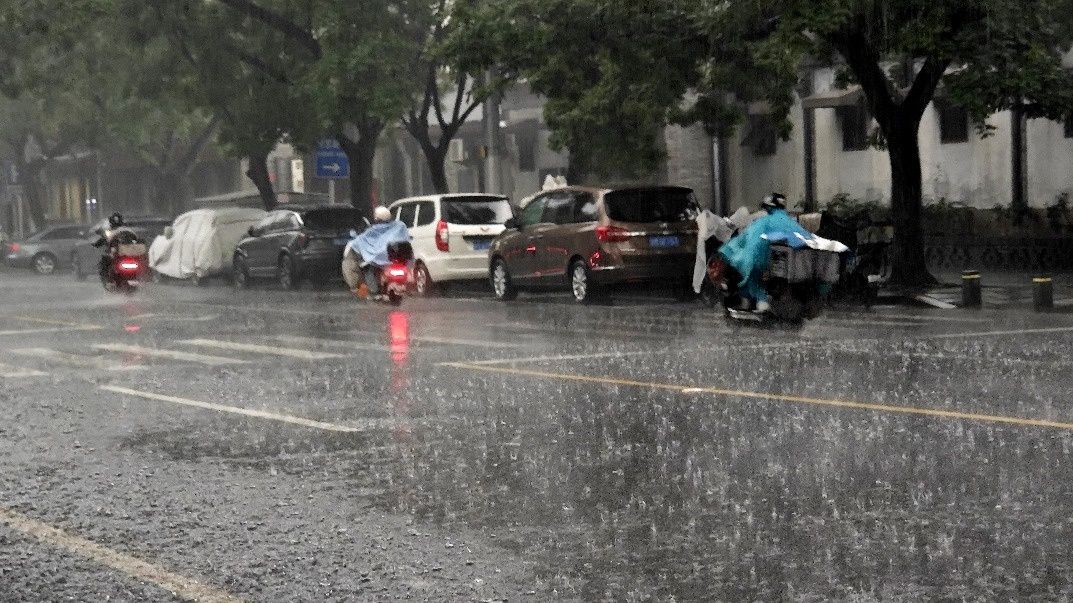
Beijing's meteorological observatory issued an orange-level rainstorm alert on Thursday afternoon, marking the city's first such warning since the 2026 flood season commenced. The alert, released at 1:30 pm, prompted immediate activation of a Level-II flood control emergency response by Beijing's flood control office, reflecting the seriousness with which authorities are treating the impending weather system.
The alert forecasts a significant weather event spanning roughly 36 hours, with heavy rainfall expected to drench the capital from Friday afternoon through early Sunday morning. Several districts face particular vulnerability, including Huairou, Miyun, Pinggu, Shunyi and Fangshan, where meteorologists anticipate the most intense precipitation bands will develop. The scale of rainfall being predicted is substantial by most meteorological standards—hourly precipitation rates in certain locations could surpass 70 millimetres, while cumulative totals over a 24-hour period may exceed 150 millimetres in the hardest-hit areas.
The geographical distribution of expected rainfall highlights Beijing's vulnerability to extreme weather events. Mountainous and hilly terrain presents particular hazard challenges, as concentrated precipitation in elevated areas can trigger flash flooding, debris flows, and other cascading hazards affecting lower-lying communities downstream. Simultaneously, low-lying urban districts face significant waterlogging risks as drainage systems become overwhelmed by the volume and intensity of rainfall. This dual threat—from steep terrain and inadequate drainage in flat areas—requires coordinated response strategies across diverse geographic contexts within the metropolitan area.
Chinese meteorological authorities operate a four-tier warning hierarchy designed to communicate severity escalation to the public and emergency responders. Red represents the highest alert level, signifying catastrophic risk; orange indicates severe threat and substantial impact potential; yellow denotes moderate concern; and blue suggests minor hazard. Beijing's issuance of an orange alert places this weather system in the second-most-serious category, suggesting authorities anticipate impacts extending beyond localized disruption to broader societal consequence. The decision to activate Level-II flood control protocols reinforces this assessment, indicating preparedness for scenario-based response requiring significant resource mobilization.
Public guidance from flood control authorities emphasizes risk reduction through activity restriction and heightened situational awareness. Residents have been instructed to minimize time spent outdoors, maintain vigilance regarding updated meteorological bulletins, and prioritize public transportation over private vehicles—a measure designed to reduce congestion and accident risk on potentially hazardous roads while maintaining mobility for essential services. The recommendations extend beyond individual households to institutional and commercial entities, reflecting recognition that coordinated organizational responses amplify overall resilience.
Educational institutions face explicit direction to suspend classes, cancel in-person training sessions, and postpone field teaching activities based on developing conditions. This precautionary approach prioritizes student and staff safety while acknowledging that educational continuity, though important, remains secondary to physical security. Workplace flexibility measures recommended to enterprises and public institutions—including remote work arrangements and staggered commute schedules—aim to distribute demand on transportation networks and reduce population density in potentially hazardous outdoor environments during peak rainfall hours.
Specific venue and activity restrictions reveal the breadth of hazard considerations embedded in Beijing's preparedness framework. Citizens are explicitly warned against visiting scenic areas featuring mountainous or water-based attractions, accessing underground commercial spaces where flooding poses particular entrapment risks, and venturing toward regions with known geological instability. Rivers and channels, which can rapidly transition from manageable water bodies to dangerous torrents during intense rainfall, are designated as no-go zones. These prohibitions acknowledge that while residents may intellectually understand weather severity, on-ground behavioral modification requires explicit, granular guidance.
Construction sites and outdoor industrial operations represent critical vulnerability points during extreme rainfall events, where workers face compounded hazards from both weather exposure and site-specific risks. The directive to suspend outdoor work and construction activities protects this vulnerable workforce while preventing damage to infrastructure projects that could cascade into secondary emergencies. This requirement also reflects evolving Chinese emergency management philosophy that recognizes economic productivity must yield to safety imperatives during genuine threats.
The issuance of this orange alert arrives as Southeast Asian and East Asian meteorological patterns shift seasonally toward increased precipitation extremes. For Malaysian observers, Beijing's experience provides instructive parallels, as monsoon systems and tropical convergence zones generate similar intense rainfall scenarios. Understanding how one of Asia's major metropolitan areas coordinates emergency response—from early warning issuance through public communication to institutional coordination—offers relevant operational insights for Malaysian city planners and emergency managers confronting comparable weather challenges during annual monsoon transitions.
Beijing's response framework demonstrates how tiered alert systems, when coupled with coordinated institutional action and specific public guidance, attempt to minimize casualties and property damage during inevitable extreme weather events. The sophistication of its messaging—distinguishing among geographic vulnerability areas, population subgroups, and institutional roles—reflects organizational capacity built through decades of flood management experience. As climate patterns generate increasingly frequent intense precipitation events across Asia, such systematized approaches to early warning dissemination and coordinated response activation become progressively more valuable for urban centers throughout the region seeking to enhance population resilience without imposing permanent restrictions on essential activities.

