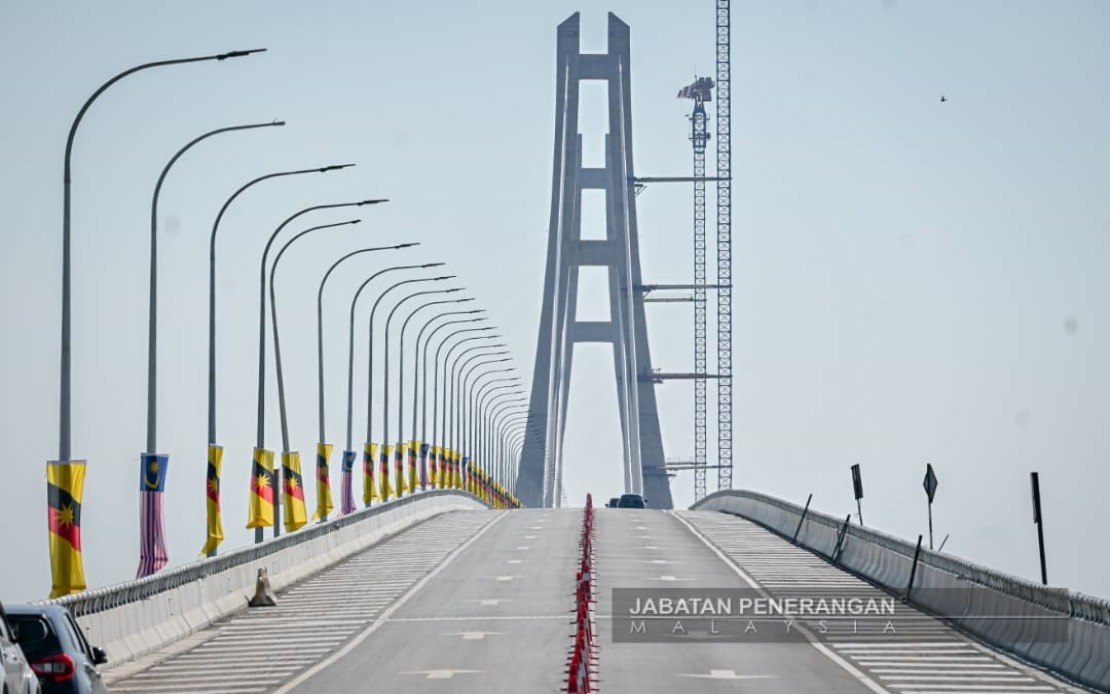
Sarawak has crossed a significant threshold in its infrastructure modernisation agenda with the official opening of the Batang Lupar 1 Bridge, a RM848.75 million investment that Premier Tan Sri Abang Johari Tun Openg characterised as transformative for the state's coastal economy. The 4.844-kilometre span, stretching across Malaysia's longest river, represents far more than a simple transportation link—it symbolises Sarawak's determination to unlock the economic potential of its outlying districts and strengthen connectivity across previously isolated communities. The project caps years of advocating by local elected representatives, who responded to constituent demands for safer, more reliable passage across the Batang Lupar River, where ferry operations had historically been plagued by weather-related disruptions and safety concerns.
The bridge functions as a cornerstone of the broader Sarawak Second Trunk Road (STRR) initiative, an ambitious coastal development corridor designed to modernise transportation infrastructure across the state's western littoral. Within this larger framework, the Batang Lupar crossing becomes integral to a RM3.21 billion integrated coastal road network scheduled for full completion by 2030. This phased approach reflects Sarawak's strategic vision: rather than viewing individual projects in isolation, state planners have conceived them as linked components of a comprehensive transportation ecosystem that will reshape regional demographics and economic flows. The designation of the bridge as Malaysia's longest river-spanning structure, formally recognised by the Malaysia Book of Records, adds symbolic weight to what is primarily a practical endeavour.
For residents of Sebuyau, Betong, Sri Aman, and Samarahan, the bridge represents liberation from the constraints that have historically defined their relationship with Kuching and other commercial hubs. The ferry service that once connected these districts imposed not merely time costs but genuine safety risks; adverse weather conditions regularly suspended operations, stranding vehicles and passengers for hours. By eliminating this bottleneck, the bridge creates conditions for more reliable economic activity, whether farmers transporting agricultural produce to urban markets, traders accessing supply chains, or workers commuting to employment centres. The psychological shift from ferry-dependent isolation to road-connected integration should not be underestimated—it fundamentally alters how communities perceive their relationship to the broader state economy.
The infrastructure development will yield measurable time savings with significant economic implications. Deputy Premier Datuk Amar Douglas Uggah Embas, who holds the portfolio for Infrastructure and Port Development, highlighted that the completed STRR network will compress the journey between Kuching and Sibu from 396 kilometres to 252 kilometres, eliminating 144 kilometres of travel distance. For commercial transport operators, this reduction translates directly into fuel savings, reduced vehicle wear, and faster product delivery cycles. For passengers, the savings accumulate across thousands of journeys annually. When extrapolated across the three-decade lifespan of major infrastructure, these efficiencies compound into substantial economic gains that extend far beyond the immediate beneficiary districts.
The bridge's strategic positioning within coastal development plans underscores Sarawak's emerging vision for regional growth along its waterfront margins. Historically, development concentrated inland or in major urban centres like Kuching. The STRR project, of which the Batang Lupar 1 Bridge forms a critical component, deliberately targets coastal zones where agricultural activity, fishing communities, and natural resources remain underutilised partly due to connectivity deficits. By improving access to these areas, the state creates conditions for value-added economic expansion—agricultural processing facilities, agro-tourism ventures, and expanded small-scale manufacturing become viable where previously they faced prohibitive logistical constraints. The bridge thus functions as both a physical structure and a policy instrument for regional redistribution of economic opportunity.
The significance of this investment also reflects broader political dynamics within Malaysian federalism. Sarawak, as a state with substantial territorial expanse and dispersed population, has historically advocated for developmental autonomy and resource allocation reflecting its unique geographic and demographic characteristics. Large-scale infrastructure projects such as the STRR represent assertions of state agency—decisions made in Kuching based on assessments of local priorities rather than federal directives. The RM3.21 billion coastal road investment demonstrates that Sarawak possesses both the fiscal capacity and political will to pursue transformative infrastructure development aligned with state-specific needs. This carries implications for how Sarawak positions itself within federal negotiations over development funding and resource allocation.
The bridge's opening arrives during a period when Southeast Asian nations are collectively reassessing infrastructure priorities in light of climate change, demographic shifts, and evolving trade patterns. For Malaysia's context, improved coastal connectivity becomes increasingly relevant as sea-level concerns necessitate strategic thinking about littoral development. Sarawak's investment in coastal road networks, while primarily motivated by current economic development objectives, may prove fortuitously aligned with longer-term adaptation requirements. Communities currently benefiting from improved inland-coastal connectivity may in subsequent decades require these same routes for climate-related relocation or adaptation strategies. The infrastructure's multivalence—serving immediate economic purposes while potentially supporting future resilience needs—adds an additional layer to its significance.
The construction achievement itself warrants attention for how it reflects evolving Malaysian engineering and project management capabilities. The Batang Lupar 1 Bridge's complexity—spanning Malaysia's longest river with significant tidal variation and challenging environmental conditions—required sophisticated engineering solutions and project coordination. That the structure was completed within the RM848.75 million budget and reached opening ceremony stage indicates competent project execution. For Malaysia's broader infrastructure development trajectory, such successes in complex regional projects build institutional knowledge and capacity that can be applied to subsequent undertakings. The recognition by Malaysia Book of Records, while perhaps ceremonial, nonetheless registers the achievement within the national institutional memory of infrastructural accomplishment.
Looking forward, the bridge's impact will depend substantially on how effectively state and federal agencies integrate it within broader economic development frameworks. A physical connection, however well-engineered, generates economic benefit only when paired with complementary policies and investments. Industrial development incentives, agricultural extension services, tourism marketing, and skills training programmes will determine whether improved connectivity translates into tangible prosperity for coastal district populations. The state government's success in implementing the complete STRR network by 2030 will similarly influence whether individual bridges function as isolated projects or as nodes within a genuinely integrated coastal development system.
For Malaysian observers monitoring Sarawak's development trajectory, the Batang Lupar 1 Bridge opening signals accelerating infrastructure investment and a state government pursuing expansive modernisation agendas. The project's completion reflects political stability, fiscal capacity, and administrative capability—qualities that determine long-term developmental competitiveness among Malaysian states. As Peninsular Malaysia grapples with aging infrastructure and competing claims on development resources, Sarawak's STRR initiative demonstrates how states with fiscal space can pursue transformative projects aligned with geographic and demographic realities. The bridge itself will serve its primary transportation function for decades, but its symbolic significance—as evidence of infrastructure-driven development strategy—may prove equally consequential for how regional development patterns evolve across Malaysian Borneo during the coming decade.

