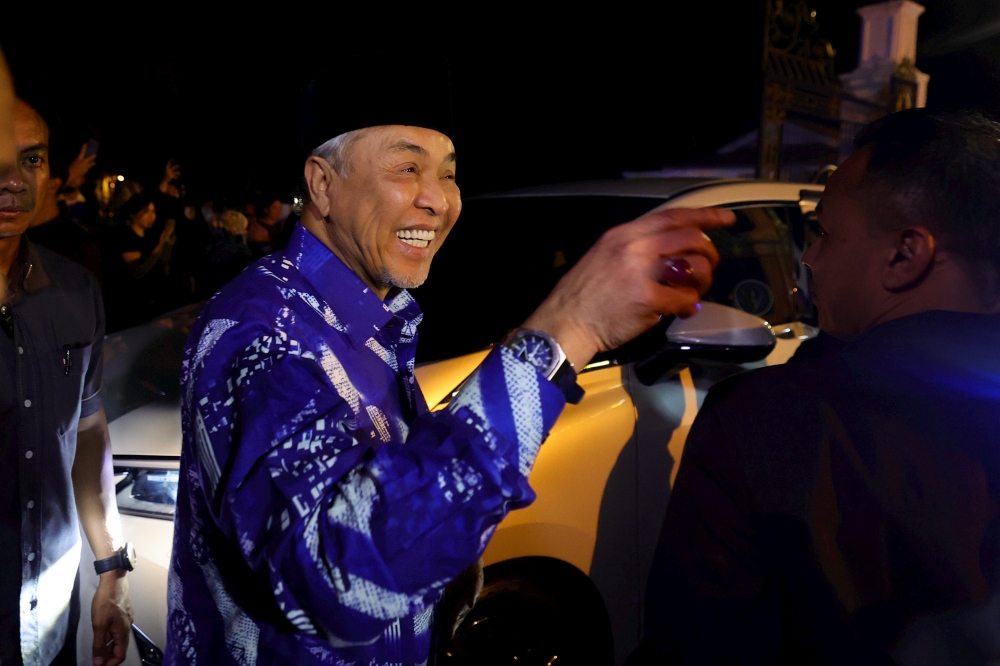
Barisan Nasional has put forward three contenders for the menteri besar position in Negeri Sembilan, coalition chairman Datuk Seri Ahmad Zahid Hamidi announced during a visit to the state capital of Seremban on Friday. The move follows internal deliberations within the coalition to identify suitable leadership for the state administration, with the formal submission now awaiting the constitutional appointment process through the Yang di-Pertuan Agong.
Zahid's disclosure marks a significant moment in BN's efforts to consolidate its leadership structure across the country's constituent states. The presentation of multiple candidates reflects the coalition's commitment to offering the monarchy a range of qualified options, consistent with constitutional conventions that vest the ultimate selection authority with the sovereign. This approach underscores the continued relevance of monarchical prerogatives in Malaysia's parliamentary system, where titular heads of state retain meaningful discretion in appointing chief executives at the state level.
The submission timing carries particular importance given Malaysia's political landscape, where state-level governance has become increasingly competitive and strategically significant. Negeri Sembilan, as a constituent state within the Federation, occupies a notable position within the broader BN framework, and the appointment of its menteri besar will influence the coalition's capacity to implement its legislative agenda and maintain administrative continuity across the nation's various states. The three-candidate framework provides flexibility while maintaining BN's institutional preference within the appointment process.
For Malaysian political observers, such developments illustrate the intricate balance between party politics and constitutional monarchy in the country's system of governance. The fact that BN—comprising multiple component parties with distinct interests and regional power bases—can present a unified slate demonstrates its organisational coherence, even as individual members may harbour their own preferences regarding the eventual appointee. This internal coordination reflects negotiations conducted behind closed doors, where consensus-building among parties like UMNO, MCA, and MIC remains essential to maintaining coalition unity.
Negeri Sembilan's political trajectory has attracted attention in recent years as demographic shifts and economic development have altered voter behaviour and expectations. The state's role as both a commercial hub and residential extension of the Klang Valley means that leadership decisions here reverberate across the broader Selangor-Kuala Lumpur metropolitan region. Whoever ultimately assumes the menteri besar role will inherit responsibility for managing urban development pressures, traffic infrastructure, and social services delivery—all concerns that resonate with residents throughout the Klang Valley corridor.
The three-name submission strategy also reflects practical politics within BN's power-sharing arrangements. By offering multiple candidates, the coalition avoids appearing to impose a single choice and instead frames the decision as one of genuine deliberation. This approach respects the constitutional framework while simultaneously managing intra-coalition expectations and regional interests. Each of the three proposed candidates likely represents different geographic, sectarian, or demographic constituencies within Negeri Sembilan, ensuring that BN's submission reflects the state's political diversity.
Such appointments carry implications extending beyond state administration. The menteri besar serves not only as executive head of the state government but also as a senior figure within BN's broader leadership hierarchy, positioned to influence coalition strategy at the national level. The individual selected will join other state chief executives in shaping federal-state relations and implementing national policies at the grassroots level. Consequently, the Yang di-Pertuan Agong's eventual choice will ripple through BN's internal power structures and potentially affect the coalition's positioning ahead of subsequent electoral cycles.
The formal submission process represents a milestone in establishing or reestablishing administrative continuity in Negeri Sembilan. Whether prompted by a previous chief executive's resignation, completion of term, or strategic repositioning, the need to present candidates indicates that BN views the state administration as sufficiently important to warrant careful selection and appropriate constitutional processes. The coalition's willingness to observe constitutional propriety—by submitting names for royal consideration rather than simply announcing an appointee—reinforces institutional norms that have weathered Malaysia's political turbulence across successive decades.
For Southeast Asian watchers of Malaysian politics, the Negeri Sembilan development exemplifies how established regional coalitions navigate contemporary governance challenges. Barisan Nasional, despite facing electoral headwinds in recent years, continues to function as a coherent entity capable of projecting unity in matters of state-level administration. The presentation of three qualified candidates for the menteri besar post demonstrates institutional resilience and the coalition's capacity to sustain itself through mechanisms beyond electoral victory alone.
The ultimate selection by the Yang di-Pertuan Agong will reveal the monarchy's priorities and preferences in this particular instance, with observers parsing the eventual choice for insights into which candidate best satisfied the sovereign's assessment of suitability, experience, and the broader political balance. That announcement, when it comes, will complete the formal appointment process and set the trajectory for Negeri Sembilan governance during the coming period.

