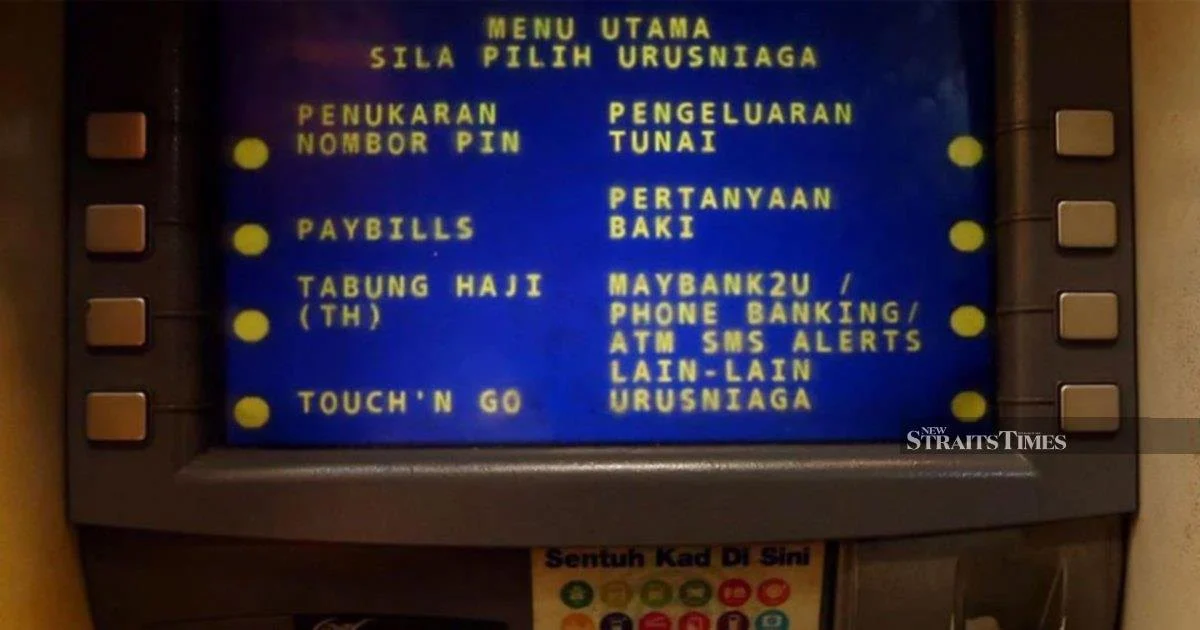
Malaysia's central bank is taking steps to ensure that customers comply with the standardised interbank withdrawal fee framework by asking the public to immediately flag any cases where they continue to incur charges at their own financial institution's automated teller machines. Communications Minister Datuk Fahmi Fadzil made the announcement regarding Bank Negara Malaysia's directive, signalling renewed focus on enforcing fee transparency across the banking sector.
The RM1 interbank withdrawal fee represents a key element of banking reform that Malaysia has implemented to create consistency across the industry. This charge applies specifically when a customer uses an ATM belonging to a different bank, establishing a uniform pricing structure meant to encourage banking competition whilst maintaining operational fairness. However, the emergence of reports showing customers being charged this fee at machines operated by their own institutions suggests implementation gaps persist despite regulatory guidance.
The distinction between own-bank and interbank ATM usage carries significant implications for consumer protection. When a depositor withdraws funds from a machine maintained by their own financial institution, no interbank fee should apply under the established framework. Such charges represent either system errors, outdated programming within ATM networks, or in some cases, potential compliance failures by individual banks. The directive from Bank Negara effectively mobilises the public as a monitoring mechanism to identify where banks may not be adhering to the prescribed fee structure.
For Malaysian consumers, the practical impact of such erroneous charges, whilst individually modest at RM1 per transaction, compounds significantly across the banking population. A customer making several withdrawals monthly from their own bank's network could lose several ringgit unnecessarily. Across millions of transactions nationally, the cumulative financial leakage to consumers becomes substantial, affecting household budgets and undermining confidence in the banking system's integrity.
The invitation to report violations represents an escalation in Bank Negara's enforcement posture. Rather than relying solely on periodic audits and compliance reviews, the central bank is effectively enlisting customers as frontline observers. This crowdsourced monitoring approach reflects the reality that regulatory bodies cannot simultaneously inspect every transaction across Malaysia's extensive ATM network. Public reporting creates accountability pressure and helps identify problem areas requiring immediate corrective action.
Technical explanations for incorrect charges may include legacy systems within some banks that have not yet fully integrated the new fee framework, particularly among institutions with older operational infrastructure. Transition periods during regulatory reforms often produce such glitches, though prolonged occurrence after implementation deadlines typically indicates insufficient institutional commitment to compliance. Database synchronisation problems across different banks' networks can occasionally cause misrouting of transactions, though such systemic issues should be uncommon.
The timing of this public appeal also suggests that despite previous communication campaigns, awareness gaps remain regarding the proper application of ATM fees. Some customers may not fully understand which machines belong to their own bank versus which are operated by competitors. Clear signage and in-app notifications have improved, yet confusion persists in certain demographics and regions. Banks themselves bear responsibility for educating account holders about fee structures through their customer service channels and digital platforms.
For Southeast Asian banking observers, Malaysia's approach exemplifies how central banks increasingly deploy transparency and public participation as regulatory tools. Rather than maintaining the traditional model of top-down supervision, contemporary monetary authorities recognise that consumer engagement multiplies regulatory effectiveness. This philosophy aligns with broader fintech-era trends toward greater democratisation of financial oversight and customer empowerment in holding institutions accountable.
The directive carries implicit warning signals to Malaysia's banking community. Banks that continue charging RM1 fees at their own ATM machines risk regulatory action and reputational damage as complaints accumulate. Bank Negara's willingness to publicly acknowledge the problem and mobilise consumer reporting suggests the central bank is prepared to take enforcement measures against persistent offenders. Financial institutions ignoring this guidance may face penalties or mandatory system corrections imposed through regulatory channels.
Customers wishing to lodge complaints can typically report such charges through their bank's customer service department, Bank Negara's own complaint portal, or through financial ombudsman services. Documentation should include transaction timestamps, ATM location codes, and account statements clearly showing the inappropriate fee. Accumulating evidence from multiple customers reporting the same machine or institution strengthens the case for regulatory intervention.
Moving forward, the sustainability of Malaysia's fee framework depends on consistent enforcement and continuous public vigilance. Banks must audit their own systems to ensure ATM networks properly identify own-bank versus competitor machines. As Malaysia progresses toward broader digital banking adoption and financial inclusion goals, maintaining trust through fee fairness represents a foundational requirement. The public's cooperation in reporting violations ultimately strengthens the integrity of Malaysia's banking ecosystem.
Bank Negara's appeal underscores that regulatory frameworks require partnership between authorities, institutions, and consumers. No centrally-planned system operates flawlessly without feedback from those directly affected by its implementation. By encouraging public reporting, Malaysia's central bank demonstrates adaptive governance that recognises when formal monitoring requires augmentation through community participation to achieve genuine compliance and fair outcomes across the sector.

