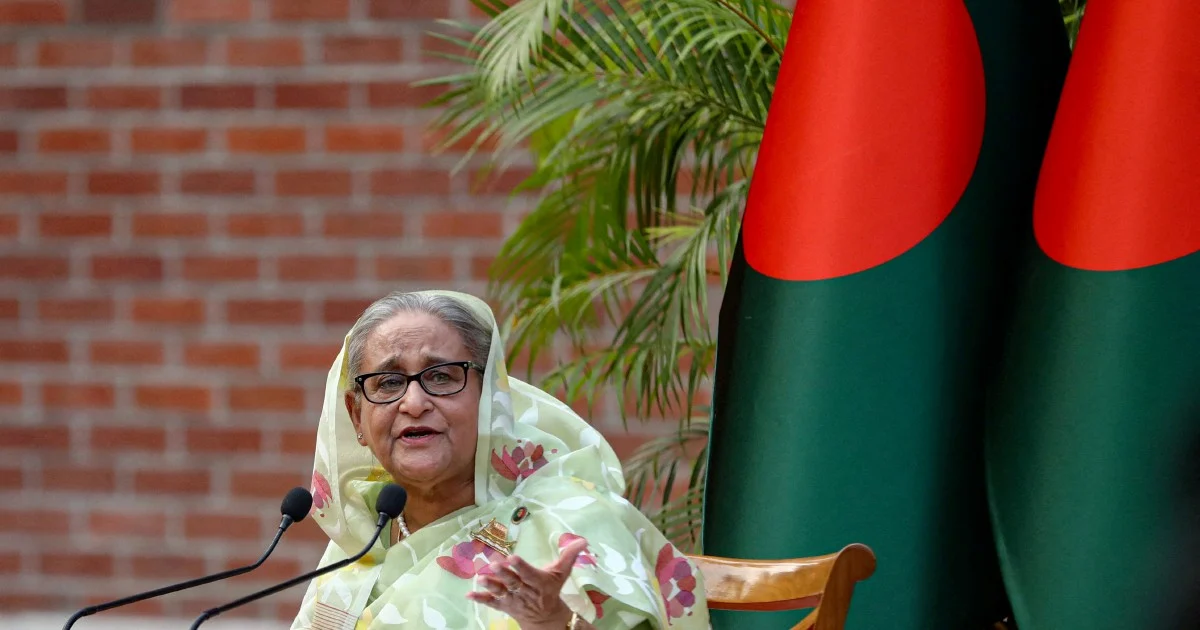
Bangladesh's political landscape has grown increasingly volatile following the removal from office of Prime Minister Sheikh Hasina, who currently remains in self-imposed exile across the border in India. A senior government minister delivered a stark warning on Monday that Hasina will face incarceration immediately upon her return to Bangladesh, a statement that directly contradicts the former premier's recent assertion to Reuters that she intended to travel home by December and present herself to judicial authorities. The pronouncement marks a significant escalation in the post-transition political tensions engulfing the country and raises serious questions about the trajectory of Bangladesh's institutional stability.
Hasina's departure from Bangladesh and subsequent refuge in India came amid extraordinary political upheaval, reflecting the profound divisions that have emerged following her government's fall from power. The circumstances surrounding her removal remain deeply contested, with the transitional authorities and various political factions offering competing narratives about legitimacy, accountability, and the country's constitutional future. Her decision to flee rather than face immediate arrest represented a crucial inflection point, allowing her to avoid the risk of detention on arrival at Bangladeshi borders and providing a necessary buffer as the political situation stabilized.
The former premier's statement to Reuters signalled what many observers interpreted as a potential breakthrough in resolving the impasse. By publicly committing to voluntary return and self-surrender before the courts, Hasina appeared to be signalling acceptance of Bangladesh's post-transition legal processes and demonstrating willingness to submit to judicial procedures. Such a gesture could have paved the way for constructive dialogue between her supporters and the interim administration, potentially allowing Bangladesh to begin the difficult work of institutional rebuilding and reconciliation. The December timeline she cited provided a specific target for both domestic and international observers monitoring the political situation.
However, the ministerial warning issued just days after her Reuters interview fundamentally alters this calculus. The government official's statement that Hasina will be imprisoned upon crossing Bangladesh's borders transforms her contemplated return from a managed legal process into what amounts to a guarantee of detention. This declaration appears to have closed off the pathway toward voluntary surrender that the former premier's previous statements had suggested might be viable. The hardening of the government's position reflects deeper political calculations about accountability, revenge, and the consolidation of power among Bangladesh's transitional leadership.
The divergence between Hasina's stated intentions and the government's formal position reveals the fundamental breakdown in trust between the deposed administration and those wielding authority in the interim period. Even as Hasina expressed her commitment to facing justice through Bangladesh's legal system, the ministerial threat suggests that the transition leadership may be approaching this situation as a political matter rather than one governed by rule of law. This distinction carries profound implications not only for Hasina personally but for Bangladesh's broader institutional health and the signal it sends about how political disputes will be managed going forward.
From a regional perspective, this development carries significance for India-Bangladesh relations and for how South Asian democracies handle the aftermath of political transitions. Hasina's presence in India and the protection afforded by that nation's territorial sovereignty have created a diplomatic dimension to what is fundamentally a domestic Bangladeshi crisis. Any attempt by authorities in Dhaka to pressure New Delhi to compel Hasina's return would risk escalating tensions between the two countries. Conversely, if India continues to provide asylum indefinitely, it effectively removes the former premier from Bangladesh's political equation while complicating the transitional government's mandate to address accountability for her administration's conduct.
The judicial dimension of this confrontation deserves particular scrutiny. Hasina indicated her willingness to submit to courts, suggesting a desire to test her case through legal mechanisms rather than face purely political punishment. The government's counter-assertion of guaranteed imprisonment regardless of legal process raises troubling questions about judicial independence and the rule of law during Bangladesh's transition. For Malaysia and other Southeast Asian democracies, the Bangladeshi situation offers cautionary lessons about how transitions of power can either strengthen or undermine institutional legitimacy and constitutional governance.
International attention to this matter stems partly from concerns about whether Bangladesh's interim administration can successfully navigate a political transition while maintaining commitment to democratic principles and institutional resilience. The credibility of Bangladesh's courts and legal system depends critically on their perceived independence from executive pressure, a quality that becomes harder to sustain when government ministers make blanket declarations about imprisonment that precede and bypass judicial proceedings. This dynamic threatens to transform what might have been a legal accountability process into what critics will characterise as political persecution.
The practical implications of the current standoff remain uncertain. Hasina's December return timeline now appears unlikely given the ministerial threats, leaving open the question of how long she remains in Indian exile and under what circumstances she might eventually return. The possibility exists that this impasse will extend indefinitely, with the former premier managing her political legacy and organisational commitments from India while the transitional government consolidates its grip on Bangladesh's institutions and political apparatus. Alternatively, continued pressure from Hasina's supporters and international actors concerned about justice and reconciliation might force the government to clarify the specific charges and legal procedures that await her.
The broader challenge facing Bangladesh's transitional leadership involves distinguishing between legitimate accountability for governmental misconduct and the settling of political scores through the machinery of state power. How the country manages this distinction will substantially determine whether the post-transition period produces genuine institutional reform or merely represents a transfer of authority to a new group of politicians operating within the same patterns of personalised power, factional competition, and weak institutional constraints that have characterised much of Bangladesh's modern history.

