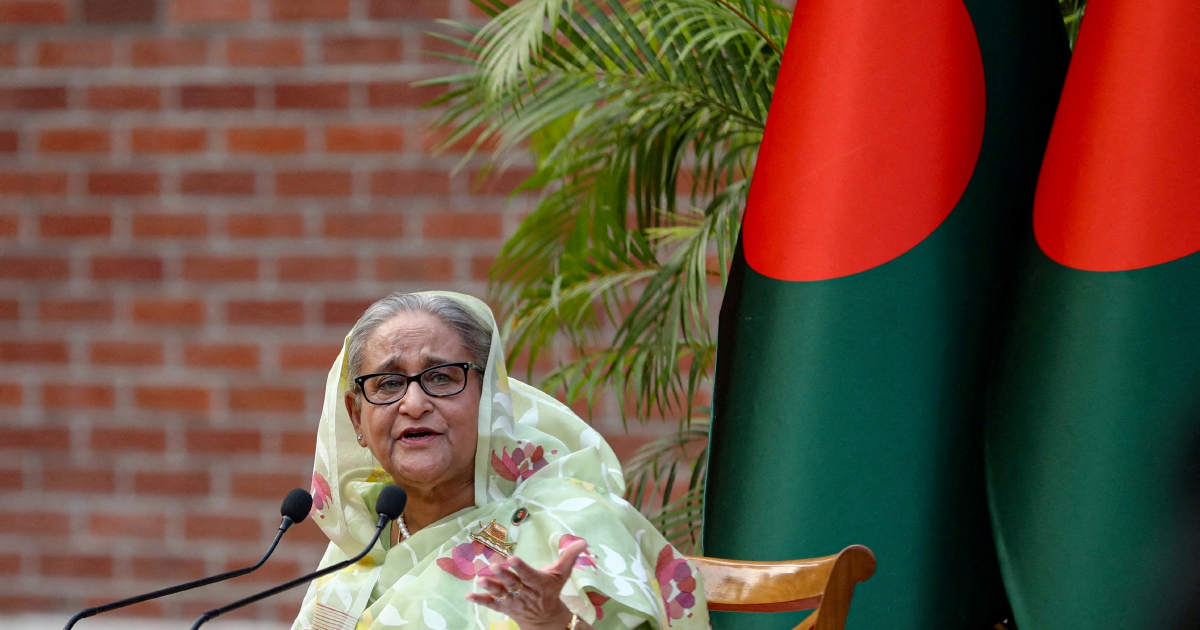
Bangladesh has moved to seize approximately 760 billion taka, equivalent to roughly $6.2 billion, in assets belonging to former Prime Minister Sheikh Hasina, members of her immediate family circle, and ten major business enterprises with documented ties to her administration. The confiscation action, announced by government authorities on Wednesday, represents one of the most substantial asset recovery operations undertaken in the country's recent history and signals the interim administration's determination to address allegations of corruption and illicit wealth accumulation during Hasina's tenure.
The scale of the seized assets underscores the complexity and reach of what investigators have characterized as entrenched networks of commercial interests linked to the former premier's rule. The inclusion of ten distinct business groups indicates that the alleged impropriety extended far beyond personal family holdings, suggesting a more systematic pattern of leveraging political authority to channel commercial advantage. This breadth of confiscation demonstrates that Bangladesh's authorities are pursuing not merely symbolic gestures but comprehensive investigations into interconnected financial structures that allegedly benefited from privileged access to government decision-making.
The seizure reflects the dramatic political upheaval that has gripped Bangladesh in recent months. Sheikh Hasina's departure from office precipitated significant domestic tensions and raised questions about governance accountability mechanisms within the country's institutional framework. The new interim leadership has made anti-corruption efforts a cornerstone of its legitimacy, particularly given the circumstances surrounding the transition of power. For observers tracking South Asian governance dynamics, the confiscation action signals a government willing to employ sweeping financial measures to demonstrate reform commitment, though questions remain about due process safeguards and the legal foundations for such expansive asset seizures.
Within the Southeast Asian context, this development carries implications for how neighbouring countries approach anti-corruption efforts and asset recovery following political transitions. Malaysia, which has undertaken its own high-profile investigations into alleged corruption involving previous administrations, may draw parallels with Bangladesh's approach. The sophistication required to trace and value such substantial asset networks—spanning real estate, business equity, foreign holdings, and other complex instruments—highlights the technical and investigative capacity challenges that regional governments face when pursuing comprehensive accountability measures.
The 760 billion taka figure represents a significant portion of Bangladesh's government revenue in a given fiscal year, amplifying the potential fiscal implications if assets are successfully liquidated or returned to state control. Such revenue could theoretically be redirected toward public services, infrastructure investment, or debt reduction—considerations that will likely influence how interim administration officials present the confiscation to a domestic audience seeking tangible improvements in living standards and governance quality.
International dimensions of the asset seizure also warrant attention. Many high-net-worth individuals with allegations against them maintain overseas holdings in jurisdictions ranging from Singapore to London to Dubai. Bangladesh's capacity to recover such assets will depend substantially on international legal cooperation and the willingness of foreign governments and financial institutions to recognize and enforce confiscation orders. This represents a practical constraint that may prevent complete recovery of all allegedly illicit wealth, a reality that confronts most developing nations attempting comprehensive corruption investigations.
The involvement of ten business groups raises specific questions about how authorities have distinguished between legitimate commercial operations and those substantially compromised by political favour or illicit finance. Some enterprises may have operated within legal parameters while benefiting from advantageous government policies, creating grey zones that complicate clear-cut confiscation decisions. The legal sophistication required to navigate such distinctions while maintaining international credibility for the confiscation process represents a significant governance challenge for Bangladesh's authorities.
Domestic public opinion in Bangladesh regarding these measures likely divides along familiar political and socioeconomic lines. Supporters view confiscation as essential accountability, particularly given the substantial public resources that may have been diverted or misappropriated during the previous administration. Critics may express concern about the precedent such sweeping actions establish for future governments, the potential absence of robust legal procedures, or the application of retroactive asset recovery measures. These concerns reflect broader tensions within Bangladesh regarding rule-of-law commitments and the balance between accountability demands and institutional restraint.
The confiscation action also intersects with Bangladesh's international relationships and standing. Development partners and multilateral institutions closely monitor how the country addresses corruption allegations, as such commitments affect aid allocation, investment climate assessments, and diplomatic positioning. A credible, legally grounded asset recovery process could enhance Bangladesh's governance reputation, whereas perception of arbitrary or politically motivated confiscations could undermine those objectives and trigger criticism from international observers.
Technical implementation of such large-scale asset seizure involves multiple challenges beyond political will. Authorities must navigate property registration systems, corporate structures, banking regulations, and valuation methodologies while maintaining detailed documentation that could withstand legal challenge. The operational capacity to manage such seized assets—maintaining properties, protecting valuables, administering frozen accounts—itself represents an institutional burden that Bangladesh's state apparatus must shoulder until final legal determinations are reached.
The timeline for resolution of specific cases, potential litigation, appeals processes, and final asset disposition remains unclear. Some confiscations may face legal challenges based on evidentiary standards, due process claims, or constitutional grounds. This prolonged uncertainty could affect the practical value realized from seized holdings, particularly if properties depreciate, business assets decline, or foreign holdings become difficult to access during extended legal proceedings.
For Malaysian observers, the Bangladesh situation offers instructive lessons regarding the integration of aggressive asset recovery initiatives within democratic institutional frameworks. As Bangladesh navigates these mechanisms, monitoring the outcomes will provide regional precedents regarding how developing democracies balance accountability imperatives with legal certainty and procedural fairness—tensions that resonate across Southeast Asia.

