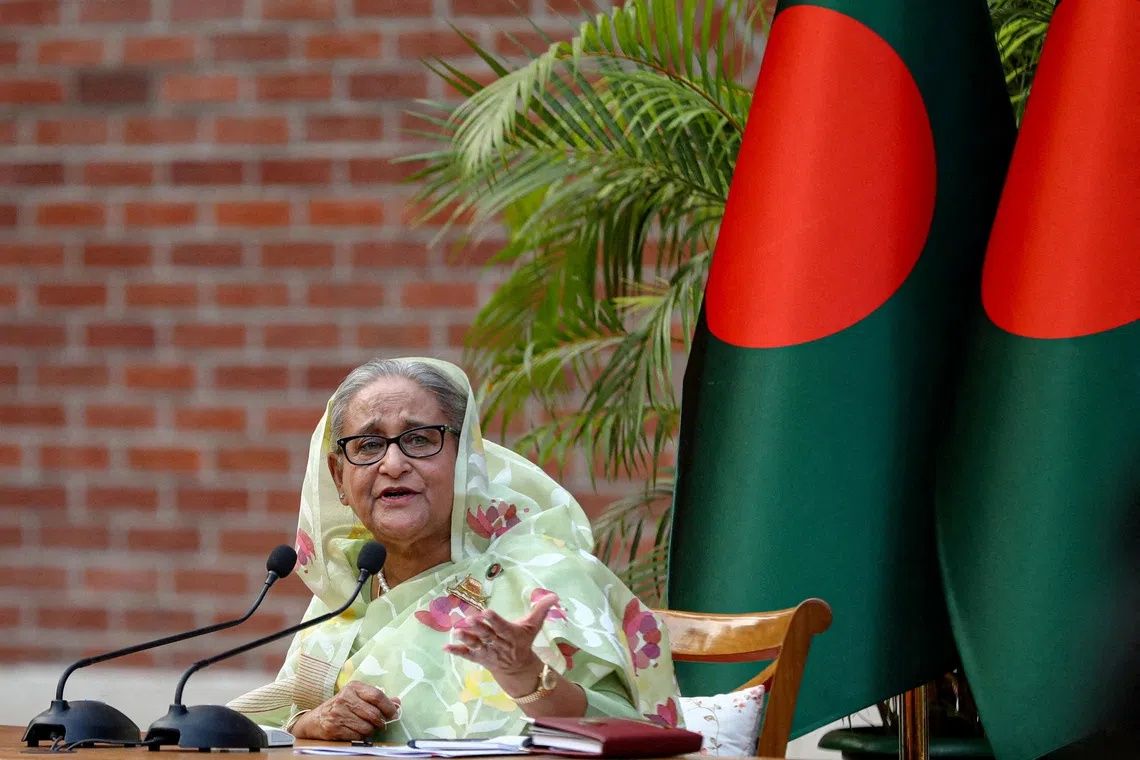
Bangladesh's foreign affairs establishment has lodged a formal diplomatic query with India regarding the planned virtual address by exiled former prime minister Sheikh Hasina, who fled the country in August 2024 after her government was toppled by a student-led uprising. The intervention marks Dhaka's first official public response to the scheduled appearance at an August 5 gathering organised by the Foreign Correspondents' Club of South Asia, an event designed to commemorate the second anniversary of the protests that precipitated Hasina's departure from power.
The timing of the dispute highlights the delicate state of relations between South Asia's two most populous neighbours. While Dhaka and New Delhi have recently adopted what officials term a "forward-looking approach" aimed at stabilising ties through enhanced bilateral engagement, the question of how India should treat high-profile opposition figures residing on its territory has emerged as an unexpected complication. State Minister for Foreign Affairs Shama Obaed Islam articulated Dhaka's frustration during a press briefing late Monday, emphasising that Bangladesh seeks explicit Indian clarity on whether New Delhi intends to permit politically active fugitives to utilise its soil for addressing domestic audiences back home.
Hasina's presence in India since her flight from Bangladesh remains a contentious issue for the interim government led by Chief Adviser Muhammad Yunus and former opposition figure Tarique Rahman, who came to power following February's transitional elections. The 78-year-old former premier faces multiple legal jeopardies in her homeland, including a death sentence imposed in 2025 for crimes against humanity related to the 2024 security crackdown that international observers, including the United Nations, estimate claimed up to 1,400 lives. Despite these serious charges and Bangladesh's ongoing extradition requests, Hasina has maintained her innocence and publicly declared her intention to return to Bangladesh in December, a prospect that has unsettled the current administration.
The Foreign Correspondents' Club of South Asia confirmed that Hasina would participate in the commemorative event via video link, accompanied by her son Sajeeb Wazed Joy and other panellists. The club's format—a virtual appearance rather than a physical presence—technically sidesteps concerns about harbouring a wanted individual, yet Bangladesh views the substance of the matter as more significant than its technical arrangements. Islam conveyed to journalists that Dhaka has repeatedly communicated its discomfort to Indian counterparts regarding Awami League leaders, of which Hasina remains the most prominent, conducting political activities and issuing statements from Indian territory.
Bangladesh's diplomatic communication reflects a broader strategic calculation. The interim government recognises that India remains a crucial regional partner whose cooperation is essential for stability and development, yet it cannot afford to appear acquiescent to activities perceived as undermining national sovereignty or supporting opposition groups. The State Minister's carefully calibrated remarks—stressing that progress in India-Bangladesh relations should not be derailed by such complications—suggest an effort to frame the issue as a procedural clarification rather than a direct accusation of Indian bad faith. Islam explicitly noted that while Bangladesh does not attribute the event to the Indian government itself, Dhaka expects to receive unambiguous assurances from New Delhi regarding its position on fugitives engaging in political discourse from Indian soil.
India has historically maintained an ambiguous posture on such matters, reflecting the complex realities of South Asian geopolitics and the principle of granting asylum to political refugees. However, Indian officials have previously indicated to Bangladesh that they do not anticipate or encourage fugitive accused individuals to conduct substantive political activities from Indian territory, a position that Dhaka now seeks to operationalise through concrete actions. The absence of an immediate response from India's foreign ministry suggests either that New Delhi is deliberating its approach carefully or that officials wish to avoid elevating the dispute through public commentary.
The dispute emerges against a backdrop of gradual normalisation between Dhaka and New Delhi. Relations deteriorated significantly following Hasina's ouster, with the interim government adopting a more independent foreign policy stance and expressing concerns about what it characterised as Indian interference during the previous administration. Yet both capitals have signalled recognition that continued acrimony serves neither nation's interests, and senior officials from both governments have engaged in repeated high-level interactions aimed at rebuilding confidence and expanding cooperation on trade, energy, and security matters.
For Malaysian and Southeast Asian observers, the episode underscores the persistent tension between competing principles in international relations—the hosting of political refugees and asylum seekers on one hand, and respect for neighbouring states' sovereignty and judicial processes on the other. The incident also illuminates how unresolved political transitions can generate diplomatic friction even when both countries ostensibly seek improved relations. Bangladesh's measured but firm response demonstrates how smaller nations navigate such complexities, deploying diplomatic language to assert positions without triggering confrontation with more powerful neighbours.
The question of whether India will grant Hasina an explicit platform remains unresolved, though the Foreign Correspondents' Club maintains its institutional independence from state direction. Should the event proceed as scheduled, Bangladesh has indicated its readiness to escalate the matter through formal diplomatic channels, a prospect that may prompt New Delhi to offer clarifications that could satisfy Dhaka's concerns without compromising principles of free expression and assembly. Hasina's own assertion that she intends to return to Bangladesh in December adds urgency to the dispute, as her claimed imminent homecoming may prove either a negotiating position or a genuine intention, with profound consequences for regional stability and the trajectory of Bangladesh's transitional governance.

