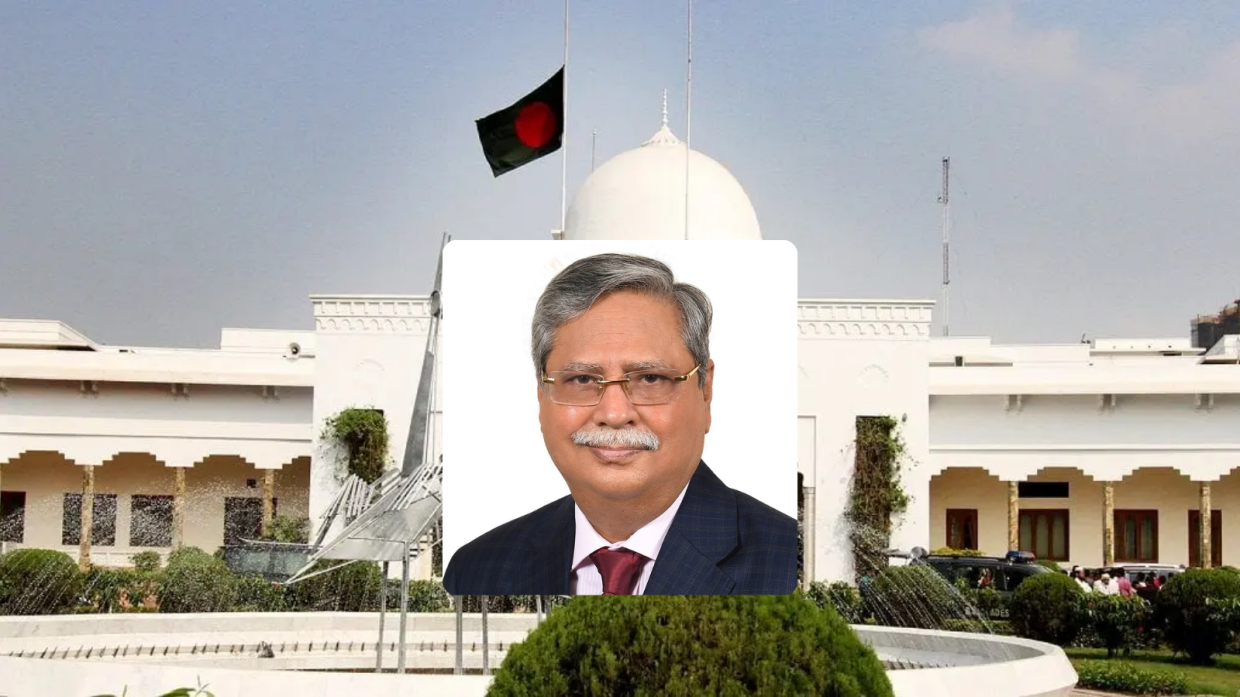
President Mohammed Shahabuddin's tenure in Bangladesh's highest constitutional office appears to be approaching its end. Multiple sources indicate the 22nd president is poised to resign in the coming days, a development that would mark a significant political realignment in the post-July 2024 landscape. Having assumed office on April 24, 2023, Shahabuddin has now become the sole remaining figure from the pre-uprising constitutional hierarchy, a distinction that government circles increasingly view as problematic rather than stabilising.
The mounting pressure on Shahabuddin appears to have crystallized around a phone conversation he conducted with former Prime Minister Sheikh Hasina during a medical visit to London in May. Hasina, who fled to India following the mass uprising last July and now faces a death sentence in absentia while her party's activities remain prohibited, reportedly discussed with Shahabuddin her intention to orchestrate a dramatic return. When intelligence agencies subsequently became aware of this exchange, senior government figures conveyed to the president that his continuation in office was no longer tenable. Yet according to a prominent BNP leader, this phone call, while significant, represents merely one layer of a considerably more intricate political situation.
The underlying tension stems fundamentally from Hasina's recent public declaration that she intends to return to Bangladesh in December alongside senior Awami League figures, ostensibly to surrender and face legal proceedings. This announcement has triggered alarm bells throughout the government apparatus, particularly within the Interim Caretaker Government framework and the current BNP-led administration. The prospect of Hasina's return has prompted a comprehensive reassessment of the constitutional architecture and who holds positions of influence during what may prove to be a destabilising period. Government officials view retaining a president who maintained contact with the exiled former premier as incompatible with maintaining firm control over political developments.
Concerns extend beyond Hasina's personal return to encompass broader Awami League reorganisation efforts. Intelligence monitoring has revealed that party activists operating within Bangladesh are attempting to rebuild organisational structures despite the formal prohibition on the party's activities. Prime Minister Tarique Rahman underscored this concern on July 17 when he directed relevant authorities during a Cabinet meeting to intensify operations against the Awami League alongside its affiliated wings, including the Bangladesh Chhatra League and Jubo League. The government's stance reflects determination to prevent the opposition party from reconstituting itself as a functional political force during this critical transition period.
Shahabuddin's position has grown increasingly untenable partly because of his own ambivalent statements regarding his future tenure. During the interim government period in December 2025, he declared his intention to step down midway through his constitutional term following the February parliamentary election, claiming he had endured humiliation from Muhammad Yunus's administration. However, following the BNP's assumption of power, his public stance shifted. In a newspaper interview on February 24 this year, Shahabuddin adopted a more malleable approach, stating he would remain in office should the government prefer his continued service but would voluntarily depart if officials wished him to resign. This flexibility has now apparently been tested and found wanting by a government increasingly uncomfortable with his presence.
A senior government source characterised Shahabuddin's departure as inevitable rather than surprising. The source expressed concern that the president had been attempting to revive established political connections, activities the government views as potentially destabilising. The principle animating official thinking appears to be that retaining any pre-uprising constitutional figure—particularly one who has demonstrated communication with exiled opposition leaders—contradicts the stated objective of fundamentally restructuring the political landscape. This reasoning reflects the post-July 2024 government's determination to consolidate control and prevent alternative power centres from emerging.
Bangladesh's constitutional framework provides a defined succession mechanism should Shahabuddin resign. Under the Constitution, the Speaker of Parliament would assume acting presidential duties pending the election of a new president through the proper constitutional procedures. This transition mechanism has been invoked before and represents an orderly, predictable process. No final determination has yet been made regarding either the precise timing of Shahabuddin's anticipated departure or the identity of his successor, though government circles suggest a decision could materialise within days. One source connected to Bangabhaban, the presidential residence, indicated that an announcement might come imminently, possibly before a scheduled July 29 meeting between the president and non-resident ambassadors from four countries.
For Malaysian and Southeast Asian observers, the Bangladeshi political upheaval carries broader implications regarding democratic transitions and constitutional governance in the region. The ease with which a constitutional figure can be pressured to resign—even one who ostensibly holds an independent office—raises questions about institutional resilience and separation of powers. The episode also illustrates how mass uprisings can fundamentally destabilise established political arrangements, creating extended periods of uncertainty regarding succession, legitimacy, and institutional continuity. Bangladesh's experience demonstrates that post-uprising governments often prioritise immediate consolidation of control over adherence to constitutional norms that might be considered settled elsewhere.
The political background to Shahabuddin's impending departure reveals deeper fractures within the Bangladeshi elite regarding the direction of political reconstruction. The government's determination to eliminate all Awami League institutional presence, combined with its apparent unwillingness to tolerate independent figures in constitutional positions, suggests a more concentrated power structure emerging from the July 2024 crisis. Whether this represents a temporary security measure or a more permanent reconstitution of the political system remains uncertain, but the trajectory clearly favours centralised control over distributed power and institutional independence during this critical transition.

