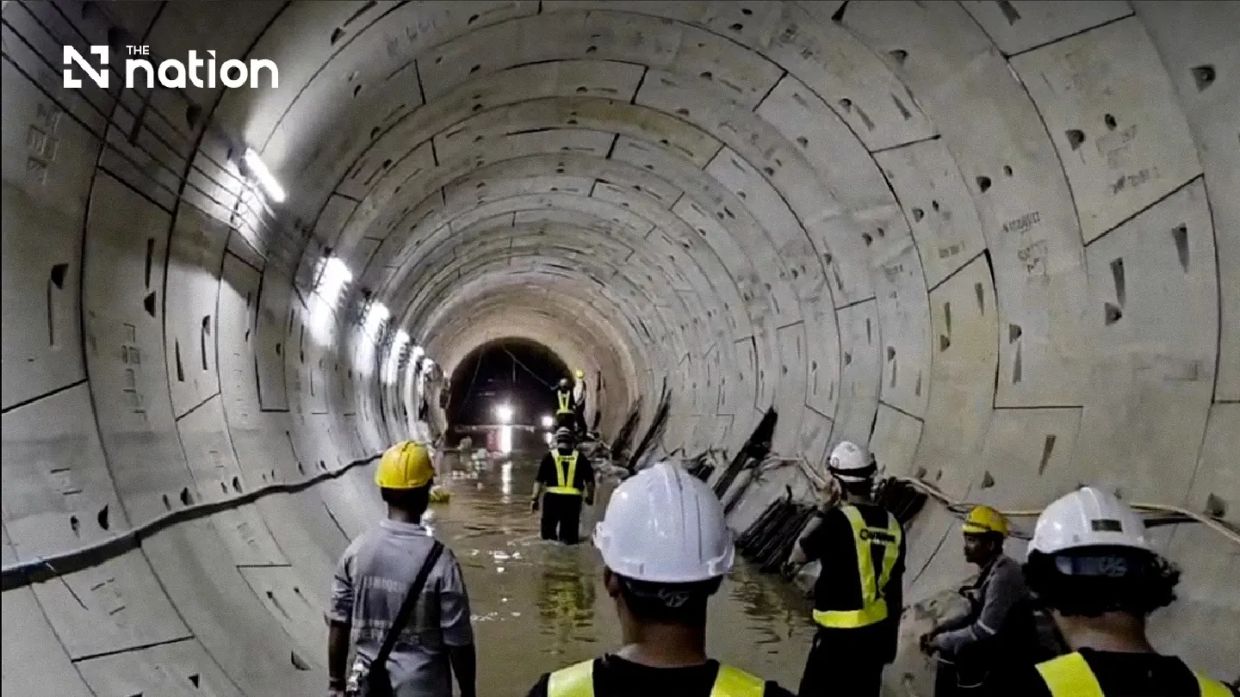
Thailand's Prime Minister Anutin Charnvirakul descended on the Purple Line construction site near Wongwian Yai in the early hours of Wednesday morning following a water intrusion incident that exposed vulnerabilities in the sprawling mass transit project. The breach occurred when monsoon rains inundated a construction shaft positioned beneath the tunnel corridor of the Tao Poon–Rat Burana segment, part of the railway extension along the Kanchanaphisek Ring Road. The unexpected flooding prompted an urgent safety assessment by transport ministry personnel and consulting engineers, underscoring growing concerns about the reliability of Bangkok's critical infrastructure projects.
The incident emerged during intense rainfall across the Thai capital on July 8, when water accumulated steadily throughout the day within the active worksite. Officials initially contained the situation, but the deteriorating conditions warranted escalated attention from senior government figures. Anutin's midnight arrival at the location marked an emphatic political intervention, signalling the administration's commitment to preventing another catastrophic failure similar to the devastating Vajira Hospital tunnel collapse that struck the project in late September 2025. His presence also reflected the sensitivity surrounding major construction disasters and the attendant public relations consequences for the government.
The Prime Minister's visit coincided with an assembly of top-tier officials who converged on the scene, including Deputy Prime Minister and Transport Minister Phiphat Ratchakitprakarn, alongside three deputy transport ministers and the deputy interior minister. This concentration of ministerial firepower underscored the gravity with which the administration treated the breach, moving beyond routine contractor oversight into the realm of crisis management. Gardphajon Udomdhammabhakdi, governor of the Mass Rapid Transit Authority of Thailand, and Prasong Suviwattanachai, executive leadership from construction firm Unique Engineering and Construction Public Company Limited, participated in the technical assessment.
The affected segment forms part of Contract 4 of the southern Purple Line expansion, specifically the Saphan Phut–Dao Khanong corridor valued at 14.982 billion baht, equivalent to approximately US$447.3 million. Unique Engineering and Construction Public Company Limited, commonly abbreviated as UNIQ, holds responsibility for this phase, which encompasses intricate tunnel excavation operations and the assembly of structural retaining walls. The complexity of these underground works, combined with Bangkok's challenging hydrogeological conditions and seasonal monsoon patterns, presents substantial engineering obstacles that demand rigorous oversight.
Deputy Transport Minister Phattharaphong Phatraprasit reported that preliminary inspections revealed the situation remained manageable, though he issued stern directives for continuous surveillance and comprehensive technical investigation into the precise origins of the water ingress. His instructions emphasised the necessity for rapid remedial action to forestall structural compromise, safeguard public welfare, and preserve the construction timeline. The transport authority and contractor face obligations to furnish routine progress updates to the ministry while adhering strictly to established engineering protocols and safety benchmarks, creating an accountability framework designed to prevent recurrence.
Anutin characterised the response as fundamentally grounded in engineering methodology, combining immediate containment with longer-term preventive infrastructure. He noted that accumulated water levels had not necessitated road surface closures, suggesting that active pumping and drainage management had effectively arrested further accumulation. The Prime Minister drew deliberate contrasts between the Wongwian Yai breach and the earlier Vajira Hospital collapse, emphasising that authorities had detected the current leak from inception and were implementing sealing procedures whilst simultaneously monitoring subsurface water elevation. Workers had maintained water levels since morning operations commenced, with no observed escalation trajectory.
To mitigate risks to surrounding urban environments, the Mass Rapid Transit Authority coordinated deployment of sophisticated movement-monitoring apparatus targeting adjacent buildings and infrastructure. Anutin confirmed that preliminary readings had revealed no anomalous displacement patterns, though heightened surveillance would persist. He downplayed expectations of protracted inspection durations, suggesting that technical teams anticipated relatively swift resolution through coordinated effort. The reference to the September 2025 Vajira Hospital disaster, which represented a watershed moment in public perception of the Purple Line project's construction standards, clearly informed the administration's decision to mobilise senior officials and demonstrate decisive crisis management capacity.
When questioned about the timing and scale of the ministerial mobilisation, Anutin provided a characteristically informal explanation, noting that he had communicated his intention to visit through a group messaging platform, which naturally attracted attendance from colleagues already engaged with the situation. This spontaneous coordination mechanism, he suggested, reflected established protocols already operational across government structures. He reframed the concentration of high-level attention not as panic-driven theatrics but as diligent oversight ensuring that proper technical procedures had been executed before escalation occurred. His emphasis on the supremacy of public safety considerations positioned the intervention as fundamentally protective rather than reactive.
Following consultations with the transit authority governor, external engineering consultants, and UNIQ representatives, Anutin conveyed their collective assurance that remediation efforts could proceed within controlled parameters, with restoration to normalcy achievable through accelerated repair schedules. This pronouncement, delivered with measured confidence at midnight, represented both a factual assessment and a carefully calibrated political messaging moment. For Malaysian observers and Southeast Asian infrastructure specialists, the incident illuminates the persistent vulnerability of major underground construction ventures to Bangkok's intense monsoon precipitation patterns and the organisational challenges inherent in coordinating complex metro projects across densely populated metropolitan territories.
The Purple Line project, expanding Bangkok's mass rapid transit network southward, remains subject to intense scrutiny following the September 2025 tunnel collapse near Vajira Hospital, which triggered widespread public concern about construction standards and regulatory oversight. That disaster exposed deficiencies in ground-control methodologies and raised fundamental questions about whether rapid infrastructure expansion programmes adequately prioritise geological investigation and contingency planning. The current breach, though apparently contained, reignites these anxieties and demonstrates that Bangkok's construction sector continues grappling with environmental challenges and management complexities that demand more sophisticated engineering solutions and governance frameworks. For regional transit authorities undertaking comparable mega-projects, the episode serves as a reminder that even well-resourced programmes require sustained attention to site-specific hydrogeological conditions and robust preventive maintenance protocols.

