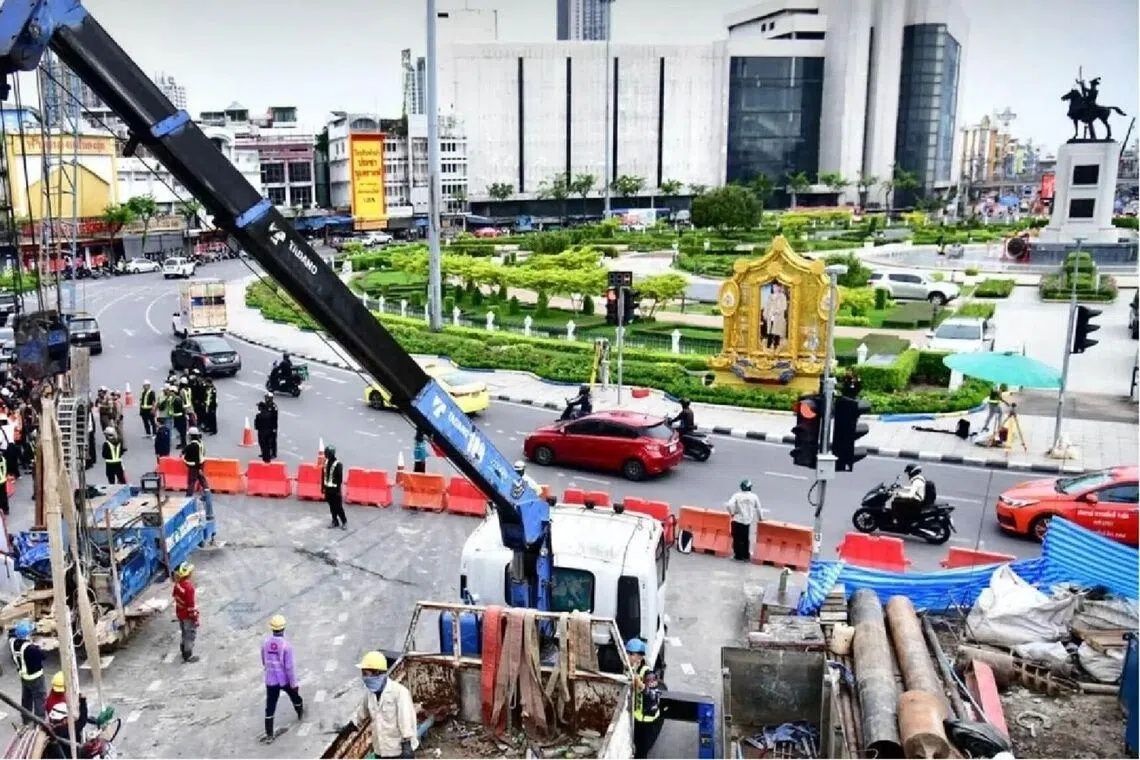
An emergency evacuation has displaced about 60 residents from three commercial buildings in central Bangkok following the emergence of a subsidence crater near the Wongwian Yai intersection, the latest in a series of construction-related underground emergencies threatening the capital's aging infrastructure. The incident stems from water seepage that penetrated a drainage sump at the lowest point of the southern Purple Line construction tunnel, allowing surrounding soil to migrate into the underground space and destabilizing the ground above. Authorities have cordoned off approximately 200 metres of Prajadhipok Road between Ban Khaek intersection and Wongwian Yai as a precautionary measure, with displaced residents transferred to temporary hotel accommodation expected to last around one week.
The emergency response mobilized multiple layers of Bangkok's administrative and emergency apparatus, underscoring the seriousness of the structural threat. Bangkok Governor Chadchart Sittipunt personally inspected the affected zone on July 9 alongside deputy governor Wisanu Subsompon and deputy permanent secretary Kanokwan Iamlim. The governor's physical presence at the site signaled the city administration's commitment to transparent crisis management, particularly important given public anxiety over successive construction failures that have plagued the capital's infrastructure development. The initial assessment indicated that water levels and subsidence rates had begun stabilizing by the inspection date, though officials warned that round-the-clock monitoring would continue indefinitely until full structural integrity was confirmed.
The Mass Rapid Transit Authority of Thailand's contractor has assumed financial responsibility for all accommodation, compensation and ancillary expenses related to the evacuation, establishing a clear contractual liability framework. This arrangement reflects regulatory lessons learned from previous construction incidents where cost allocation disputes delayed recovery efforts. Residents will not be permitted to return until engineers complete comprehensive structural assessments of both the evacuated buildings and surrounding infrastructure. The staggered recovery process acknowledges that subsidence events often trigger secondary failures in adjacent structures as soil properties shift and stress distributions change within underground networks.
Technological monitoring systems have been deployed to provide real-time early warning of any further movement. The Department of Disaster Prevention and Mitigation installed two Rescue Guardian units on buildings within 30 metres of visible road cracks, instruments capable of measuring tilting and structural displacement and automatically alerting authorities to abnormal conditions. This technological layer complements traditional engineering inspections, creating a hybrid surveillance approach that should theoretically detect developing crises before they escalate into catastrophic failures. Engineers from Thailand's national Urban Search and Rescue team have joined the technical assessment, bringing specialized expertise in evaluating structural safety under non-standard conditions.
The traffic disruption compounds an already congested transportation corridor that serves as a major arterial link through central Bangkok. All outbound lanes of Prajadhipok Road spanning 200 metres have been closed entirely to minimize vibrations that could further destabilize surrounding soil or compromise nearby structures. Two inbound lanes have been temporarily converted to handle outbound traffic, creating a makeshift capacity reduction of approximately 50 percent in this direction. Motorists have been diverted to alternative routes including Itsaraphap, Lat Ya and Somdet Chao Phraya roads, though these secondary routes lack sufficient capacity for sustained high-volume diversion and experience regular congestion during peak hours.
The location's proximity to major educational institutions amplifies the socioeconomic impact beyond immediate residents and motorists. Suankularb Wittayalai School and Suksanari School both draw students and parent vehicles from across metropolitan Bangkok, meaning the road closure disrupts daily transportation patterns for several thousand families. Governor Chadchart has indicated that Bangkok may implement shuttle services modelled on arrangements deployed following the earlier subsidence incident near Vajira Hospital, potentially absorbing educational transportation demand through public transit to reduce private vehicle volumes in the affected zone. Such interventions require coordination between the city administration, education authorities and school administrations, making them logistically complex despite their apparent simplicity.
This incident represents the second major subsidence event affecting the Purple Line project, raising questions about whether systemic construction management weaknesses extend across the entire corridor or remain localized to specific contract sections. The current emergency site near Wongwian Yai falls under a different contractor than the earlier Vajira Hospital collapse, suggesting that contractor-specific practices may not fully explain the pattern. Alternatively, the Purple Line's routing through densely urbanized areas with high groundwater tables and complex underground utility networks may inherently generate exceptional engineering challenges that standard construction protocols inadequately address. The repetition of failures within the same megaproject invites scrutiny of design assumptions, environmental impact assessments and contractor vetting processes.
The coordination structure established to manage the emergency reveals how Bangkok's disaster response architecture functions when multiple agencies must cooperate under time pressure. A forward command centre has been established near the subsidence point to orchestrate activities among the Bangkok Metropolitan Administration, the Mass Rapid Transit Authority, the project contractor, district authorities, police and emergency response teams. This centralized coordination theoretically prevents duplicative efforts and communication failures, though such command structures frequently suffer from unclear authority divisions and inter-agency rivalries that hamper decision-making. The deployment of generators, lighting equipment and specialized machinery supporting overnight operations suggests authorities are prepared for extended crisis management rather than quick resolution.
The immediate remedial priority focuses on sealing the water leak that initiated the subsidence cascade and preventing additional soil migration into the tunnel. Continuous monitoring instruments track road surface elevation, soil displacement rates, water seepage volumes and building condition indicators, generating data streams that inform decisions about when restrictions can be safely relaxed. The transition from emergency response to recovery phases will likely extend beyond the initially projected one-week accommodation period, as engineering conservatism typically mandates extended observation periods before declaring sites safe for reoccupancy. Residents and businesses displaced by the evacuation face significant financial and psychological disruption regardless of whether the underlying structural threat ultimately proves manageable.
The broader implications for Bangkok's infrastructure development trajectory are substantial. Each construction incident erodes public confidence in megaproject delivery and raises insurance costs and contractor overhead for future projects, ultimately increasing project expenses regardless of technical adequacy. Political accountability for subsidence incidents falls primarily on the governor's administration even though construction execution rests with contractors and the Mass Rapid Transit Authority. This accountability structure creates pressure for responsive crisis management but can also incentivize operational transparency that reveals system vulnerabilities previously hidden from public awareness. The Wongwian Yai incident will likely trigger enhanced oversight mechanisms for Purple Line construction and potentially generate procedural revisions affecting other major Bangkok infrastructure projects currently under development.

