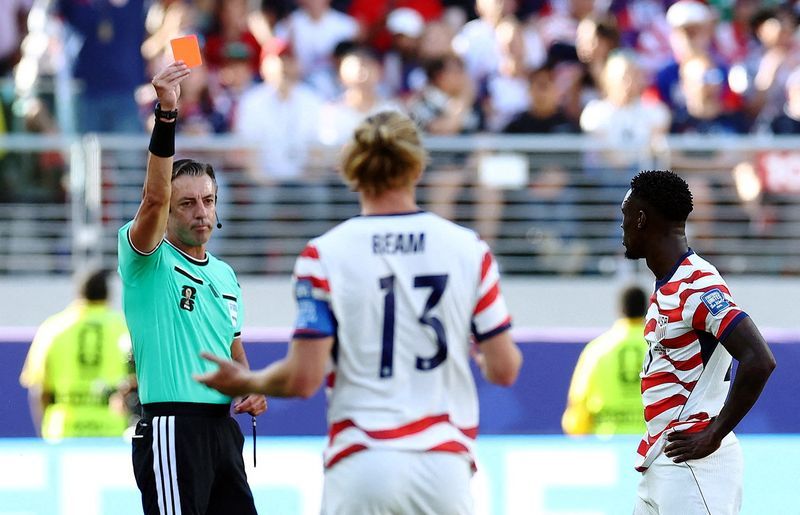
The reversal of Folarin Balogun's World Cup red card suspension has triggered alarm among senior figures in English football, who fear the episode could permanently damage public trust in officiating and disciplinary processes. Howard Webb, the Premier League's refereeing chief, and Richard Masters, the league's chief executive, have both warned that FIFA's handling of the American forward's case—which involved intervention by U.S. President Donald Trump—creates dangerous precedents that extend far beyond the global tournament and into the domestic season beginning this week.
The Balogun situation has become one of the most divisive episodes in recent football history, largely because of the transparency issues surrounding FIFA's decision-making. Webb, who led officials through the 2010 World Cup final, expressed particular disquiet about how the process unfolded rather than the original on-field decision itself. The fact that political pressure played a documented role in overturning the suspension—something FIFA subsequently acknowledged—has crystallized concerns about the vulnerability of football's governance structures to external influence. What troubles Webb most is not the debate over whether the red card should have been given, but rather how the subsequent reversal was handled through a mechanism that appeared improvised rather than established protocol.
The deeper anxiety among English football administrators centres on how this incident will ripple through the sport's ecosystem. In an era where social media amplifies every controversial decision, the Balogun affair provides ammunition to those inclined to suspect corruption or bias in officiating. Webb articulated this concern explicitly, noting that fans already tend to interpret disputed decisions through a lens of suspicion rather than accepting the professional judgement involved. When a high-profile international case demonstrates that suspensions can be overturned through political channels, it inevitably fuels conspiracy theories about how decisions are really made at all levels of the game.
The timing of this controversy is particularly problematic for the Premier League, which is entering a new season with heightened scrutiny on refereeing standards. Every contentious call will now be examined not merely for its technical correctness but through the prism of whether external pressure might have influenced the decision. Webb acknowledged that the World Cup fallout would inevitably carry momentum into domestic competition, even if officials themselves maintain absolute integrity. The erosion of faith in the system—rather than actual corruption—represents the genuine threat to football's credibility.
Masters took a different angle, lamenting that the global conversation around the World Cup has been hijacked by off-field controversies when it should celebrate exceptional football and athletic performances. He highlighted Spain's dominant tournament display and England's agonizing semi-final defeat as the narratives that deserved prominence. Instead, the Balogun situation has monopolized attention, shifting focus from competitive merit to administrative dysfunction. This represents a significant loss for football as a sport, as the quality of play and human drama take backseat to institutional failures.
Criticism of FIFA's disciplinary framework has also emerged from the Balogun case, with Masters pointing out that the world governing body's regulations lack mechanisms available in most domestic competitions to review and overturn dismissals. Unlike the Premier League and other established leagues that have formal appeal processes, FIFA apparently lacked a standard procedure for reconsidering red cards—or at minimum, exercised extraordinary latitude in this instance. This structural weakness not only enabled the Balogun reversal but also allowed it to appear ad hoc and politically motivated rather than rules-based and principled.
The episode arrives as the Premier League implements significant new officiating protocols designed to accelerate play and reduce time-wasting. Webb indicated that referees will adopt a lower threshold for penalizing offences throughout the season, meaning fewer warnings and more actual punishment of fouls. This aggressive enforcement stance requires that officials command absolute respect and that their decisions are perceived as impartial and technically sound. The Balogun controversy undermines both conditions, as it casts doubt on whether decisions at the highest level are truly made on sporting grounds or whether external pressure can alter outcomes.
What particularly concerns Webb is not merely that a single decision was overturned, but that the method used to overturn it opens conceptual space for questioning officials' integrity across all competitions. When people observe that political intervention can influence FIFA's judgment, they naturally begin to wonder whether less visible forms of pressure might similarly affect other high-stakes decisions. This reasoning, while not based on evidence according to Webb's professional experience, becomes psychologically compelling to casual observers who encounter it repeatedly on social media platforms.
The Premier League's officials recognize that the coming season will require them to execute their duties with exceptional clarity and consistency, precisely to counteract the damage inflicted by the World Cup affair. Every marginal decision will be dissected and contextualized within the broader narrative of whether football's establishment can be trusted to police itself fairly. Webb's assertion that controversial decisions are increasingly portrayed as corrupt reflects a fundamental challenge facing modern football: how to maintain institutional credibility when technological capabilities for scrutiny exceed the transparency of decision-making processes.
As the new season commences with fresh laws designed to enhance the sport's spectacle, the refereeing establishment faces an ironic challenge. The very mechanisms intended to improve the game—stricter enforcement, less tolerance for gamesmanship, and more visible penalties—will themselves come under heightened suspicion because of lingering questions about the fairness of FIFA's disciplinary systems. Webb and Masters have signaled that restoring public confidence in officiating will require not just correct decisions but demonstrable adherence to transparent, consistent processes that cannot be influenced by political or external pressure. The Balogun case has set a high bar for proving that football's institutional structures are genuinely devoted to sporting integrity rather than other considerations.

