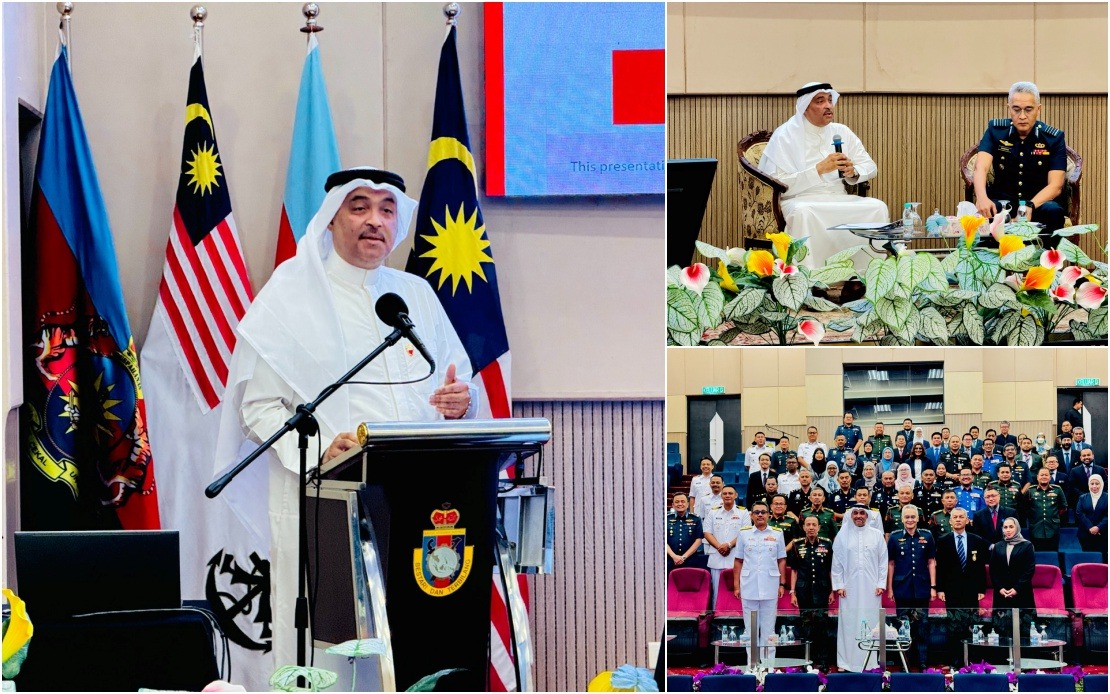
The relationship between Bahrain and Malaysia is entering a new phase of strategic depth, driven by genuine commitment from both nations' leadership to expand cooperation across multiple domains. During a significant address at the National Resilience College in Putrajaya, Bahrain's Ambassador Dr Waleed Khalifa Al Manea outlined the trajectory of bilateral ties, emphasizing how the two countries are working in concert to address shared challenges while building institutional frameworks for sustained partnership.
At the foundation of this strengthening relationship lies the personal rapport between His Majesty Sultan Ibrahim, King of Malaysia, and His Majesty King Hamad bin Isa Al Khalifa of Bahrain, complemented by the active engagement of their respective prime ministers. Malaysia's Prime Minister Datuk Seri Anwar Ibrahim and Bahrain's Crown Prince and Prime Minister His Royal Highness Prince Salman bin Hamad Al Khalifa have championed initiatives that translate political goodwill into tangible cooperative mechanisms. This leadership-level commitment provides the essential foundation upon which bilateral institutions and practical collaborations can develop with stability and purpose.
One striking manifestation of this partnership's maturation is Malaysia's hosting of the 2026 Formula 1 Gulf Air Bahrain Grand Prix, an arrangement that Ambassador Al Manea characterized as a potent symbol of the evolving relationship. Beyond its sporting dimensions, the event represents diplomatic recognition and the embedding of mutual interests within high-profile international platforms. For Malaysia, securing a Formula 1 fixture not only elevates its global sporting profile but also demonstrates its capacity to engage major international sporting bodies and their stakeholders, including Gulf nations with significant economic influence. For Bahrain, the arrangement affirms its capacity to maintain prestigious international partnerships despite regional complexities.
The bilateral agenda extends significantly into security and maritime affairs, domains of particular relevance to Southeast Asia and Malaysia's strategic interests. Ambassador Al Manea's presentation underscored Bahrain's comprehensive approach to regional security, which integrates military readiness with diplomatic engagement and civilian protection protocols. This framework has become increasingly pertinent given the evolving threat landscape in West Asia, where tensions over maritime routes and infrastructure protection have global ramifications. Malaysia, as a key Southeast Asian economy dependent on freedom of navigation through critical international waterways, shares Bahrain's vested interest in maintaining secure passage for commercial and naval traffic.
The tensions arising from Iranian actions targeting Gulf Cooperation Council member states have assumed dimensions that extend well beyond the immediate region. Ambassador Al Manea specifically referenced attacks on civilians, vital infrastructure and maritime navigation channels, emphasizing how these incidents carry consequences for ASEAN nations and Malaysia. The targeting of shipping routes and energy infrastructure affects global supply chains, energy markets and insurance costs that directly impact Malaysian businesses and consumers. By engaging with Bahrain on these issues, Malaysia positions itself as a stakeholder in Gulf security architecture and demonstrates its commitment to defending international maritime norms that underpin global commerce.
Malaysia's co-sponsorship of UN Security Council Resolution 2817 represents a concrete expression of this engagement. The resolution's emphasis on respecting state sovereignty, protecting civilians and halting attacks aligned with Malaysia's own strategic interests and values. Through this action, Malaysia signalled that Southeast Asian nations view destabilization in the Gulf not as a distant concern but as a matter affecting regional and global stability. The co-sponsorship also reflected Malaysia's diplomatic sophistication in balancing its own regional relationships while contributing to international peace-building efforts through multilateral mechanisms.
Bahrain's presidency of the UN Security Council in April provided an opportunity to advance international coordination on maritime security and freedom of navigation. During this tenure, the kingdom leveraged its institutional position to drive initiatives protecting critical infrastructure and ensuring safe passage for international shipping. These efforts resonate strongly with Malaysia, which relies on uninterrupted maritime trade and maintains significant economic interests in Gulf waters through its shipping, trading and energy sectors. The coordination between Bahrain and Malaysia in multilateral forums reflects a deepening strategic alignment that transcends traditional bilateral exchanges.
The broader context of this partnership involves Malaysia's careful navigation of its relationships within the Muslim-majority world while maintaining pragmatic engagement with diverse regional actors. Bahrain, as a significant Gulf power with strong ties to Western nations and regional security arrangements, offers Malaysia access to governance expertise, security insights and diplomatic channels that enhance Malaysian influence and understanding. Conversely, Malaysia provides Bahrain with insights into Southeast Asian dynamics, Islamic world perspectives and development models that have succeeded in multicultural societies. This mutual exchange of strategic knowledge strengthens both nations' capacity to address contemporary governance and security challenges.
The attendance at Ambassador Al Manea's lecture by senior Malaysian defence and security officials, including the Commandant of the National Resilience College and representatives from the Malaysian Armed Forces, Royal Malaysia Police and Maritime Enforcement Agency, underscores institutional buy-in for deepened engagement with Bahrain. Such high-level participation signals that Malaysia's security establishment views Bahrain relations as integral to national defence planning and strategy formulation. The inclusion of parliamentarians and academics further indicates that this partnership is intended to permeate across civilian, military and scholarly spheres, creating multiple channels for sustained dialogue and cooperation.
Moving forward, this strategic partnership appears positioned to expand into areas beyond traditional security cooperation. Trade, investment, educational exchanges and cultural initiatives represent natural extensions of the current trajectory. For Malaysia, deepening ties with Bahrain provides access to Gulf markets and investment opportunities while positioning the nation as a bridge between Southeast Asia and the Middle East. For Bahrain, engagement with Malaysia strengthens its connections to the dynamic and expanding economies of ASEAN, a region of growing strategic significance. Both nations recognize that in an increasingly multipolar world, sustained bilateral partnerships built on shared interests and mutual respect provide essential anchors for stability and prosperity.

