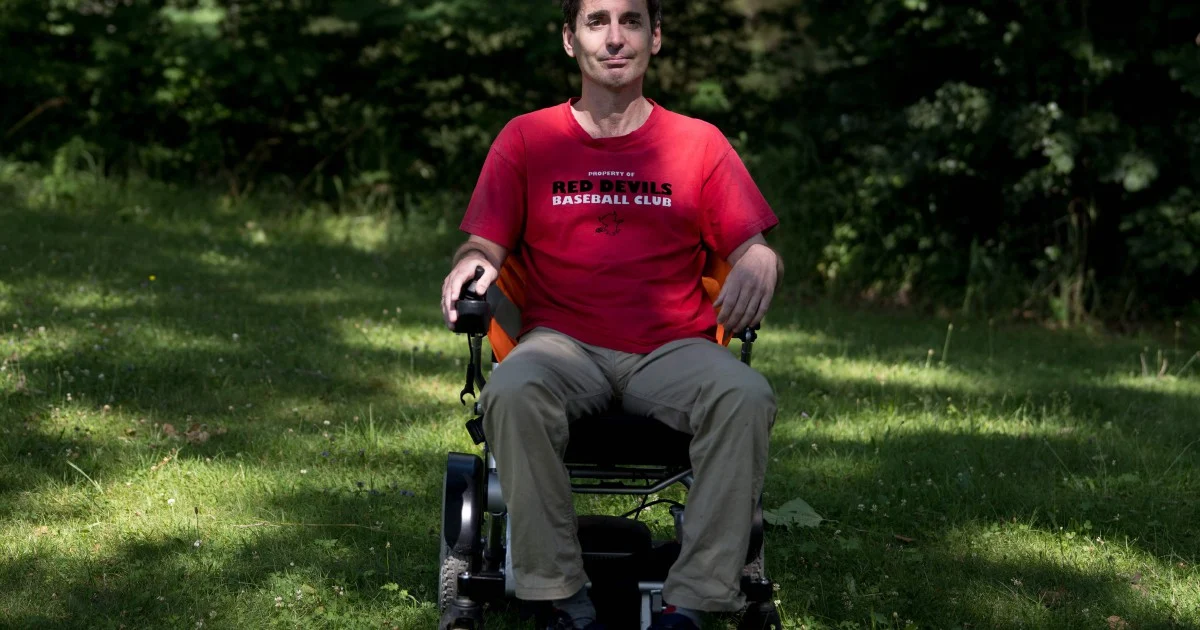
Mex Muellner, an Austrian wheelchair user, is mounting a legal challenge against his country's climate policy at the European Court of Human Rights, claiming that the government's inadequate response to global warming disproportionately endangers people with disabilities. His case represents a novel approach to holding governments accountable for climate inaction through human rights frameworks rather than environmental law alone, raising significant questions about state obligations to protect vulnerable populations from climate-related harms.
Muellner's decision to pursue legal action crystallized during recent heatwaves that rendered him effectively immobilized in his wheelchair. The extreme temperatures made it physically hazardous for him to leave his residence, underscoring how climate impacts fall unequally across society. For people with mobility impairments, heat waves create compounding challenges: the inability to self-regulate temperature through movement, reduced access to cooling centres designed without accessibility in mind, and increased dependence on caregivers whose own circumstances may limit their availability. His experience illuminates a dimension of climate justice that receives insufficient attention in both policy and public discourse.
The case hinges on whether Austria's climate targets and mitigation efforts satisfy its obligations under the European Convention on Human Rights, particularly the right to life and the right to private and family life. By framing climate change as a human rights issue rather than purely an environmental or regulatory matter, Muellner's legal strategy challenges courts to recognize that inadequate climate governance can constitute a violation of fundamental rights. This approach has gained traction internationally, with similar cases emerging in Germany, Belgium, and Switzerland, suggesting a broader judicial reckoning with state climate responsibility may be underway.
Austria, despite its reputation for environmental consciousness and renewable energy investment, has faced criticism from climate advocates for not meeting European Union emissions reduction targets and for maintaining policies that some argue contradict its climate commitments. The country generates a significant portion of its electricity from hydroelectric and renewable sources, yet its transport sector and building infrastructure remain heavily dependent on fossil fuels. Muellner's lawsuit effectively demands that Vienna reconcile the gap between its stated climate ambitions and measurable implementation, particularly regarding how those gaps affect citizens most vulnerable to climate impacts.
The implications for Southeast Asia, including Malaysia, are substantial. If European courts recognize climate inaction as a human rights violation, it establishes a precedent that could embolden similar litigation in other jurisdictions. Malaysia, as a tropical nation facing intensifying heat stress, flooding, and other climate impacts, could see increased legal challenges against government and corporate climate policies. Disabled individuals and other vulnerable groups may leverage human rights frameworks to compel stronger climate action, especially given Malaysia's existing climate commitments under the Paris Agreement and its own human rights institutions.
Disability rights experts emphasize that people with disabilities often face the severest consequences of climate-related disasters and environmental degradation, yet remain largely absent from climate policy discussions. Heat-sensitive conditions, mobility impairments, and chronic health issues are exacerbated by rising temperatures and extreme weather events. Muellner's case elevates disability rights to the centre of climate discourse, arguing implicitly that any credible climate policy must account for the needs and protection of disabled citizens. This intersectional perspective challenges governments to design climate adaptation and mitigation strategies that actively benefit vulnerable populations rather than treating them as afterthoughts.
The European Court of Human Rights has increasingly recognized environmental conditions as relevant to human rights protections, though it has historically been reluctant to accept broad climate cases. Muellner's strategy of personalizing the climate crisis through his own experience—demonstrating concrete, immediate harms rather than abstract future risks—may prove more compelling to judges accustomed to case-specific rather than systemic reasoning. His narrative of being trapped indoors during deadly heat provides visceral evidence that climate inaction produces tangible rights violations today, not merely hypothetical future damage.
Austria's response to the lawsuit will likely emphasize its substantial investments in renewable energy, its participation in EU climate frameworks, and recent policy initiatives aimed at emissions reduction. The government may argue that climate change is a global problem requiring international cooperation, and that Austria alone cannot solve it through domestic policy. However, Muellner's lawyers will counter that such arguments amount to an abdication of responsibility: each state must nonetheless do its part, and each state bears direct responsibility to protect its own citizens from foreseeable harms that government action could mitigate.
The broader significance of this case extends beyond Austria or even Europe. It signals a potential shift in how climate accountability operates globally. Rather than relying solely on international climate negotiations, environmental treaties, or national legislative action, vulnerable individuals and groups may increasingly turn to courts to compel climate protection as a matter of human rights. For Malaysia and other developing nations grappling with climate impacts while managing limited resources, this trend could reshape political expectations and legal obligations.
Muellner's willingness to transform his personal suffering during a heatwave into a test case demonstrates how individual rights can become vehicles for systemic change. His lawsuit essentially asks: if a government recognizes that climate change poses risks to human life and dignity, yet fails to adopt adequate protections, has it violated the rights of those it has failed to protect? For disability communities and climate-vulnerable populations worldwide, the court's answer will carry enormous weight.

