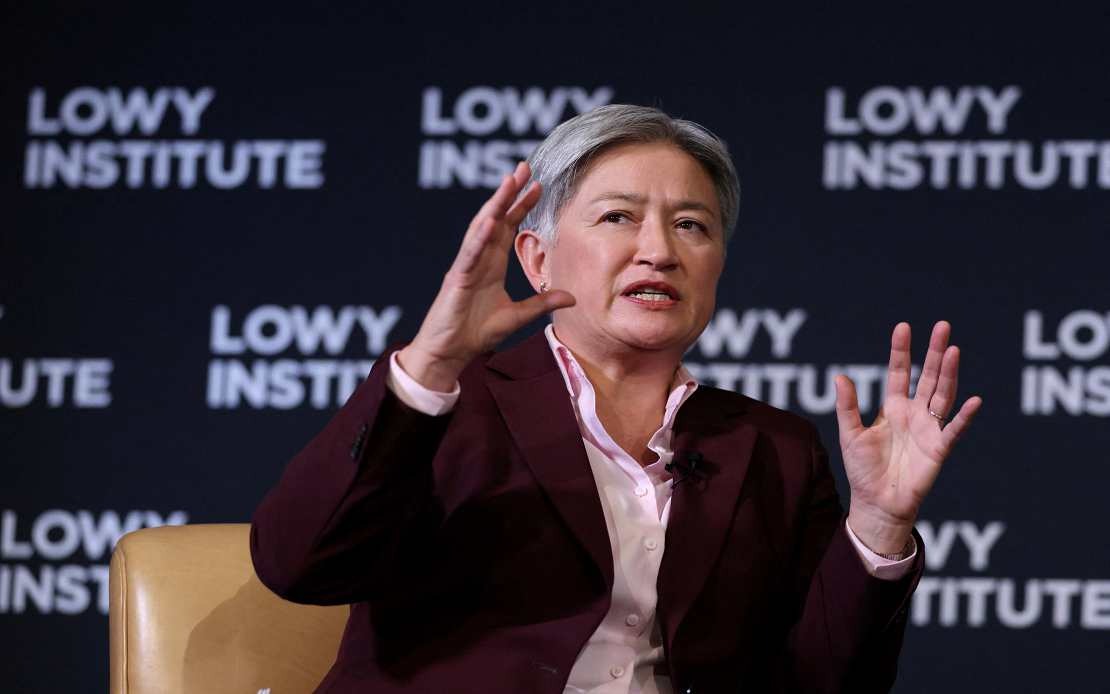
Australia's Foreign Affairs Minister Penny Wong has issued a stark warning that abandoning the country's multicultural fabric in favour of a monocultural society would leave it economically isolated and strategically vulnerable. Speaking at the Lowy Institute in Sydney on Friday, Wong directly countered growing political pressure from populist movements seeking to restrict immigration and retreat from international engagement. Her intervention comes as Australia grapples with shifting public sentiment on migration and rising support for hardline nationalist policies that could reshape the country's diplomatic and economic positioning in the Indo-Pacific region.
Wong's remarks were a deliberate response to Senator Pauline Hanson, whose One Nation party has emerged as an increasingly influential force in Australian politics. In June, Hanson articulated a platform centred on creating a monocultural Australian identity, a call that Wong characterised as a "melancholic fantasy" that misunderstands the nation's historical foundations and contemporary strengths. The foreign minister stressed that Australia has functioned as a multicultural society throughout its modern history, not as an exception to some imagined homogeneous ideal but as the essential architecture of its prosperity.
The substance of Wong's critique extends beyond cultural sentiment to encompass practical geopolitical and economic consequences. She argued that pursuing monoculturalism would require Australia to "curtail our choices and to cut off our connections," deliberately isolating the nation from trading partners, international coalitions, and sources of innovation and talent. This framing links immigration policy directly to Australia's capacity to maintain its strategic partnerships, particularly crucial given regional competition involving China and the importance of alliances in the Indo-Pacific. For Malaysia and other Southeast Asian neighbours, Australia's orientation towards integration or insularity carries implications for regional stability, investment flows, and the rules-based international order.
The electoral backdrop for this debate reveals significant shifts in Australian public opinion that pose challenges for the centre-left Labour government. According to YouGov Australia polling conducted in July, One Nation's support has surged to 26 per cent of voters intending to vote at the next general election, a dramatic increase from the 6.4 per cent of votes the party secured at the 2025 election. This represents more than a fourfold expansion of electoral backing in a single year, suggesting that anti-immigration sentiment and nationalist messaging are resonating with a substantial segment of the Australian electorate.
The same polling data indicates erosion across the established major parties. The governing Labour Party's support has contracted from 34.5 per cent at the 2025 election to 28 per cent, whilst the conservative Coalition has experienced an even sharper decline, dropping from 31.8 per cent to 20 per cent. These movements suggest that traditional party structures are fragmenting as voters gravitate toward One Nation as a vehicle for expressing dissatisfaction with mainstream political responses to migration, economic pressures, and cultural change. The 2028 general election looms as a potential inflection point where these trends could translate into significant parliamentary shifts.
One Nation's policy platform extends well beyond immigration restriction to encompass a comprehensive reorientation of Australia's international posture. The party has pledged to reduce foreign aid, withdraw from multilateral institutions, and fundamentally alter Australia's approach to global engagement if elected to power. Such measures would represent a dramatic departure from decades of Australian strategic doctrine and could reshape relationships throughout the region. For Southeast Asian nations including Malaysia, which benefit from Australian development assistance, security cooperation, and participation in regional forums, these proposed changes carry material consequences.
Public sentiment on immigration appears to be shifting in directions that One Nation has successfully channelled into political support. The Lowy Institute's annual poll for 2026, released in June, found that 55 per cent of Australians believe the total number of migrants entering the country is excessive, an increase from 53 per cent in 2025 and 48 per cent in 2024. This steady upward trajectory in restrictionist sentiment suggests that concerns about immigration levels have intensified rather than plateaued, providing fertile ground for One Nation's advocacy and potentially constraining the political space for pro-immigration arguments even among more moderate political actors.
The disconnect between Wong's defence of multiculturalism and the apparent public mood captures a fundamental debate within contemporary Australian politics. The foreign minister's argument rests on demonstrating that multicultural integration yields strategic and economic advantages, yet this message appears to be losing purchase among voters who perceive immigration as a source of cultural disruption or economic competition. The challenge facing Wong and the Labour government involves reframing the multiculturalism debate in ways that acknowledge public concerns about integration, housing pressure, and labour market impacts whilst maintaining openness to immigration and international engagement.
For regional observers in Southeast Asia, including Malaysian policymakers and business leaders, the trajectory of Australian politics carries significance that extends beyond domestic concerns. A One Nation-led government would likely reorient Australia's engagement with the region in unpredictable ways, potentially reducing aid contributions that support regional development, withdrawing from multilateral forums where consensus-building occurs, and adopting more transactional approaches to bilateral relationships. The current debate between Wong and One Nation thus represents a crucial juncture in determining whether Australia will continue as an outward-looking regional participant or pivot toward strategic isolation.

