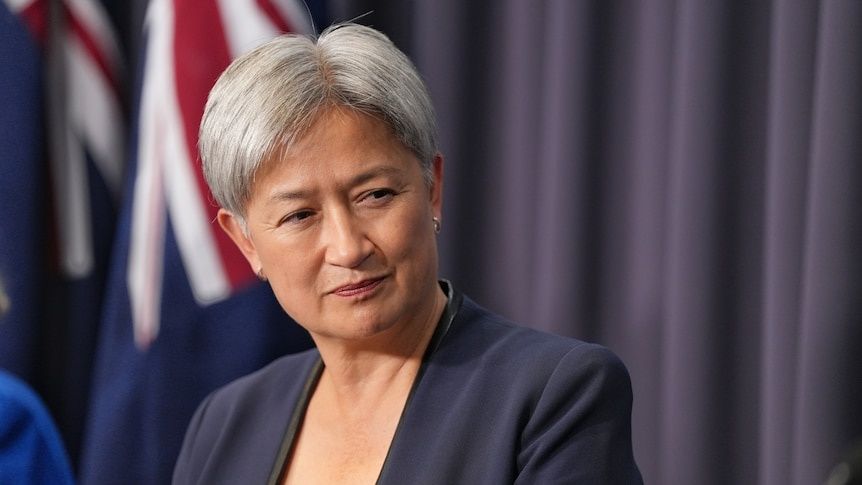
Australia's Foreign Minister Penny Wong is mounting a vigorous defence of multiculturalism, positioning it as foundational to the nation's prosperity and global standing in a direct challenge to the ascendant far-right One Nation party. In a major speech to the Lowy Institute in Sydney on Friday, Wong will articulate a vision of Australia as fundamentally diverse, arguing that the country's strength lies in its ability to embrace people from diverse backgrounds. The Malaysian-born Wong, who made history as the first Asian-Australian to reach cabinet level, brings personal gravitas to an argument that has become increasingly contested in Australian politics as One Nation consolidates support.
Wong's central thesis rests on historical fact: roughly half of all Australians were either born overseas or have at least one parent born outside the country, according to census data. This demographic reality underpins her assertion that "Multicultural Australia is the only Australia that has ever existed." Rather than treating multiculturalism as a recent experiment or optional policy choice, Wong reframes it as the authentic continuity of Australian society across generations. This framing is significant because it shifts the debate from whether Australia should embrace diversity to whether Australia can afford to abandon the diversity that has always defined it.
The political context shaping Wong's intervention cannot be understated. Pauline Hanson's One Nation party has experienced a remarkable surge in popularity this year, emerging as the country's most favoured party according to polling data. Political analysts suggest that One Nation could occupy a kingmaker position following the 2028 federal election, potentially wielding disproportionate influence over government formation and policy priorities. Hanson herself has long drawn international comparisons to US President Donald Trump and French National Rally leader Marine Le Pen, reflecting her populist, anti-establishment positioning. Her recent rhetoric explicitly calls for Australia to adopt a "monoculture" framework and to fundamentally reorient the country's international relationships, including reducing foreign aid and reassessing participation in multilateral organisations.
One Nation's messaging has grown increasingly provocative. Hanson created substantial controversy earlier this year by invoking Australia's "White Australia" policy, a historical framework that explicitly restricted immigration based on race and operated through much of the twentieth century until its dismantling in the 1970s. Her willingness to reference this discredited policy as a model suggests the boundaries of acceptable political discourse are shifting. Wong's speech directly confronts this rhetorical escalation by warning against "external and internal forces" that seek to divide the Australian community, implicitly framing One Nation's appeals as destabilizing rather than protective.
Wong's argument extends beyond domestic politics into strategic and economic dimensions. She contends that Australia's capacity to navigate the complex international environment depends fundamentally on maintaining diverse partnerships and connections. A monoculture approach, she suggests, would voluntarily diminish Australia's strategic options at precisely the moment when the country faces mounting pressure from larger powers. The Foreign Minister warns that "military power, economic coercion, and control of the materials and technologies the world depends on, are used to constrain choices" by rival powers. In this context, abandoning international relationships and retreating from multilateral engagement would leave Australia more vulnerable, not more secure.
The economic and business case for multiculturalism forms another pillar of Wong's response. Her speech will highlight the considerable contributions made by refugees and migrant communities to Australian business creation and sporting achievement. These concrete examples serve to counter One Nation narratives that portray immigration primarily through the lens of competition for jobs and resources. By showcasing success stories spanning entrepreneurship and national sporting pride, Wong attempts to reframe immigration from a zero-sum threat narrative to one emphasising mutual benefit and national achievement.
The Australian Labor government has acknowledged the political pressures driving One Nation's rise. Prime Minister Anthony Albanese has conceded that "legitimate concerns" about economic stress and housing affordability are fuelling support for far-right politics. This represents a strategic attempt to separate legitimate grievances from the divisive political responses being offered by One Nation. Albanese, whose Italian surname itself embodies Australian multiculturalism, has signalled that the government will adjust immigration policy settings while maintaining commitments to diversity. Immigration intake levels are already declining from recent peaks, though the government is framing this adjustment as a measured response to capacity constraints rather than capitulation to nativist demands.
The government's approach reflects recognition that simply defending multiculturalism on principle may be insufficient to counter One Nation's political momentum. Instead, Labor is attempting to navigate between acknowledging economic anxieties and maintaining the multicultural framework. Albanese has explicitly committed to reducing immigration numbers "without vilifying people, without trying to divide the community, but bringing people together in the national interest." This language suggests an effort to prevent the debate from becoming purely about reducing immigration levels and instead positioning such adjustments within a broader narrative of social cohesion and shared purpose.
For Southeast Asian observers, the trajectory of Australian politics carries significant implications. Malaysia, as a regional middle power with substantial people-to-people connections to Australia, has a direct interest in the health of Australian multiculturalism and pro-engagement international orientation. A shift toward nationalist isolationism in Australia could reverberate across regional diplomatic and economic relationships. Malaysian business communities maintain substantial investments in Australia, while educational and cultural exchanges remain vibrant. The rise of One Nation's monoculture rhetoric potentially threatens these established patterns of regional cooperation that have evolved over decades.
The broader strategic significance lies in Wong's articulation of how domestic cohesion relates to international standing. Her argument that diversity strengthens rather than weakens Australia's global position directly challenges One Nation's framing. If Wong and Albanese can successfully reposition the debate to emphasise that multiculturalism serves national security and economic interests, they may arrest One Nation's momentum. However, the difficulty lies in addressing the genuine economic anxieties and distributional concerns that animate support for the far-right without either abandoning multicultural commitments or appearing dismissive of voter concerns. How Australia navigates this tension will significantly shape regional relationships and the character of Indo-Pacific cooperation in the coming decade.

