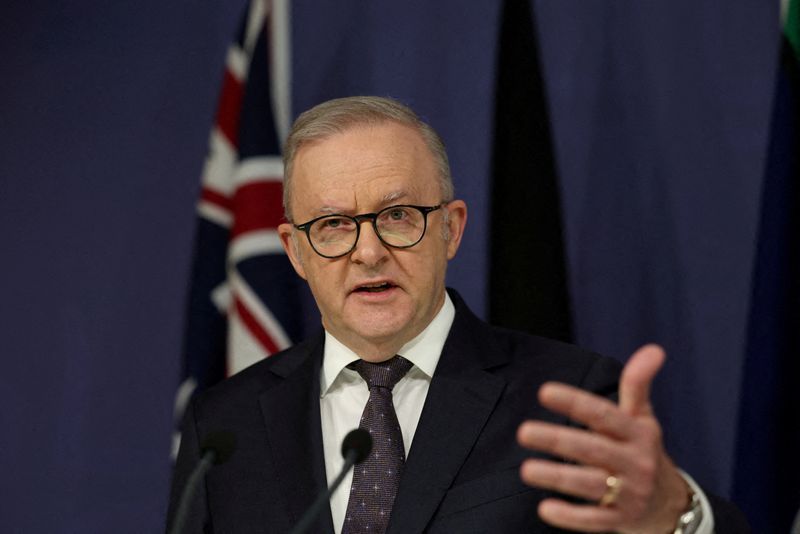
Australia is moving to centralise its artificial intelligence governance by establishing a dedicated Office of AI embedded directly within the Prime Minister and Cabinet's department, signalling a strategic shift toward comprehensive oversight of a technology reshaping economies globally. Prime Minister Anthony Albanese will formally announce this initiative in a major policy address in Sydney, presenting it as a landmark move that positions Australia alongside leading nations grappling with how to harness AI's economic potential while protecting citizens from emerging harms.
The decision reflects growing recognition that fragmented, ad-hoc regulation across different government agencies and industry sectors fails to address the scale and speed of AI's integration into society. Albanese is expected to frame the new office as analogous to how governments historically coordinated responses to transformative technologies. He will draw parallels to aviation regulation in the 1920s and genetic engineering frameworks developed in the 1990s, emphasising that AI demands the same calibrated governmental architecture that enabled those sectors to flourish while operating within safety guardrails.
Currently, Australia lacks dedicated AI legislation and instead relies on a patchwork of existing privacy laws, consumer protection statutes, and a non-binding ethical framework for the sector. This regulatory vacuum has created uncertainty for both businesses seeking to invest in AI infrastructure and regulators concerned about unintended consequences. The new office will consolidate responsibility for developing consistent AI standards, establishing clearer approval pathways, and creating streamlined compliance mechanisms that reduce bureaucratic friction without compromising oversight.
For multinational technology companies and investors evaluating where to establish AI operations in the Asia-Pacific region, regulatory clarity functions as a decisive competitive advantage. By presenting Australia as offering predictable, whole-of-government coordination, policymakers believe the nation can attract significant capital flows and talent. This carries particular weight as competition intensifies across Southeast Asia and beyond, with countries like Singapore and South Korea also racing to position themselves as regional AI hubs.
However, the announcement arrives amid intensifying public concern about AI's disruptive potential. Labour unions and economists have raised alarms about job displacement across white-collar and blue-collar sectors, while environmental advocates point to the massive water and energy demands of data centre expansion required to support AI compute. These infrastructure needs coincide with Australia's ongoing drought crises and energy transition challenges, creating genuine tension between the growth narrative and sustainability imperatives.
Beyond employment and environmental concerns, stakeholders have flagged risks spanning intellectual property infringement, where AI systems are trained on copyrighted material without permission or compensation, to security and safety vulnerabilities as critical systems become increasingly automated. Privacy advocates worry that the voluntary ethics framework has proven insufficient to prevent data misuse or algorithmic bias that disproportionately affects vulnerable populations. A single coordinated office theoretically possesses greater leverage to enforce standards across government agencies and influence corporate behaviour than dispersed departmental efforts.
The timing reflects Australia's broader ambition to establish itself as not merely a consumer of global technology platforms but as a sovereign innovator and infrastructure player in the AI economy. The government has previously signalled interest in attracting major data centre investment, recognising that controlling domestic computing infrastructure conveys strategic advantages in an era when digital capacity translates to geopolitical influence. A clear regulatory framework removes one barrier to these investments materialising.
Regional implications matter considerably for Malaysian policymakers and businesses. As Australian regulation becomes clearer, it may establish de facto standards that multinational enterprises apply across their Asia-Pacific operations, influencing how AI governance evolves in Malaysia, Singapore, and neighbouring markets. Should Australia successfully balance investment attraction with effective safeguards, the model could inform how other countries structure their own AI oversight mechanisms. Conversely, if the office struggles to deliver certainty or is perceived as either too restrictive or insufficiently protective, lessons will circulate rapidly through regional business and regulatory networks.
The establishment of this office also signals that voluntary, industry-led approaches to AI governance have lost credibility with policymakers, even those ideologically inclined toward light-touch regulation. The move reflects a global pattern whereby governments are stepping in where markets have failed to self-regulate or where the stakes—affecting employment, privacy, safety, and environmental sustainability simultaneously—exceed what industry ethics codes can adequately address. This recalibration toward explicit state coordination represents a pivotal moment in how democracies are approaching technological governance.
While Albanese's address will likely focus on investment attraction and regulatory efficiency, the office's actual effectiveness will depend on resourcing, political will across competing ministries, and whether it possesses authority to enforce standards or merely coordinate advisory guidance. The gap between announcement and implementation frequently proves decisive in technology policy. Malaysia and other regional economies will watch closely how Australia translates this office from concept into functioning governance infrastructure, and whether it genuinely delivers the promised balance between fostering innovation and protecting public interest.

