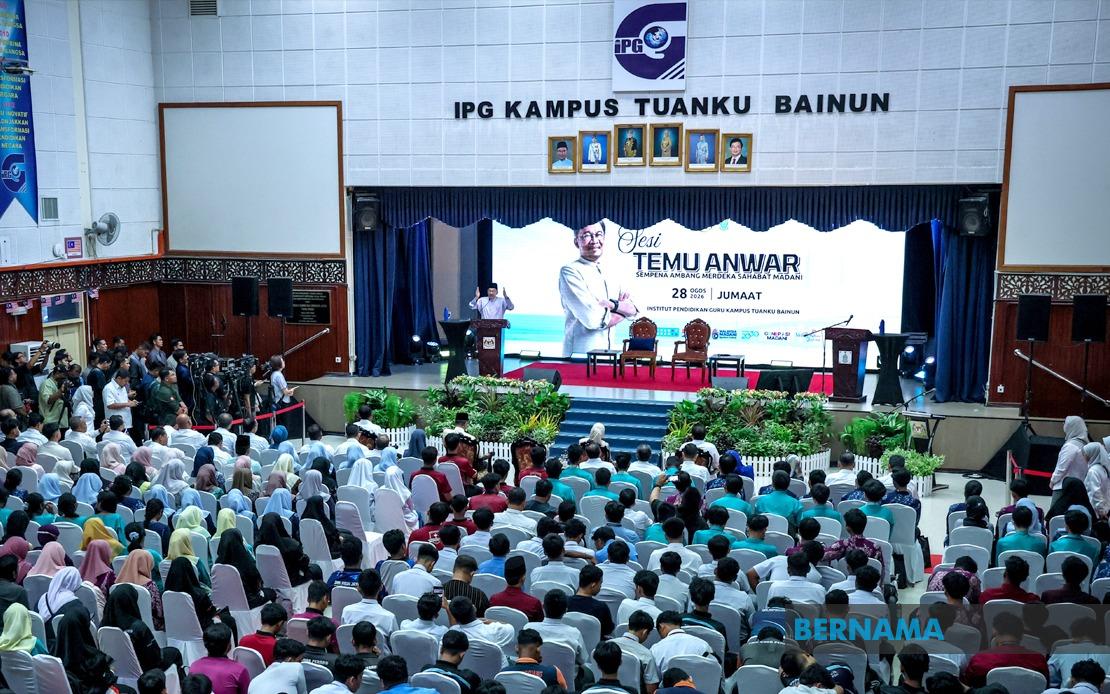
Prime Minister Datuk Seri Anwar Ibrahim has articulated his vision for university students as active participants in public discourse, justifying the government's decision to fully repeal the Universities and University Colleges Act 1971 (AUKU). Speaking during a Temu Anwar session in Bukit Mertajam attended by Education Minister Datuk Seri Fadhlina Sidek, Anwar emphasised that the legislative change represents a fundamental shift in how Malaysia's government views the role of young people in society and their capacity to engage with complex ideas.
The Prime Minister's remarks underscore a deliberate policy departure from restrictions imposed on student activism and expression that have remained in place for more than five decades. Anwar framed the repealing of AUKU as an acknowledgement that young Malaysians who have reached voting age possess sufficient maturity to participate in political and social discourse without governmental censorship. His argument rests on a logical proposition: if the state trusts 18-year-olds with the franchise, it should similarly trust them with the ability to articulate their perspectives on matters affecting their communities and nation.
Central to Anwar's reasoning is his belief that unfettered student expression generates tangible educational benefits beyond the classroom. He contends that permitting young people to voice concerns, engage in substantive debate, and even express views that may ultimately prove incorrect fosters intellectual development in ways that traditional pedagogical methods cannot replicate. This approach aligns with contemporary educational theory emphasising active learning and student agency as cornerstones of tertiary education.
The repeal carries particular significance for Malaysia's political landscape and international standing. For decades, AUKU restrictions prevented students from participating in partisan political activities, organising demonstrations, or making public statements on governance matters. The lifting of these constraints signals the current administration's commitment to democratic pluralism and represents a direct reversal of policies inherited from earlier periods of Malaysian governance. The symbolic weight of this change extends beyond university campuses to broader conversations about democratic maturity and generational trust.
For Malaysian university students themselves, the implications are substantial. Freed from AUKU's prohibitions, students can now organise politically, join political parties, and participate publicly in electoral processes—activities previously constrained by legal penalties. This expansion of permissible conduct potentially transforms campus environments into more vibrant spaces of intellectual contestation and political engagement. However, this newfound freedom also introduces questions about institutional governance and how universities will manage competing interests between academic integrity and political activism.
Anwar's emphasis on critical thinking addresses longstanding concerns among Malaysian educators and civil society observers regarding the development of analytical and evaluative capabilities among younger cohorts. By permitting students to test ideas through open debate—including those ideas that may ultimately prove flawed—the framework theoretically cultivates more rigorous intellectual habits than environments characterised by circumscribed discourse and official orthodoxy. The Prime Minister's framing suggests the government views student error as pedagogically valuable rather than socially dangerous.
The Education Minister's presence at the session underscores institutional alignment within government regarding this policy direction. Fadhlina Sidek's participation signals the Ministry of Education's endorsement of the AUKU repeal and suggests coordinated implementation across Malaysia's higher education system. This administrative cohesion matters considerably given that individual universities must operationalise the legislative change through revised student conduct policies and campus governance frameworks.
Regionally, Malaysia's AUKU repeal positions the country within emerging patterns of democratic reform in Southeast Asia. Other nations in the region have undertaken similar examinations of restrictions on student activism and expression, recognising that knowledge economies increasingly depend upon creative, independently-minded graduates capable of navigating complex problem-solving. The Malaysian initiative thus reflects broader regional recognition that overly restrictive campus environments may disadvantage national competitiveness in contemporary global markets.
However, the practical effects of AUKU's repeal will depend substantially upon implementation details and institutional culture. While legal prohibitions have been removed, universities may continue imposing non-statutory restrictions on student conduct through disciplinary codes, funding conditions, or administrative procedures. The extent to which campuses genuinely embrace the freedom implied by AUKU's abolition will reveal whether this represents transformative reform or merely legislative symbolism. Student organisations and civil society groups will likely monitor implementation carefully.
Anwar's rhetorical framing also reflects evolving thinking about the proper relationship between government and civil society in Malaysia. Rather than positioning student activism as inherently threatening to state stability, his remarks characterise youthful political engagement as normal democratic participation and intellectual development as a public good. This represents a notable deparature from decades of rhetoric portraying student activism with suspicion and framing restrictions as essential to national security and institutional order.
The timing of AUKU's repeal coincides with broader efforts by the current administration to rebuild institutional trust and distance itself from governance practices associated with earlier periods. Positioning the government as champion of youth freedom and critical thinking contributes to this narrative rebranding while simultaneously addressing long-standing criticisms from international observers and domestic civil society advocates who viewed AUKU as emblematic of authoritarian restrictions on fundamental freedoms.
Looking forward, the practical implications for Malaysian campuses remain to be fully realised. Universities will need to develop policies enabling the exercise of these newly-restored freedoms while maintaining academic standards and ensuring campus safety. Meanwhile, student organisations will assess whether this legal change translates into genuine cultural transformation or whether institutional resistance and informal pressures continue constraining expression. The true test of AUKU's repeal lies not in legislative language but in how Malaysian universities embrace—or resist—the intellectual pluralism and democratic engagement it purports to enable.

