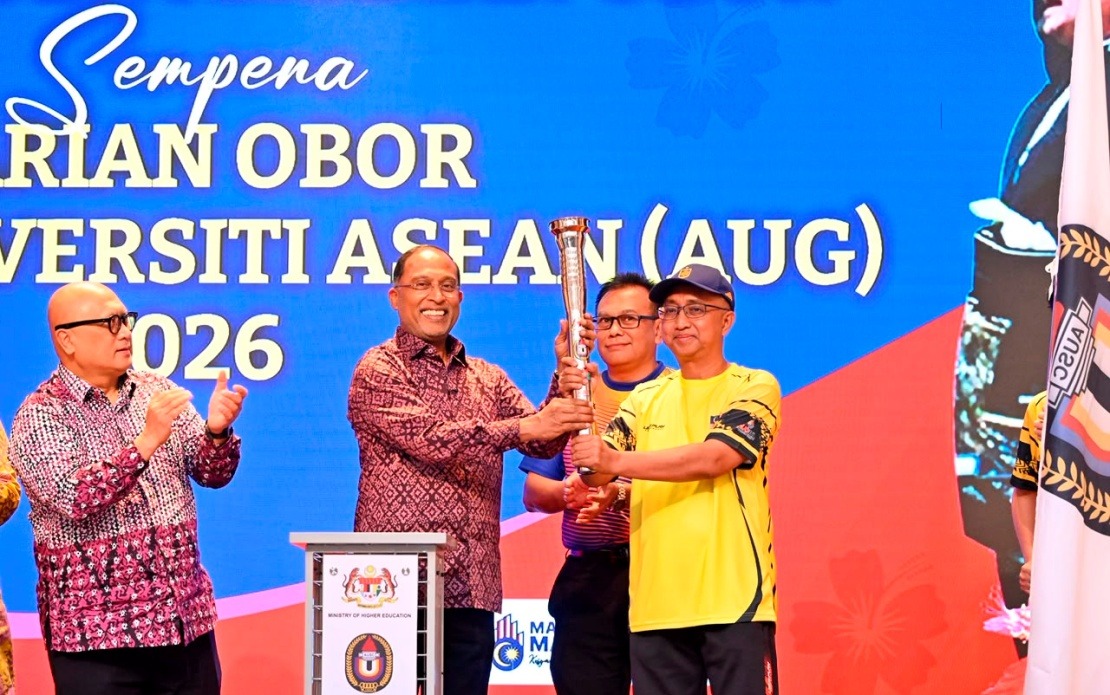
Malaysia formally commenced its preparation for hosting the ASEAN University Games 2026 with the lighting of the ceremonial torch at the Ministry of Higher Education headquarters in Putrajaya, marking a symbolic pivot toward one of Southeast Asia's largest university sports competitions. The torch handover, conducted during the MOHE's monthly assembly, represents more than ceremonial tradition—it signals the beginning of an intensive campaign to marshal Malaysia's competitive resources and organisational capacity for an event that will draw athletes from across the region to compete on home soil.
Higher Education Minister Datuk Seri Dr Zambry Abd Kadir presented the torch to Prof Dr Mohammad Ismail, the chief of Malaysia's contingent and Deputy Vice-Chancellor for Student and Alumni Affairs at Universiti Malaysia Kelantan, cementing the institutional partnership between government and tertiary education in staging the games. Zambry's statement emphasised that Malaysian athletes shoulders a dual responsibility—competing for personal and institutional honour while simultaneously representing the nation's broader aspirations on the ASEAN stage. This framing underscores how university sports have transcended purely athletic dimensions to become expressions of national identity and soft power within the region.
The ceremonial torch run featured four elite Malaysian athletes whose disciplines span multiple competitive domains, each selected to embody excellence within their respective fields. Long jumper Andre Anura Anuar and shot putter Nani Sahirah Maryata, both competing for Universiti Putra Malaysia, joined karate practitioner Thevendran Kaliana Sundram representing Universiti Pertahanan Nasional Malaysia and taekwondo competitor Lee Hui Yee of Sultan Salahuddin Abdul Aziz Shah Polytechnic. The inclusion of athletes from both traditional universities and vocational institutions reflects Malaysia's intent to mobilise its full spectrum of tertiary-level sporting talent.
The torch's inaugural journey traced a symbolic path across Malaysia's institutional landscape, departing from the Ministry of Higher Education grounds, proceeding through the Ministry of Tourism, Arts and Culture before returning to its starting point. This routing embeds the games within broader narratives of cultural significance and national tourism positioning, suggesting that AUG 2026 will function as more than a sporting spectacle—it will serve as a vehicle for showcasing Malaysia's capacity to stage international events and celebrate regional academic excellence. Subsequent stages of the torch relay will traverse Malaysia's premier universities, including Universiti Kebangsaan Malaysia, Universiti Putra Malaysia, Universiti Pertahanan Nasional Malaysia, Universiti Malaya and Universiti Teknologi MARA, ensuring that competitive preparation becomes visible and institutionally embedded across the nation's higher education system.
The scale of AUG 2026 demands organisational sophistication commensurate with Malaysia's aspirations as a regional host. The December 10-19 competition will assemble approximately 4,669 individuals drawn from 11 countries, comprising 2,849 athletes and officials alongside 700 match officials and referees and 920 logistical volunteers. This workforce deployment underscores the infrastructure and human resource coordination required to execute a multi-venue, multi-sport event spanning several weeks—a challenge that tests not only Malaysia's sporting apparatus but also its administrative systems and hospitality capacity.
Nineteen distinct sporting disciplines will feature across the games, distributed among venues in Shah Alam, Kuala Lumpur, Serdang and Bangi, operating under the thematic framework of "HOLISTIC.EXCELLENCE." This thematic positioning suggests an organisational philosophy emphasising comprehensive athletic development alongside academic and personal advancement—a narrative increasingly prevalent in Southeast Asian sports discourse, which positions university competition as formative experience rather than mere athletic contest. The geographic spread of venues across the Klang Valley region and surrounding areas ensures that the games will leave visible imprints on multiple urban and institutional spaces, amplifying their symbolic and infrastructural impact beyond any single location.
Malaysia's hosting role carries particular significance within the ASEAN sporting calendar, positioning the nation as a reliable and capable convener of large-scale regional competitions. For Malaysian universities and athletes, the games represent both opportunity and pressure—the chance to demonstrate competitive capability before regional peers while advancing institutional prestige within ASEAN's academic hierarchy. The torch run serves as the visible inauguration of this process, transforming abstract competition into tangible mobilisation visible to students, institutional leaders, and the broader public.
The involvement of multiple Malaysian universities through the torch relay emphasises that AUG 2026 functions as a collaborative national endeavour rather than an isolated government programme. By directing the torch through institutions that will field competitors, the Ministry creates visible points of connection between ceremonial significance and grassroots athletic preparation. This approach generates institutional investment in the games' success and distributes promotional responsibility across Malaysia's tertiary education system, ensuring that awareness and competitive momentum build through multiple channels rather than relying solely on centralised communication.
For Southeast Asian university athletes, the concentration of competition within Malaysia provides a comparatively accessible venue that reduces travel costs and logistical complexity compared to hosting in more geographically peripheral locations. This accessibility may elevate participation quality and diversity, potentially attracting stronger contingents from regional nations and producing more competitive sporting outcomes. Malaysia thus positions itself as a facilitator of ASEAN-wide sporting development through its commitment to providing efficient, professional hosting.
The December timing of the competition—occurring after most university semesters conclude—demonstrates careful scheduling to accommodate academic calendars across diverse national education systems. This coordination underscores Malaysia's sophistication in event management and willingness to accommodate regional institutional realities rather than imposing rigid timelines. Such flexibility strengthens Malaysia's reputation as a cooperative and considerate regional partner, attributes that extend beyond sporting competition into broader diplomatic and institutional relationships.
As the torch begins its journey across Malaysian institutions, it catalyses the transformation of preparation from planning phase into active mobilisation. University athletic departments will accelerate training programmes, coaching hierarchies will intensify selection processes, and institutional leadership will amplify their public commitment to competitive success. The torch becomes a tangible symbol around which these efforts coalesce, converting ministerial proclamations into visible, embodied action that resonates throughout Malaysia's tertiary education landscape.

