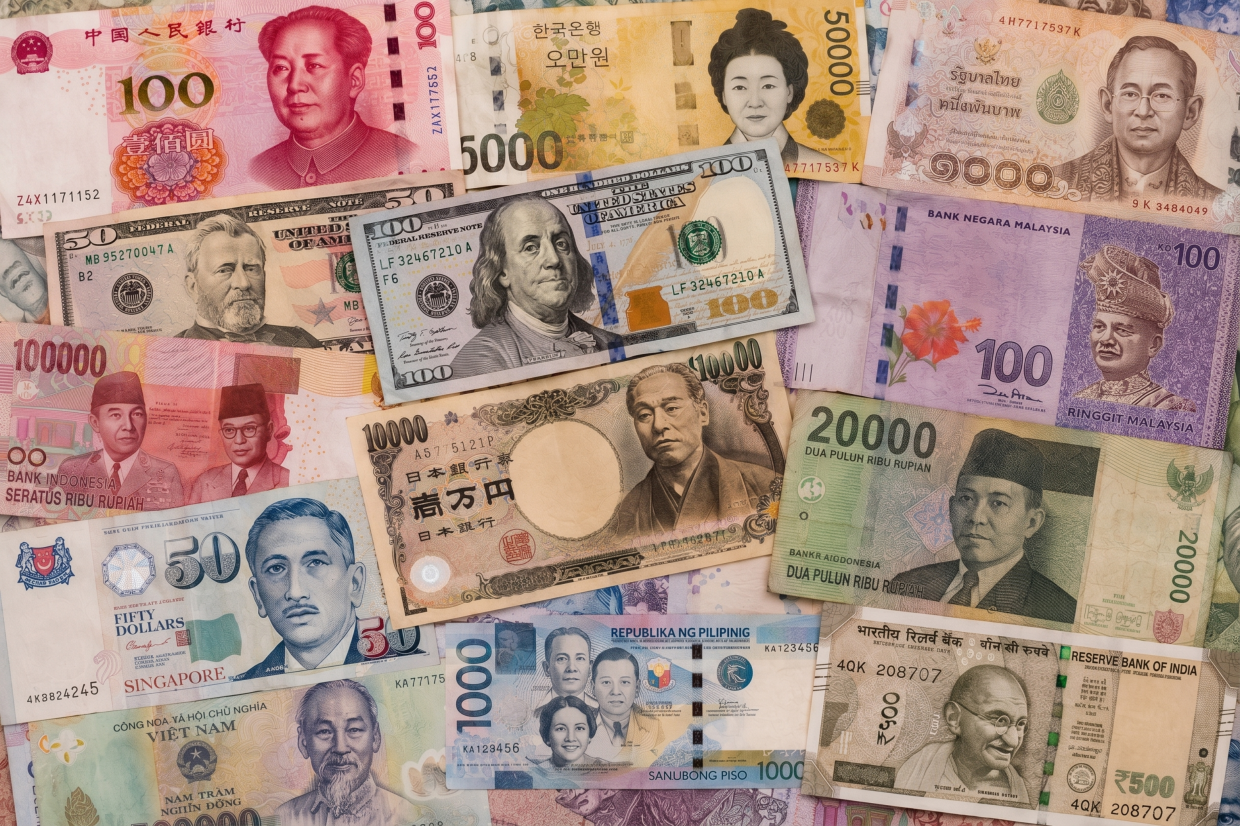
Geopolitical tensions in the Middle East delivered a sharp jolt to Asian financial markets on Monday, triggering a broad retreat across regional currencies and equity bourses. The resurgence of conflict in the Gulf region sent crude oil prices climbing approximately 4 percent, immediately rekindling concerns about inflationary pressures across Asia's emerging economies. This renewed anxiety over price stability lifted the U.S. dollar index to fresh highs against a basket of major currencies, establishing stronger greenback demand and putting sustained pressure on regional monetary units that had shown relative resilience in recent weeks.
The depreciation extended broadly across emerging Asia's currency markets as investors rushed to secure dollar positions against mounting uncertainty. Indonesia's rupiah weakened to 18,140 per dollar, marking its lowest valuation in over a month as foreign capital sought safer ground. The South Korean won slipped to 1,507.9 per dollar, reflecting similar risk-off positioning throughout the region. Malaysia's ringgit declined to 4.0780 per dollar, tracking the broader trend of emerging market currency weakness amid elevated geopolitical risk and shifting expectations around global monetary policy.
South Korea's equity market experienced the most dramatic deterioration, with the KOSPI benchmark index collapsing 7.96 percent to touch its weakest level in ten weeks, triggering automatic trading circuit breakers designed to arrest sharp sell-offs. The semiconductor sector bore the brunt of selling pressure, with SK Hynix, the world's dominant producer of artificial intelligence-specialized memory chips, plummeting 13 percent in a single session. The sharp decline reflected profit-taking from investors following the company's marquee United States market debut just days earlier, even as enthusiasm for AI-driven semiconductor demand remained intact.
The downturn in SK Hynix and broader chipmaking stocks reflects mounting uncertainty about the sustainability of extraordinary earnings growth tied to artificial intelligence infrastructure spending. Market participants have grown increasingly skeptical about whether the exceptional margins and production volumes generated by demand for high-bandwidth memory chips can persist as major cloud computing operators embrace more disciplined capital allocation strategies. This skepticism has intensified volatility in semiconductor equities, particularly among highly leveraged single-stock exchange-traded funds that amplify price movements and force mechanical selling when positions deteriorate. These structural vulnerabilities in leveraged derivative products have exacerbated downward momentum in technology-heavy Asian indices.
Despite the significant one-day decline, South Korea's equity market has demonstrated remarkable resilience throughout 2024, recording gains approaching 63 percent year-to-date and maintaining its position among the world's strongest performing bourses. However, the KOSPI's cumulative decline of approximately 25 percent since establishing a record closing price on June 22 suggests that valuations had reached levels many investors considered stretched. The recent volatility reflects a normalization process as profitable positions are liquidated and market participants reassess the duration and magnitude of AI-driven earnings expansion.
Malaysia's financial markets painted a more complex picture despite the ringgit's weakness against the dollar. The local equity benchmark advanced to a three-week high, suggesting that domestic investors maintained appetite for Malaysian stocks despite currency headwinds. This divergence between currency weakness and equity strength partly reflects political developments that have begun reshaping investor expectations around medium-term policy trajectories. A decisive electoral defeat inflicted on Prime Minister Anwar Ibrahim's coalition partner in a crucial Johor state election on Saturday has raised substantive questions about the durability of the federal government's political alliance and amplified speculation regarding the timing of an early national general election.
The political uncertainty introduces fresh variables into Malaysia's investment calculus that warrant careful analysis from a regional perspective. Goldman Sachs analysts have flagged that deteriorating clarity around coalition stability and potential disruptions to the government's economic policy agenda could gradually erode the so-called "policy-stability premium" that has supported Malaysian asset valuations relative to comparable emerging markets. This premium compensates investors for the relatively consistent macroeconomic policy frameworks that Malaysia has maintained under the current administration, making it an important factor in foreign capital flows and currency dynamics. However, Goldman's assessment also noted that measures undertaken by Bank Negara Malaysia in June specifically designed to encourage foreign exchange inflows should provide meaningful support against excessive ringgit depreciation, even if political risk considerations persist in constraining overall demand.
Performance across the broader region reflected the mixed sentiment pervading Asian markets following the Middle East escalation. Equities in the Philippines edged marginally higher, while Indonesian shares advanced 0.5 percent, suggesting that not all emerging markets succumbed to uniform selling pressure. Taiwan's market declined fractionally, while Singapore's benchmark index fell as much as 0.7 percent, ending a remarkable seven-session streak of consecutive record highs that had characterized trading through the previous week. This interruption to Singapore's momentum, while modest in magnitude, signals that even the region's most defensive markets have begun pricing in elevated geopolitical risk and potential economic headwinds from sustained oil price elevation.
The week ahead will bring critical economic data releases and monetary policy decisions that promise to significantly influence regional asset trajectories. Singapore will publish advance second-quarter economic growth figures, while Malaysia will release inflation readings and preliminary output data for the same period. The Federal Reserve's latest inflation print will command attention from regional investors assessing the probability of additional rate increases, while the Bank of Korea will announce its interest rate decision, potentially signaling how aggressively South Korea intends to respond to domestic economic conditions and external shocks. These data releases and policy moves will provide essential guidance for investors attempting to navigate heightened uncertainty stemming from geopolitical tensions and reassess positioning across regional currency and equity markets.

