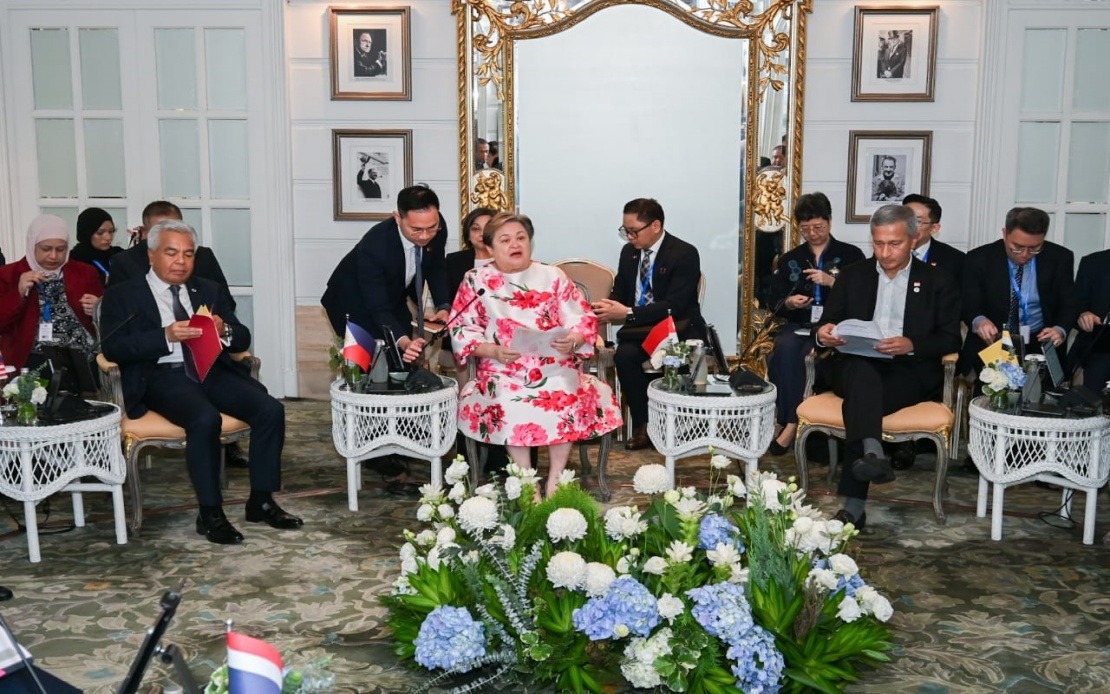
ASEAN has reaffirmed its commitment to the Five-Point Consensus as the cornerstone of its approach to Myanmar's political crisis, signalling the regional organization's determination to maintain diplomatic pressure on Naypyidaw despite recent setbacks. The stance emerged from a significant gathering of ASEAN foreign ministers in Bangkok on Sunday, marking the first in-person meeting with Myanmar's foreign minister since the 2021 military coup triggered the country's ongoing instability. The Philippines, serving as ASEAN's current Chair, underscored the bloc's resolve to pursue engagement while acknowledging Myanmar's government has publicly rejected the peace framework that has guided ASEAN's approach for over three years.
Philippine Secretary for Foreign Affairs Maria Theresa Lazaro, representing ASEAN's leadership on Myanmar matters, emphasized that the Five-Point Consensus remains non-negotiable despite Naypyidaw's recent parliamentary motion rejecting it. Speaking alongside Thailand's Foreign Minister Sihasak Phuangketkeow, Lazaro stressed that all stakeholders in Myanmar's conflict—from the military government to opposition forces—have consistently engaged with the framework regardless of their stated positions. The message conveyed an important reality for Southeast Asian diplomacy: ASEAN's consensus-based approach sometimes requires pushing forward even when one member state appears resistant, treating the framework as the organization's collective position rather than a negotiating document.
The Five-Point Consensus, adopted in April 2021 immediately following Myanmar's coup, establishes four fundamental objectives: immediate cessation of all violence, inclusive dialogue encompassing all parties to the conflict, humanitarian assistance delivery to affected populations, and facilitation by an ASEAN Special Envoy. Over the past three years, this framework has provided ASEAN with a diplomatic language for engaging Myanmar without formally condemning the military junta—an approach consistent with the bloc's non-interference principle while still maintaining pressure for change. The rejection by Myanmar's parliament last week represented a symbolic challenge to ASEAN's approach but did not fundamentally alter the organization's commitment to the framework.
During the Bangkok meeting, ASEAN conveyed three specific expectations to Myanmar's government, each addressing different dimensions of the country's humanitarian and political crisis. First, the regional organization called for substantial expansion of humanitarian assistance reaching the most vulnerable populations affected by ongoing violence and displacement. As part of this initiative, the ASEAN Chair plans to launch a dedicated humanitarian mission designed to identify barriers to aid delivery and explore mechanisms for increasing the flow of relief supplies to conflict-affected areas. This focus on humanitarian dimensions reflects mounting regional concern about the deteriorating civilian situation in Myanmar, where access to basic services has become critically compromised in numerous regions.
Second, ASEAN pressed Myanmar for measurable reductions in violence, particularly attacks targeting civilians and non-combatants. The emphasis on this point acknowledges that three years into the post-coup period, military operations continue causing substantial casualties among the general population, with reported incidents of indiscriminate attacks on villages and civilian areas. For ASEAN member states, especially those sharing borders with Myanmar like Thailand and Laos, civilian violence has direct regional spillover implications, generating refugee flows and destabilizing frontier communities. Third, the organization demanded expansion of inclusive political dialogue aimed at genuine national reconciliation, encompassing establishment of conditions conducive to such dialogue and the release of thousands of political prisoners detained since 2021.
Thailand's position on Myanmar, articulated by Foreign Minister Sihasak, introduced an important conceptual framework increasingly shaping ASEAN's strategy: calibrated engagement conceived as a reciprocal process rather than unilateral accommodation. Sihasak's remarks suggested that ASEAN's continued diplomatic outreach should not be interpreted as unconditional acceptance of Myanmar's current trajectory. Instead, the Bangkok meeting signalled that further dialogue depends upon observable movement from Naypyidaw toward addressing ASEAN's stated concerns. This framing preserves ASEAN's non-confrontational diplomatic approach while establishing implicit conditions for continued engagement—a delicate balance reflecting internal tensions between maintaining dialogue and avoiding effective legitimation of the military administration.
The procedural structure of Sunday's meeting itself carried significance for understanding ASEAN's evolving approach to Myanmar. Convening as an Informal Meeting of ASEAN Foreign Ministers followed by an Extended Informal Consultation created diplomatic space for substantive discussion while technically remaining informal, preserving flexibility if outcomes proved contentious. The Philippines' leadership ensured Malaysia's representation through Foreign Ministry Secretary-General Tan Sri Amran Mohamed Zin, maintaining the principle of full ASEAN participation despite Cambodia's unexplained absence. This full attendance—with the noted Cambodia exception—demonstrated that Myanmar's situation commands consistent attention across the organization's membership.
Assessing progress toward ASEAN's expectations represents an ongoing diplomatic challenge lacking clear metrics or enforcement mechanisms. Sihasak indicated that ASEAN would evaluate Myanmar's performance at the ASEAN Summit scheduled later in 2024, establishing a timeline for measuring whether Naypyidaw demonstrates tangible movement on the three priority areas. However, historical patterns suggest Myanmar's military leadership has shown limited responsiveness to ASEAN pressure when such pressure conflicts with the junta's core interests. The question facing ASEAN member states involves determining what constitutes sufficient progress to justify continued engagement versus what circumstances would warrant escalating diplomatic pressure or stepping back from dialogue.
For Malaysia and other Southeast Asian nations navigating this complex situation, ASEAN's reaffirmation of the Five-Point Consensus reflects the bloc's fundamental commitment to regional stability and humanitarian mitigation despite Myanmar's government resistance. Malaysia's presence in Bangkok reinforced the principle that Myanmar's crisis remains fundamentally an ASEAN matter requiring collective response rather than individual state positions. The emphasis on humanitarian assistance and violence reduction speaks to Malaysia's own security interests, given concerns about potential destabilization affecting regional maritime safety and economic corridors. ASEAN's persistence with the Five-Point Consensus, despite its rejection by Myanmar, demonstrates the organization's belief that maintaining a principled diplomatic framework serves long-term regional interests even when short-term cooperation appears limited.
The outcomes of the Bangkok meeting illuminate growing recognition within ASEAN that the Myanmar crisis has fundamentally altered the organization's diplomatic environment. Rather than seeking quick resolution through negotiated settlements, ASEAN appears resigned to sustained engagement predicated on incremental progress across multiple dimensions—humanitarian access, violence reduction, and political dialogue—simultaneously. This approach acknowledges that Myanmar's transition will prove neither swift nor complete, requiring ASEAN to sustain diplomatic mechanisms and humanitarian initiatives over an extended period. For the Philippines as current Chair and other Southeast Asian nations invested in regional stability, maintaining pressure through the Five-Point Consensus framework represents a strategic choice to preserve ASEAN's relevance while avoiding the appearance of either enabling military rule or abandoning a member state to isolation.

