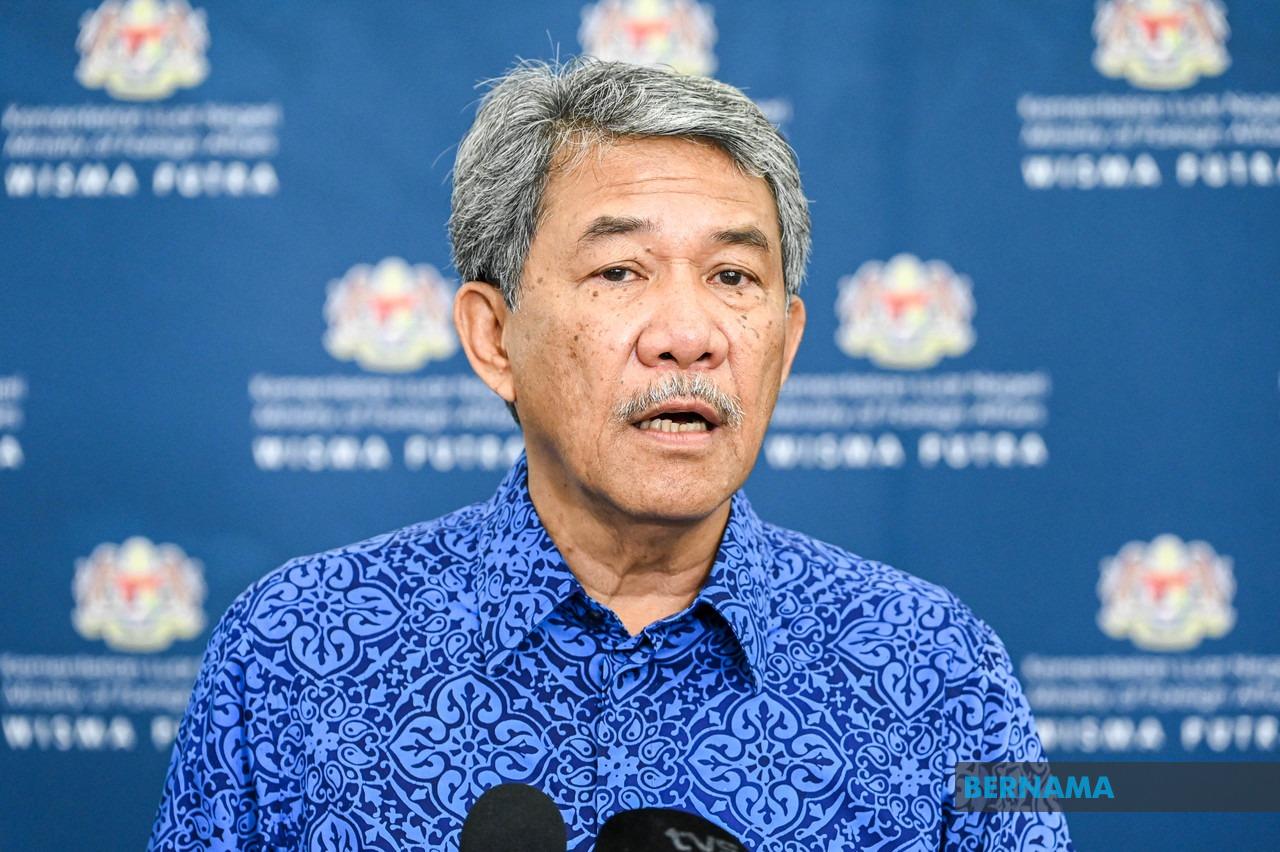
Malaysia's Foreign Minister Datuk Seri Mohamad Hasan has delivered a stark assessment of the regional and international landscape, arguing that ASEAN's founding principle of centrality has become more vital than ever as the post-Cold War order crumbles under the weight of geopolitical rivalry and economic competition. Speaking at the 59th ASEAN Day celebration in Putrajaya on Monday, Mohamad characterised the current global environment as fractured and unpredictable, marked by intensifying competition between major powers and the erosion of the multilateral institutions that have underpinned regional stability for decades.
The foreign minister's remarks underscore a critical juncture for the 10-member association, which has long positioned itself as a neutral arbiter and voice of consensus in Southeast Asia. Rather than viewing ASEAN centrality as an entrenched right, Mohamad reframed it as a privilege that requires constant vigilance and strategic commitment to maintain. This subtle distinction carries significant weight: it acknowledges that ASEAN's influence is neither guaranteed nor permanent, but rather depends on the political will and unity of member states to uphold the principles established when Indonesia, Malaysia, the Philippines, Singapore, and Thailand signed the Bangkok Declaration on August 8, 1967.
The deterioration of the international order extends beyond traditional diplomatic channels. Mohamad identified major power rivalries, geopolitical competition framed in economic terms, and the fraying of multilateral institutions as defining characteristics of the emerging landscape. For Southeast Asia specifically, this fragmentation presents both acute risks and strategic opportunities. The region has benefited enormously from an open, rules-based international system that allowed smaller nations to punch above their weight through multilateral engagement and economic integration. As that system weakens, ASEAN faces pressure from powerful neighbours seeking to expand their sphere of influence and reshape regional norms according to their preferences.
Central to Mohamad's argument is the proposition that ASEAN unity directly correlates with the region's collective prosperity and security. He stressed that internal divisions among member states would inevitably weaken ASEAN's negotiating position with major powers and undermine its capacity to shape regional outcomes. This concern reflects real tensions within the bloc, where varying strategic orientations, economic interests, and governance models have occasionally created friction over policy direction and priority-setting. The warning against fragmentation carries particular relevance given contemporary challenges ranging from maritime disputes to competing approaches to Myanmar's political crisis and divergent economic integration preferences.
Mohamad articulated a vision of ASEAN as an active agent of change rather than a passive observer of global developments. He emphasised the importance of engaging with diverse international partners on equal footing, positioning the region as an autonomous actor capable of shaping global rules and norms rather than merely responding to them. This framing addresses a persistent vulnerability in ASEAN diplomacy: the risk that member states, seeking individual advantage through bilateral engagement with major powers, might inadvertently undermine collective bargaining strength. The appeal to regional unity gains urgency when viewed through this lens, as economic and security interdependencies with China, India, the United States, and other powers create competing pressures on individual governments.
Economic modernisation featured prominently in Mohamad's vision for sustaining ASEAN's regional and global relevance. He highlighted the digital economy as a primary driver of future growth, pointing to ongoing negotiations around the ASEAN Digital Economy Framework Agreement as evidence of the bloc's capacity to innovate and adapt. The emphasis on digital transformation reflects recognition that traditional trade agreements and institutional arrangements require updating to address the realities of technology-driven commerce, data flows, and supply chain reorganisation. Efforts to modernise existing agreements with trading partners including China, India, and the Republic of Korea demonstrate ASEAN's determination to remain central to regional economic architecture even as the composition and mechanisms of trade relationships evolve.
Environmental sustainability emerged as another cornerstone of the proposed economic agenda. Rather than treating green energy transition as peripheral to ASEAN's strategic interests, Mohamad positioned it as integral to long-term economic competitiveness and energy security. The acceleration of the ASEAN Power Grid exemplifies this approach, offering the potential to attract investment, enhance regional connectivity, and reduce dependence on external energy suppliers. For Malaysia and other member states with significant renewable energy potential, this emphasis on embedding sustainability into economic planning creates opportunities for technological leadership and industrial development in emerging sectors.
The composition and evolution of ASEAN itself reflects the bloc's adaptability and aspirational character. Established with five founding members, ASEAN has expanded to ten full members through successive waves of inclusion—Brunei joining in 1984, Vietnam in 1995, Laos and Myanmar in 1997, and Cambodia in 1999. Most recently, Timor-Leste became the tenth member during the 47th ASEAN Summit in October of the previous year. This enlargement process has introduced greater diversity in economic development levels, governance systems, and strategic orientations, complicating consensus-building while simultaneously expanding ASEAN's representative legitimacy and regional reach.
The overarching theme selected for this year's commemoration, "Navigating Our Future Together," carries multilayered significance. It serves simultaneously as the theme for ASEAN 2026 under the Philippines' chairmanship, signalling continuity of strategic messaging and collective commitment across multiple policy cycles. The language of navigation deliberately evokes both the region's maritime heritage and contemporary challenges of steering through treacherous waters. This metaphor resonates particularly strongly for an organisation that has survived multiple existential challenges, from Cold War divisions to the 1997 Asian financial crisis, by emphasising pragmatic cooperation over ideological alignment.
For Malaysia, which has historically positioned itself as a bridge-builder within ASEAN and between the bloc and the wider world, Mohamad's emphasis on regional centrality and principled engagement carries domestic implications. Maintaining ASEAN's role as an autonomous actor requires that member states, including Malaysia, resist bilateral pressure from major powers that might incentivise deviation from collective positions. The appeal for equality in external partnerships acknowledges the reality that smaller nations often face asymmetrical power relationships with larger neighbours, necessitating coordinated regional action to maintain negotiating leverage.
The broader context of global fragmentation lends urgency to ASEAN's stated commitment to regional multilateralism. As the rules-based international order faces stress from revisionist powers and declining faith in institutions, ASEAN's demonstrated capacity to maintain consensus-based decision-making and non-interference in internal affairs offers an alternative model for managing interstate relations. Whether this model can adapt sufficiently to address contemporary challenges—from great power competition to transnational issues like climate change and pandemic preparedness—remains an open question requiring sustained commitment from all member states.

