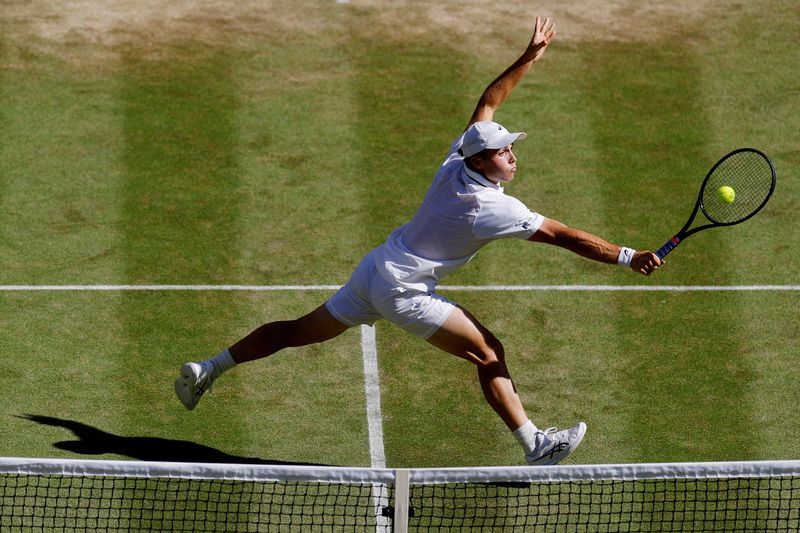
Arthur Fery's improbable journey through Wimbledon has captured the imagination of British tennis fans, with the 24-year-old wildcard now carrying the home nation's hopes almost entirely on his shoulders as the tournament progresses into its decisive stages. The France-born player, who was raised in London, has managed something few predicted when the Championships began: he reached the last eight in only his second appearance on Centre Court, adding to a narrative that has already produced some of the most dramatic tennis of the fortnight.
Fery's passage to the quarterfinals has been nothing short of theatrical. His latest victory came on Monday when he overcame fellow wildcard Grigor Dimitrov in a gruelling five-set marathon that showcased both his mental fortitude and technical prowess. The scoreline of 7-5 3-6 4-6 6-4 7-6(7) masked the intensity of the contest, particularly the fourth set in which Dimitrov, the 35-year-old former world number three, appeared to be closing in on victory with a commanding 4-3 lead and a break in hand. Fery's ability to claw back from that position drew roars from the crowd that observers compared to the noise generated at football matches, a fitting comparison given that England's World Cup victory over Mexico was unfolding simultaneously in Mexico City.
The backdrop to Fery's achievement cannot be overstated. British tennis entered this year's Championships with 19 players competing in the singles draw, yet an extraordinary 15 of them exited in the opening round. This historically poor performance has made Fery's continued presence on Centre Court almost entirely responsible for maintaining a British presence in the later rounds of the tournament. His role as the de facto standard-bearer for domestic hopes has transformed what might otherwise have been a routine run into something approaching a national sporting narrative, with each successive victory amplifying the pressure and attention surrounding his performance.
Fery's quarterfinal opponent will be Flavio Cobolli, the Italian world number ten, but crucially Fery arrives at this matchup with genuine form and recent winning experience against the same player. Earlier this year at the Australian Open, Fery demonstrated the ability to beat higher-ranked opponents, a credential that provides legitimate grounds for optimism rather than mere wishful thinking. The American sixth seed Taylor Fritz has publicly endorsed Fery's abilities, recounting practice sessions before the World Tour Finals where Fery consistently outplayed him during baseline exchanges. Fritz specifically highlighted the quality of Fery's forehand relative to his frame and his exceptional serving technique, suggesting that Fery possesses the technical foundation to compete at this level consistently rather than through chance or fortune.
The journey to the quarterfinals has not been without physical tribulation. Fery's third-round victory over Zizou Bergs on Saturday required him to overcome not only a significant match situation but also recurring nosebleeds that would ordinarily derail a player's concentration and rhythm. Overcoming a two-sets-to-one deficit and a double break down in the fourth set demonstrated the kind of resilience that separates journeyman players from those capable of deep tournament runs. That performance proved the longest match of the Championships at that point, a testament to the gruelling nature of Fery's path through the draw.
Fery's background as a Stanford college tennis player provides important context for understanding his emergence. The American university system has produced numerous professional competitors who leverage their experience in a collegiate environment to translate into professional success. Fery's education at one of tennis's premier college programmes suggests he has possessed the foundational skills and mental preparation necessary for professional competition, even if his climb up the rankings has been gradual rather than meteoric. His ranking of 114th at the week's outset has risen dramatically toward the top 70, reflecting both the quality of his performance and the ranking points accumulated through extended tournament runs.
The emotional dimension of Fery's experience cannot be overlooked, particularly given the extraordinary circumstances surrounding his matches. In his post-match reflection following the Dimitrov victory, Fery acknowledged the unique privilege of playing Centre Court for what might be only the first or final time in his career. This perspective reveals a player acutely aware of the rarity and significance of his opportunity, a consciousness that often produces the kind of fearless tennis that characterises deep tournament runs. His observation that British sport more broadly appears to be performing well globally suggests he is drawing motivation from the broader sporting context, including England's World Cup progression.
The implications of Fery's run extend beyond mere sporting achievement. For Malaysian and Southeast Asian audiences, Fery's story demonstrates the unpredictable nature of professional tennis and the ways in which wildcards and lower-ranked players can upset established hierarchies. It also illustrates how tournament formats that permit wildcard entries can generate compelling narratives that engage casual and dedicated sports followers alike. The contrast between British players' overwhelming first-round exits and one player's unexpected progression highlights the volatility inherent in professional sport, where preparation, mental resilience, and fortune align in ways that defy conventional expectation.
Fery's birthday, coinciding with the men's singles final on Sunday, looms as a potentially historic date should his improbable run continue. Whether he advances further or eventually falls to the demands of top-ten opposition, his tenure at this year's Wimbledon has already rewritten British tennis narratives and provided a template for how lower-ranked players with genuine technical skills and appropriate mental fortitude can compete at sport's highest level.

