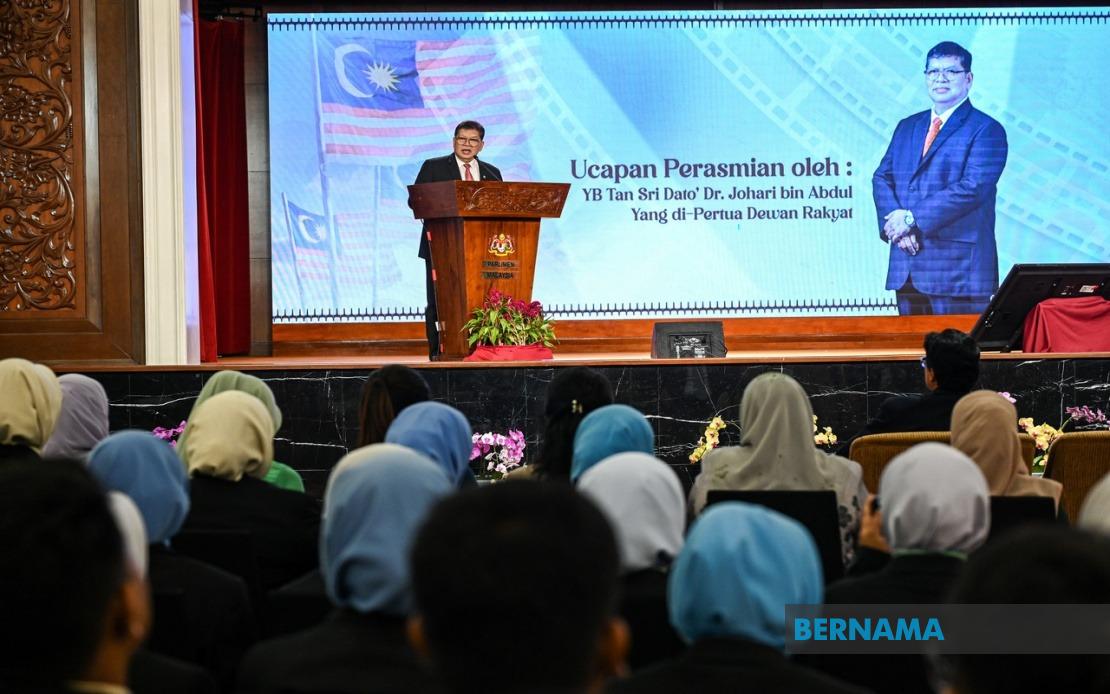
Parliament has unveiled a short film titled "Arkitek Bangsa" as part of a comprehensive effort to inspire the nation's youth toward leadership and stronger patriotic commitment. Unveiled at a special screening held at the Parliament Building in Kuala Lumpur on July 16, the production represents a deliberate strategy to reshape how young Malaysians perceive their role in nation-building and their capacity to contribute meaningfully to the country's future trajectory.
The initiative reflects growing concern among policymakers about cultivating a generation equipped not merely to inherit democratic institutions but to actively strengthen them. According to parliamentary leadership, the film serves as a cultural instrument designed to communicate that leadership qualities are not innate traits reserved for a select few, but rather capacities that can be developed through sustained exposure, mentorship, and structured training programmes. This philosophical approach challenges traditional notions of leadership as something individuals are born into, instead framing it as an achievable aspiration for any young Malaysian willing to invest effort in personal development.
The underlying message emphasizes that each young person should aspire to become an "architect of the nation," a metaphor that carries particular weight in the Malaysian context. The framing suggests that just as architects design physical structures that serve communities for generations, so too should young citizens approach their engagement with national development as a long-term commitment requiring vision, planning, and meticulous execution. This conceptual framework aims to instil deeper responsibility and conviction among the youth demographic, encouraging them to view their contributions not as peripheral but as foundational to national continuity.
The "Arkitek Bangsa" film does not operate in isolation but rather integrates into a broader ecosystem of youth-engagement initiatives already established by Parliament. The Parliament School Programme has proven particularly significant in this regard, having successfully brought 1,057 schools to visit the legislative complex. These visits expose students directly to the mechanics of parliamentary democracy and the legislative process, creating tangible connections between constitutional theory taught in classrooms and the living practice of governance observed within the Parliament Building itself.
Beyond traditional parliamentary awareness, the institution has deepened its engagement with the National Service Training Programme (PLKN), a compulsory military-style training initiative for young Malaysians. Through a special select committee, Parliament ensures that the PLKN curriculum incorporates components addressing national consciousness and civic responsibility, thereby extending the reach of nation-building messaging beyond parliamentary walls into military and civilian institutional frameworks. This coordinated approach suggests recognition that youth formation requires multiple touchpoints across different governmental and institutional domains.
The Youth Parliament itself has undergone significant structural expansion intended to amplify young voices within parliamentary processes. Membership has been expanded from 100 to 222 participants, a meaningful increase that broadens participation opportunities. More substantially, the introduction of a proportional representation electoral system for Youth Parliament selection marks a shift toward more inclusive representation mechanisms, potentially capturing perspectives from diverse demographic groups and geographic regions that might have been underrepresented under previous selection methods. This structural reform suggests that Parliament views youth engagement not as a ceremonial exercise but as a mechanism through which institutional legitimacy can be renewed.
The central metaphorical argument underlying the film carries particular resonance for Southeast Asian audiences grappling with questions of national consolidation. The notion that constructing a nation requires sustained effort across generations, while destruction can occur rapidly, acknowledges fragility inherent in newly consolidated states. For Malaysia specifically, a country that achieved independence less than a century ago and which continues to navigate complex communal and federative arrangements, this messaging addresses latent anxieties about national stability. By positioning every young person as a potential guardian of national achievement, the film reframes youth engagement from an optional civic activity into a responsibility tied to existential national preservation.
The film's intended circulation strategy emphasizes systemic integration across multiple governmental ministries and agencies responsible for nation-building functions. This approach ensures that the "Arkitek Bangsa" narrative achieves repetition and reinforcement across diverse institutional settings where young people encounter state authority and national messaging. Such dispersal across institutional domains reflects understanding that single-point interventions rarely reshape values; sustained reinforcement through multiple trusted institutions proves more effective in inculcating desired attitudes and behaviours.
The production also addresses intergenerational memory, particularly the preservation and transmission of narratives about sacrifice and contribution from earlier generations. In a nation where independence and post-independence nation-building occurred within living memory for older cohorts but increasingly occupies historical rather than experiential terrain for youth, institutional mechanisms for historical consciousness-building become necessary. The film provides a vehicle through which younger Malaysians can develop appreciation for foundational efforts that created contemporary stability, potentially strengthening emotional investment in national continuity.
The film's emphasis on cultivating confidence in Malaysian identity reflects broader regional patterns where several Southeast Asian states emphasize national pride as a counter to globalization pressures and external influences perceived as potentially destabilizing. The aspirational framing—encouraging young people to feel grateful for their Malaysian birth and proud of their national identity—operates as a soft-power approach to nation-building, relying on emotional and psychological engagement rather than coercive mechanisms. This methodology aligns with contemporary understanding that sustained national commitment emerges more effectively from internalized conviction than from institutional compulsion.
For Malaysia's broader youth policy framework, the "Arkitek Bangsa" initiative signals Parliament's recognition that democratic institutions require continuous cultural reinforcement, particularly among generations without direct memory of pre-independence conditions. By positioning leadership development as accessible and necessary, Parliament attempts to redirect youth aspirations toward contributing to existing institutions rather than seeking alternatives outside established frameworks. This preemptive institutional engagement reflects awareness that political stability depends partially on integrating successive generations into existing power structures rather than allowing them to develop alternative centres of authority.

