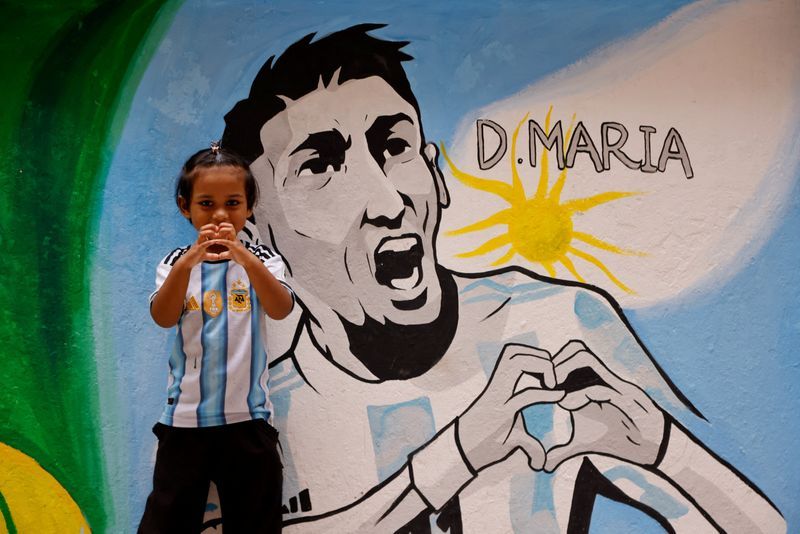
The football world will witness a poignant echo of history when Argentina and Switzerland collide in the World Cup quarter-finals on Saturday in Kansas City, Missouri. The two nations last met in the knockout stages over a decade ago in Sao Paulo, where Angel Di Maria's extra-time goal extinguished Swiss hopes and propelled Lionel Messi's Argentina toward their long-awaited World Cup triumph. Now, in a twist that underscores the unpredictable nature of international tournaments, these same competitors will lock horns once more, though the narrative has shifted dramatically in favour of the South Americans.
The intervening years have fundamentally transformed Argentina's standing in world football. Then, in 2014, they arrived in Brazil burdened by a World Cup drought extending back nearly 30 years, desperate to harness Messi's exceptional talent during what was recognised as his prime years to finally secure the trophy that eluded them. Today, Argentina arrive in North America as defending world champions, having conquered Qatar 2022 with a team composition that has proven both resilient and destructively potent. Their runner-up finish in 2014 itself represented a watershed moment, establishing them as genuine contenders rather than perpetual nearly-rans dependent solely on Messi's individual brilliance.
For Switzerland, the passage of 12 years tells an equally compelling story, though one of gradual ascendancy rather than immediate triumph. In 2014, they remained outsiders to the tournament's deepest stages despite consistent qualification records. That Di Maria goal in Brazil denied them the quarter-final appearance that had eluded them since 1954, a 60-year absence that ranked among international football's more frustrating droughts. Now, under Murat Yakin's management, Switzerland have finally broken through that psychological and competitive barrier, reaching the last eight for the first time in seven decades by eliminating Colombia through a penalty shootout following a tense goalless draw.
Messi, now 39 years old, remains the gravitational centre around which the match orbits, despite the physical toll that age inevitably exacts on even the greatest athletes. He no longer possesses the blistering pace and explosive athleticism that defined his 2014 performance, yet his relevance to Argentina's World Cup campaign has, paradoxically, deepened rather than diminished. His captaincy and tactical intelligence have become as valuable as his goalscoring prowess. Argentina's dramatic 3-2 recovery against Egypt in the last 16, achieved after trailing 2-0 with mere minutes remaining, showcased both the vulnerability and resilience of Scaloni's squad. Messi's mere presence appeared to galvanise his teammates, embodying the psychological intangibles that transform matches when the outcome appears settled.
The continuity between these two encounters is remarkably slender. Only three players from that 2014 confrontation remain in circulation: Messi himself, Swiss captain Granit Xhaka, and defender Ricardo Rodriguez. Both Xhaka and Rodriguez, now 33 years old, carry the weight of that earlier defeat while recognising the exceptional quality they face. Xhaka has articulated a blend of respect and determination, acknowledging Messi's undiminished standing whilst insisting that Argentina's strength extends beyond their talismanic figure. Rodriguez similarly recognised that the defending champions represent a comprehensive threat rather than a one-player proposition, though he correctly identified Messi as the paramount challenge.
Switzerland's path to this quarter-final reveals a team that has evolved considerably in their defensive approach and structural sophistication. Rather than relying solely on the compact defensive organisation that characterised their past campaigns, they have gradually incorporated more attacking ambition into their tactical framework. However, that progression was complicated by an injury to midfielder Johan Manzambi, whose creative contributions were conspicuously absent during the Colombia encounter. The prospect of his return would substantially enhance Switzerland's capacity to construct offensive opportunities against Argentina's expansive midfield and defence.
Yakin has identified specific tactical vulnerabilities in Argentina's recent performances, suggesting that the defending champions' struggles against Cape Verde and their near-capitulation to Egypt expose genuine weaknesses that a well-organised Swiss side can target. This assessment challenges the notion that Argentina remain an invincible force, an observation that has injected genuine confidence into the Swiss camp. The quarter-final presents Switzerland with a historical opportunity, the chance to finally overcome the team that denied them 12 years ago whilst doing so against reigning world champions.
Argentina coach Lionel Scaloni faces the challenge of maintaining momentum whilst managing the physical demands that multiple recovery comebacks impose on his players. He is expected to retain the core of the side that defeated Egypt, though he has publicly acknowledged that Switzerland represent an extraordinarily testing assignment. Scaloni recognises both their World Cup tradition and the exceptional individual talents within the squad, suggesting he anticipates a closely contested tactical battle rather than a predetermined outcome. The defensive solidity and midfield discipline that have characterised Swiss performances throughout the tournament will pose genuine problems for an Argentina side that has been drawn into absorbing periods of sustained pressure.
The tactical contest will likely revolve around how Argentina's attacking threat, centred on Messi and the dynamic involvement of wingers Julian Alvarez and Nicolas Tagliafico, can be accommodated within Argentina's structural requirements, balanced against Switzerland's capacity to prevent sustained breakdown of their defensive shape. Both teams have demonstrated resilience under pressure, though Argentina's proven ability to recover from seemingly hopeless positions provides them with a psychological advantage that even 12 years of development cannot fully erase from the Swiss collective memory.
This quarter-final transcends mere football, embodying the cycles of sporting fortune and the enduring relevance of exceptional individuals within competitive environments. Argentina will be favoured, their status as defending champions and Messi's continuing presence providing obvious advantages. Yet Switzerland's long-delayed arrival at the last eight suggests a team capable of surprising even the most decorated opponents. The match promises to be a compelling narrative of redemption, resilience, and the complex interplay between historical context and present reality in international sport.

