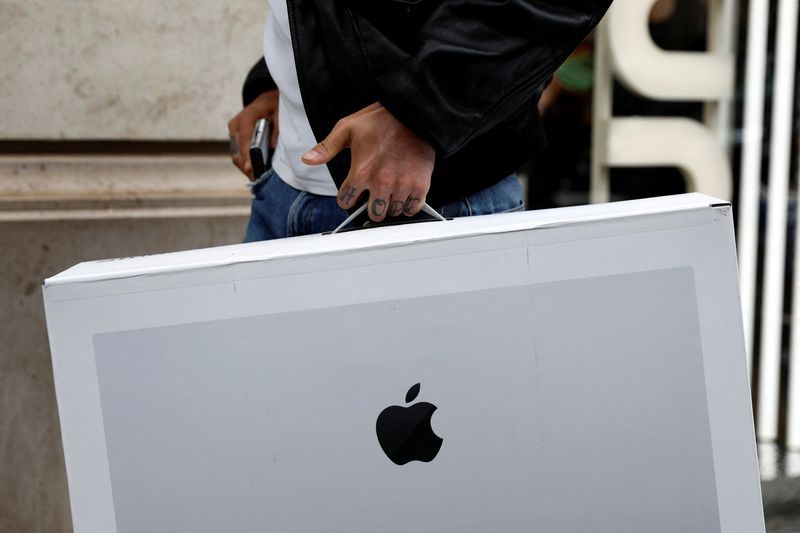
Apple has displaced Nvidia from the top position in global market capitalisation, marking a significant turning point in how investors are evaluating artificial intelligence exposure. The Cupertino-based technology giant reached a valuation of $4.88 trillion on Friday, edging past Nvidia's $4.86 trillion following a 3.5 percent decline in the chipmaker's stock price. The reshuffling represents Apple's return to the summit for the first time since April of the previous year, fundamentally altering the hierarchy among technology titans that has dominated discussions around AI's commercial potential.
The transition underscores a broadening of investor perspectives that extends well beyond the most straightforward beneficiaries of the AI revolution. For nearly twelve months, Nvidia has occupied the coveted top ranking, riding waves of enthusiasm for its graphics processing units that power generative AI systems across enterprise and consumer segments. That sustained dominance created an impression of inevitability around chip manufacturers capturing the bulk of AI-related wealth creation. However, market movements reveal a more nuanced calculus emerging among institutional and retail investors alike, one that recognises value in different positions across the technology supply chain.
Analysts attribute Apple's ascendancy to shifting sentiment regarding the company's strategic positioning within artificial intelligence. Previously dismissed as a laggard unwilling to commit substantial capital towards developing proprietary AI models, Apple is now viewed through a different lens. As Toni Meadows, head of investment at BRI Wealth Management, explains, the market has recalibrated its assessment. Apple operates with considerably lower capital expenditure requirements compared to companies racing to build large language models. Crucially, the company possesses multiple avenues for monetising artificial intelligence through service subscriptions, ecosystem integration, and encouraging device upgrades among its installed base of nearly two billion active users globally.
This revaluation carries particular significance given the timing relative to Apple's leadership transition. Chief Executive Tim Cook is preparing to hand over operational control to John Ternus, a veteran hardware engineer, in September. The milestone of reclaiming the world's most valuable company status may well colour perceptions of Cook's tenure, providing a counternarrative to suggestions that Apple had fallen behind in the artificial intelligence competition. The company's recent introduction of an overhauled Siri voice assistant represents a deliberate effort to narrow the technological gap separating it from competitors and nascent startups that have captured market imagination through advanced AI capabilities.
Underlying Apple's potential lies a largely untapped resource that numerous analysts have identified as transformative: the vast quantities of personal data residing on iPhones and other Apple devices. This information could substantially enhance Siri's responsiveness and accuracy, enabling the assistant to deliver more contextually relevant and personalised responses. The challenge confronting management involves extracting economic value from this data whilst maintaining the privacy commitments that have become central to Apple's brand positioning. Reconciling these competing imperatives represents a significant technical and strategic hurdle that will likely define the company's AI trajectory over the coming years.
However, observers caution against interpreting Apple's ascendancy as a permanent realignment of market leadership. Nvidia's supremacy, though temporarily interrupted, rests upon foundations that remain structurally sound. The company continues functioning as an indispensable supplier to nearly every organisation pursuing artificial intelligence initiatives. The graphics processors manufactured by Nvidia are driving the current generative AI explosion, and demand for computing infrastructure shows no signs of abating despite recent market volatility. Nvidia possesses the capacity to reclaim the top ranking if investor sentiment shifts once more, particularly if new data regarding artificial intelligence adoption rates or capital spending plans emerges to reinvigorate enthusiasm for semiconductor stocks.
Apple itself confronts its own set of vulnerabilities that temper optimism about sustained dominance. The company has pursued pricing strategies designed to offset mounting production and development costs, an approach that risks constraining demand among price-sensitive consumer segments. In markets across Southeast Asia and other developing economies where price elasticity significantly influences purchasing decisions, such strategies could prove counterproductive. Additionally, the broader technology sector currently faces headwinds as investors conduct reassessments regarding artificial intelligence's sustainability as an investment theme and its actual near-term revenue generation capacity.
The competitive landscape has simultaneously expanded beyond the traditional duopoly of Apple and Nvidia. Memory chip manufacturers including Micron Technologies have emerged as major beneficiaries of artificial intelligence infrastructure buildout, with Micron achieving a trillion-dollar market capitalisation milestone in May. South Korea's SK Hynix recently listed on the Nasdaq exchange, introducing another significant competitor into the investor consciousness. According to Benjamin Hall, vice president for alpha research at Segal Marco Advisors, this proliferation of viable investment candidates could diffuse attention and capital away from the concentrated focus on the seven largest technology companies that have dominated markets throughout recent years.
The semiconductor sector overall experienced considerable turbulence during July as investors conducted comprehensive reviews of artificial intelligence's investment thesis. The Philadelphia SE Semiconductor Index declined nearly 19 percent from record highs, reflecting widespread recalibration of valuations and expectations. This correction, whilst steep, has not entirely eroded the index's annual performance gains, suggesting that underlying confidence in semiconductor sector fundamentals persists despite acknowledged near-term uncertainties. For Malaysian investors and technology-focused funds operating throughout Southeast Asia, these shifts carry implications for portfolio construction and exposure to different segments of the global technology ecosystem.

