Prime Minister Datuk Seri Anwar Ibrahim has moved to emphasise the value of national unity and political cohesion, posting a four-line Malay pantun on his official Facebook page that highlights the importance of discipline, solidarity and friendship among leaders. The message, which appeared yesterday on July 22, reflects a carefully calibrated attempt to reinforce harmony within the Federal Government even as its constituent coalitions engage in vigorous electoral competition. The post resonated strongly across social media platforms, accumulating more than 11,500 likes within two hours and generating over 1,700 comments, many of them crafted in traditional pantun verse and commending the Prime Minister's diplomatic and statesmanlike approach.
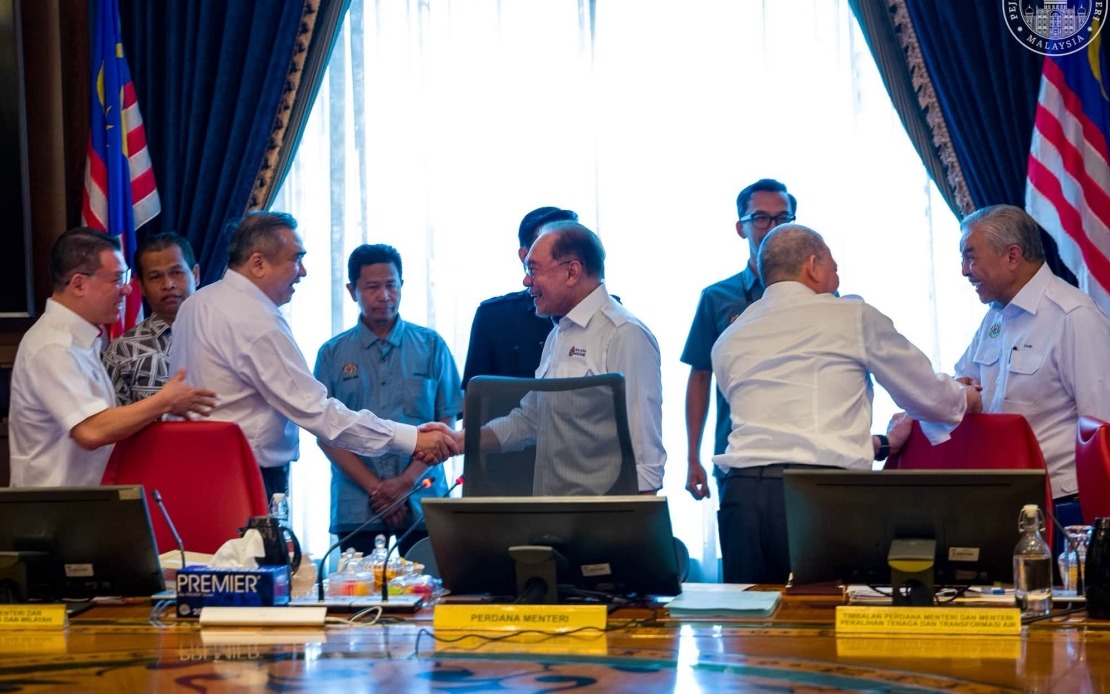
The timing of Anwar's message carries significant political weight given the current electoral landscape in Negeri Sembilan, where Pakatan Harapan and Barisan Nasional—ostensibly partners in the Federal Government—are fielding competing candidates across most constituencies. The posting was accompanied by photographs from a recent Cabinet meeting featuring Deputy Prime Minister Datuk Seri Dr Ahmad Zahid Hamidi and Transport Minister Anthony Loke, both of whom were captured in relaxed and convivial settings. These visual elements served to reinforce the message of internal stability and collaborative governance despite the surface-level tensions of state-level political competition.
The Negeri Sembilan state election represents a complex test of the Federal Government's internal cohesion. Pakatan Harapan, led by Anwar himself, is contesting all 36 state assembly seats in an effort to consolidate its position, while Barisan Nasional, chaired by Ahmad Zahid, has strategically fielded 25 candidates and negotiated an electoral pact with Perikatan Nasional to maximise its competitive advantage. This three-way configuration demonstrates how state elections have become potential flashpoints where the implicit understandings underpinning federal coalitions can be tested and destabilised. Anwar's poetic intervention appears designed to prevent such tensions from cascading upwards into the national government structure.
The dissolution of the Negeri Sembilan State Assembly on June 5 triggered an election cycle that will culminate in polling on August 1, preceded by early voting on July 28. This compressed timeframe has intensified campaigning and heightened the visibility of inter-coalition rivalry, making the Prime Minister's message of unity particularly strategic. By appealing to shared values of friendship and consensus at this juncture, Anwar seeks to establish a rhetorical framework that emphasises the primacy of federal stability over state-level political positioning. The inclusion of an evergreen 1980s musical accompaniment added a culturally resonant and nostalgic element designed to broaden the appeal of the message.
The response from social media users demonstrates how Anwar's pantun struck an emotional and cultural chord that transcended conventional partisan divisions. Comments were notably diverse, with numerous respondents composing their own pantun verses in reply, suggesting that the Prime Minister's deployment of traditional Malaysian literary forms successfully engaged audiences across multiple demographic and political segments. This authentic cultural engagement contrasts sharply with more purely transactional political messaging and may reflect a genuine appreciation for the statesmanship implied by such an approach during a period of electoral competition.
For Malaysian observers and regional analysts, the episode illuminates the delicate balancing act required to maintain coalition governments in highly fractionalised political environments. The Federal Government comprises two distinct coalitions with separate leadership structures, historical rivalry, and competing policy preferences, yet both are locked into a constitutional arrangement requiring their cooperation. The Negeri Sembilan election creates a natural moment where this cooperation is tested, as individual coalitions seek to enhance their electoral performance and leverage within both state and federal arenas. Anwar's message essentially functions as an inoculation against the risk that state-level competition could poison federal relationships.
The broader context of Malaysian politics suggests that such symbolic and communicative strategies have become increasingly important as coalitional governments fragment and recombine. Unlike single-party governments, multiparty coalitions require constant reinforcement of shared commitment and regular reminders of the mutual benefits of cooperation. The poetic form chosen by Anwar carries particular weight in the Malaysian context, where pantun represents a distinctly national literary tradition and carries connotations of wisdom, cultural authenticity, and emotional resonance that conventional political messaging cannot achieve. The choice of medium thus constitutes a form of political craft that signals respect for cultural norms and desire for genuine connection.
Looking forward, the outcome in Negeri Sembilan will provide an early indicator of whether the Federal Government's internal cohesion can withstand genuine electoral competition. A decisive victory by either coalition could either strengthen federal bonds through demonstrated electoral strength or alternatively intensify internal tensions through perceptions of unequal performance. A more fragmented result might paradoxically strengthen the coalition by forcing interdependence and compromise. Anwar's pre-election unity message essentially pre-frames whatever outcome emerges as compatible with continued federal cooperation, a shrewd positioning that seeks to establish interpretive space for maintaining the status quo regardless of Negeri Sembilan's electoral verdict.
For Southeast Asia more broadly, Malaysia's experiment with grand coalitions spanning historically antagonistic parties offers lessons in institutional creativity and political compromise. The Federal Government model depends fundamentally on leaders' ability to maintain public commitment to coalition values even while pursuing competitive advantage within that framework. Anwar's pantun exemplifies this delicate choreography—an elegant reminder of unity that acknowledges competition without endorsing its escalation. As Malaysia navigates an increasingly complex political terrain, such messages of measured statesmanship may prove essential to maintaining democratic stability and institutional continuity.

