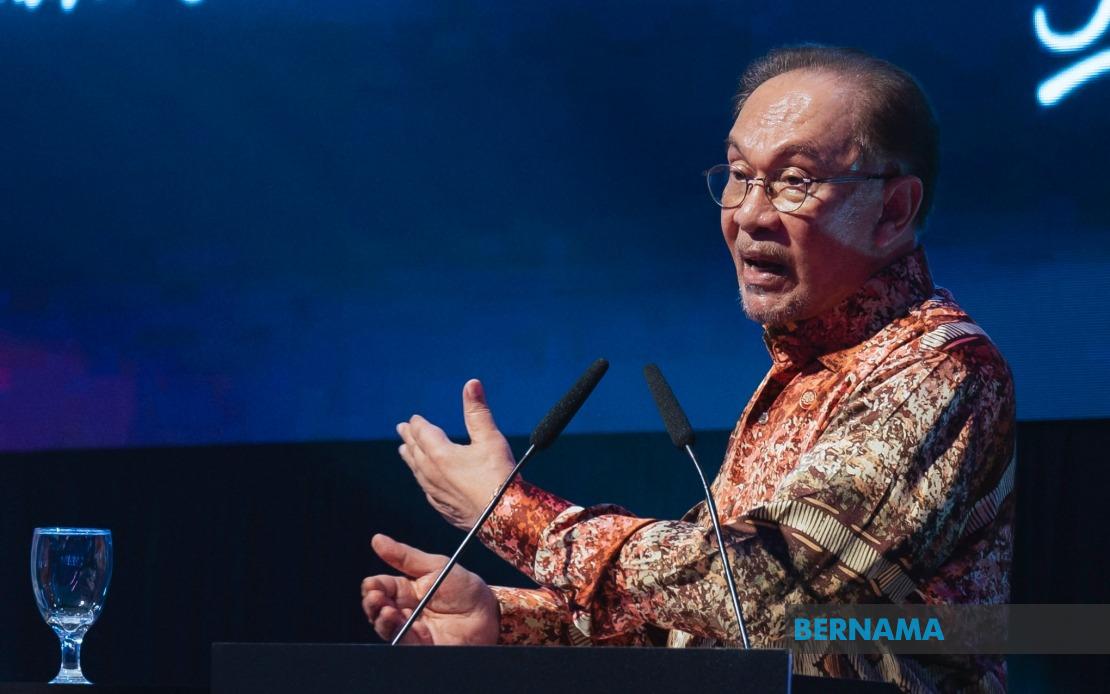
Prime Minister Datuk Seri Anwar Ibrahim sparked debate when discussing China's position on Taiwan, particularly regarding Beijing's stance on the potential use of force should peaceful reunification efforts collapse. Yet interpreting these statements as endorsement for military action would misrepresent their substance. The underlying argument engages classical deterrence theory, centring on how states protect their sovereignty and territorial integrity while remaining committed to peaceful resolution as the preferred approach.
Anwar's core proposition draws on an instructive domestic analogy. He suggested that no government would passively accept the fragmentation of its federation without mounting meaningful resistance. This principle extends beyond Malaysia's specific circumstance; it reflects a universal understanding that states possess an inherent interest in preserving their territorial composition. The logical extension involves maintaining the capacity to defend that integrity, even whilst prioritising negotiated settlement over confrontation. This distinction between capacity and intention remains crucial to understanding the deterrence framework he articulated.
The strategic logic underpinning such a position operates across a clear hierarchy. Negotiation, legal mechanisms, and political compromise occupy the primary tier of dispute resolution. Force represents a backstop position rather than an opening gambit. However, completely renouncing the possibility of military action can paradoxically destabilise the very peace one seeks to preserve. When a party explicitly forswears all defensive options, it removes a constraint on adversarial behaviour. Deterrence functions precisely because credible uncertainty exists regarding potential consequences. The mere existence of capacity to respond, even unutilised, shapes the calculations of those contemplating challenges to the established order.
This conceptual framework aligns with Malaysia's longstanding recognition of the People's Republic of China whilst maintaining de facto economic and cultural engagement with Taiwan. Malaysia has not granted diplomatic recognition to Taipei, treating the mainland as the legitimate representative of China. Within this diplomatic architecture, accepting Beijing's framing of Taiwan as an internal matter becomes plausible. Conversely, acknowledging that China views reunification as a fundamental sovereignty question does not require endorsing coercive methods to achieve it. The position accommodates both Malaysia's formal adherence to One China and its practical interest in regional stability.
Taiwan's perspective diverges substantially. Taipei maintains that the island functions as a sovereign democratic state, with its own government, armed forces, and electoral system. From this standpoint, any governmental acknowledgment of Beijing's right to employ force carries dangerous implications. Framing the issue as one of legitimate state behaviour risks normalising coercion as an acceptable tool for resolving disputes. The democratic polity on Taiwan understandably recoils from characterisations that treat their self-determination as subject to external force. This tension reflects genuine disagreement over fundamental facts, not merely different interpretations of identical circumstances.
Yet Anwar's articulation merits consideration on its own terms. Deterrence logic, refined through decades of strategic doctrine, posits that the availability of forceful response prevents its necessity. Countries maintain military establishments not primarily to wage war but to ensure that potential adversaries lack confidence in their ability to achieve objectives through aggression. This reasoning applied to the Taiwan question means that China's retention of military options theoretically dissuades separatist movements or third-party interference. Whether one accepts or rejects this logic, it represents a recognisable school of strategic thought rather than warmongering.
The implications for Southeast Asia demand careful consideration. A military confrontation across the Taiwan Strait would reverberate catastrophically throughout the region. Global supply chains dependent on semiconductor manufacturing would face severe disruption. The freedom of navigation through crucial waterways would face contestation. Trade flows that sustain economies across ASEAN would suffer dramatic contraction. Malaysia, as a trading nation whose prosperity depends on stable regional and global commerce, has compelling interests in avoiding such outcomes. The nation's position should remain firmly anchored to promoting restraint, dialogue, and peaceful mechanisms for dispute resolution.
Separating Anwar's analytical framework from endorsement of military solutions proves essential for accurate interpretation. His remarks reflect realist international relations theory: the observation that states do not voluntarily accept territorial dismemberment and maintain defensive capacity accordingly. This positions Malaysia within a balanced posture that affirms its One China policy whilst stopping short of legitimising coercive approaches. The distinction matters for regional peace; conflating deterrence discussion with war advocacy risks inflaming precisely the tensions one seeks to manage.
Malaysia's diplomatic challenge involves maintaining this equilibrium whilst strengthening mechanisms that channel disputes toward peaceful settlement. Membership in ASEAN provides a forum for advancing shared interests in regional stability. Engagement with both Beijing and Taipei, conducted through appropriate channels, allows Malaysia to encourage restraint without compromising its official position. Supporting international law frameworks that discourage the use of force advances Malaysian interests whilst respecting the sovereignty concerns of all parties involved.
The fundamental principle guiding statecraft in this domain remains straightforward: nations preserve the capacity to defend themselves precisely so they need never exercise that capacity. Anwar's Taiwan commentary, properly understood, applies this principle whilst maintaining commitment to peaceful resolution. Malaysia can embrace this realist assessment without endorsing conflict, recognising instead that deterrence functions as conflict prevention when credibly maintained. The nation's continued advocacy for dialogue, restraint, and settlement through established international mechanisms represents the most constructive expression of these principles.

