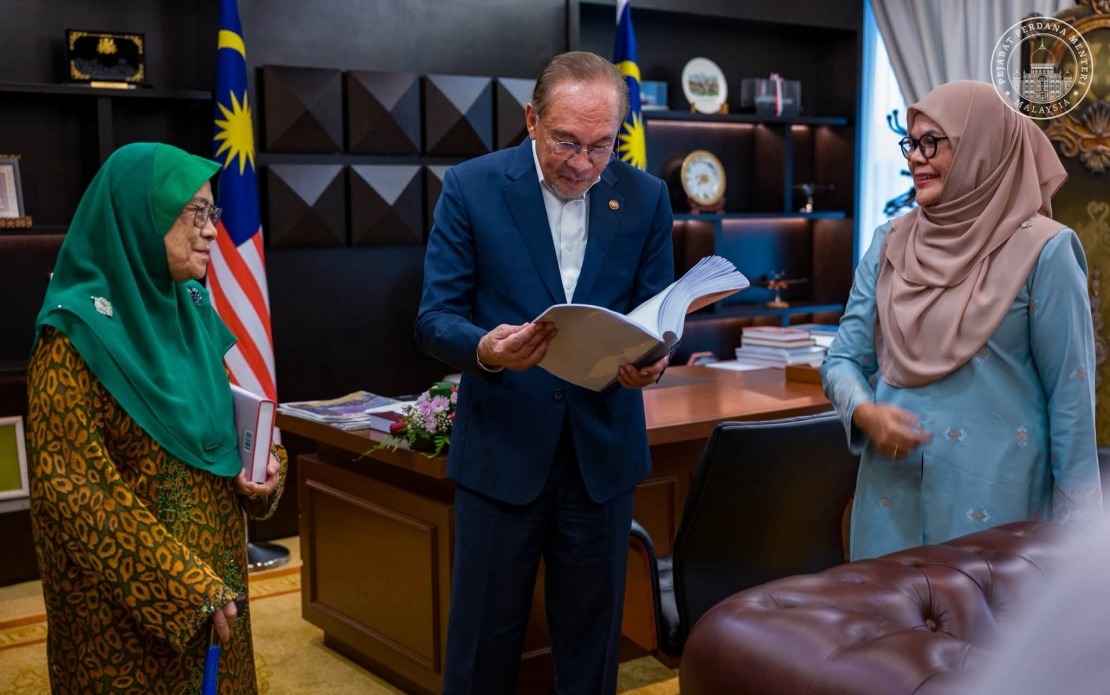
Prime Minister Datuk Seri Anwar Ibrahim has thrown his weight behind a newly completed book that chronicles his political thinking and worldview, expressing confidence that the publication will become an enduring reference point for Malaysian policymakers and citizens grappling with questions of governance and personal integrity. The initiative reflects a deliberate effort to institutionalize Anwar's intellectual legacy at a time when his administration is navigating complex domestic and regional challenges.
The book, developed by Professor Dr Salinah Ja'afar of the Academy of Malay Studies at Universiti Malaya, represents a collaborative scholarly project that drew extensively on Anwar's own insights. The Prime Minister participated actively in the manuscript's development, reviewing drafts and providing substantive feedback to ensure the work captured the nuances of his thought. This hands-on approach underscores the importance Anwar attaches to how his ideas are transmitted and interpreted by posterity.
The project benefited from the scholarly stewardship of Professor Emeritus Datuk Dr Nik Safiah Abdul Karim, a renowned linguist whose academic credentials lent rigor to the book's preparation. Nik Safiah's involvement signals that the manuscript has undergone serious intellectual vetting, moving beyond mere biographical narrative to engage substantively with Anwar's philosophical framework. The choice of Nik Safiah as academic adviser also reflects careful consideration about ensuring the work meets academic standards rather than serving as political propaganda.
Anwar underwent exclusive interviews with both scholars to deepen their understanding of his evolving worldview and to capture dimensions of his thinking that might not emerge from written records alone. These conversations reportedly explored how his personal experiences, decades of reading and intellectual engagement, and encounters with political adversity have shaped his approach to governance. For scholars and future analysts examining Malaysia's political trajectory, these recorded conversations may prove invaluable in understanding the rationale behind key policy decisions.
The Prime Minister's stated hope that the book will serve as a reference for future generations speaks to a broader concern among long-serving political figures about ensuring their intellectual contribution endures beyond their tenure in office. Anwar appears motivated by a conviction that deliberate documentation of political philosophy can guide subsequent leaders and citizens in nation-building efforts. This reflects acknowledgment that political transitions are inevitable, and that institutional memory matters profoundly for continuity of democratic values and national development.
For Malaysian readers and observers, the timing of this publication merits consideration. Anwar has led the government through the post-2022 political realignment that reshaped the nation's coalition politics. A retrospective articulation of his ideas on governance, constitutional democracy, and social cohesion may help establish a benchmark against which his administration's record can be measured. It also positions his intellectual contributions within Malaysia's broader democratic discourse.
The focus on nation-building and personal values as core themes suggests the book will address more than procedural aspects of governance. References to personal values development indicate Anwar intends the work to engage moral and ethical dimensions of leadership, potentially offering insights into how he believes leaders should navigate the tension between pragmatic political necessity and principled conduct. This resonates particularly in a Southeast Asian context where questions of leadership integrity and democratic accountability remain contested.
Scholar-led documentation of living politicians' ideas carries both advantages and risks. Rigorous academic treatment can elevate the discourse beyond partisan point-scoring, yet the selectivity inherent in any intellectual biography inevitably reflects authorial choices about which ideas deserve emphasis. Malaysian readers approaching this work should recognize it as a collaborative interpretation rather than an unmediated window into Anwar's thinking, valuable precisely because of its scholarly framing rather than despite it.
The project also reflects Malaysia's broader intellectual culture, where formal documentation of political thought remains less systematized than in older democracies. Few Malaysian political figures have commissioned comprehensive scholarly studies of their ideas while still in office. This initiative may set a precedent for more deliberate preservation and analysis of contemporary Malaysian political philosophy, enriching the national conversation about governance models and development trajectories.
For Southeast Asian readers observing Malaysian politics, the book will likely offer insights into how a major regional political figure reconciles democratic principles with pragmatic coalition-building in a plural society. Anwar's approach to managing ethnic and religious tensions while pursuing economic modernization has influenced discussion across the region about balancing competing social demands. A systematic articulation of his framework could influence how neighboring countries approach analogous challenges.
The publication timing also matters for Malaysia's relationship with key international partners and multilateral institutions. As Malaysia engages with global discussions about democratic resilience, the rule of law, and anti-corruption frameworks, a documented exposition of a sitting prime minister's thinking on these issues provides valuable context for foreign policymakers and observers trying to understand Malaysian governance trajectories.

