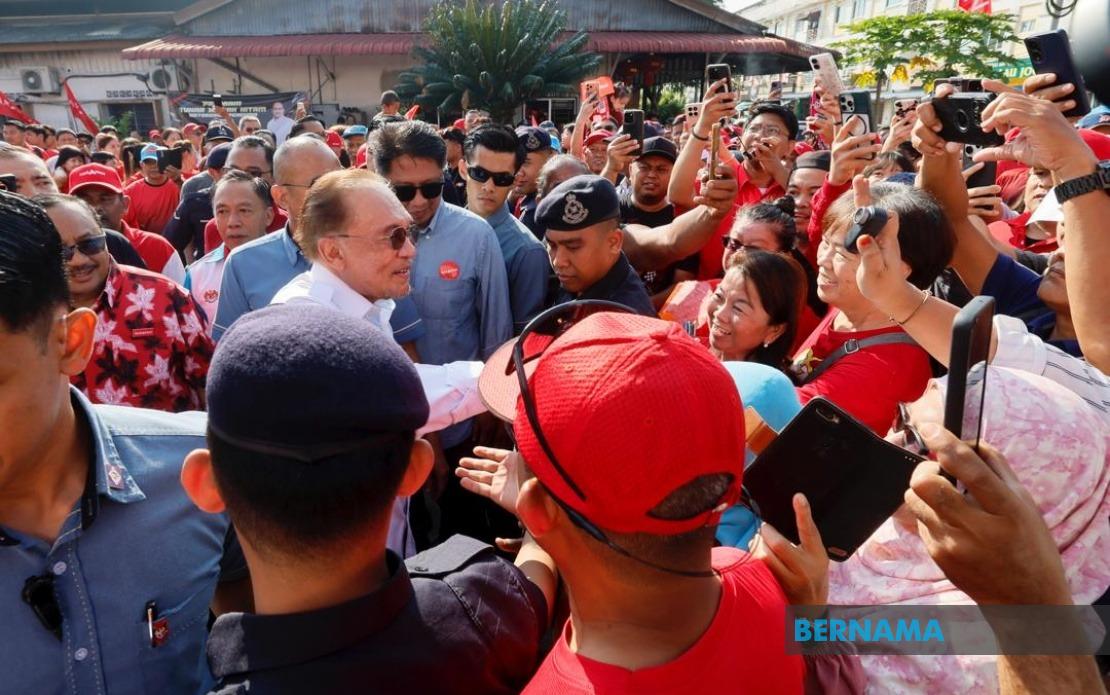
With only six days remaining before Johor voters head to the polls, Prime Minister Datuk Seri Anwar Ibrahim has injected fresh momentum into the Pakatan Harapan campaign machine by holding community engagement sessions in two critical state constituencies. The visit to Machap and Layang-Layang represented a strategic show of force by the ruling coalition during the ninth day of the official campaign period, underlining the competitive intensity of this regional electoral contest.
The timing of Anwar's intervention carries particular significance for Pakatan Harapan's efforts in Johor, where the coalition has been working to consolidate support following the coalition's mixed performance in recent electoral cycles. His hands-on approach to campaigning—participating in a casual community breakfast programme that drew more than 1,000 residents—demonstrates the personal political capital the Prime Minister is willing to expend to secure strategic state seats. This form of direct engagement serves a dual purpose: it reassures party cadres on the ground while simultaneously providing a morale lift that can translate into heightened volunteer energy during the final campaign week.
Nur Hafiz Roslan, representing Pakatan Harapan in the Machap state seat, spoke of how the Prime Minister's presence conveyed an unmistakable signal about the coalition's governing philosophy. Anwar's emphasis on working diligently and performing righteous service to the community—what Nur Hafiz characterised as centering all campaign efforts on serving the people rather than fostering division—establishes a narrative framework that distinguishes Pakatan Harapan's approach from alternative political offerings. For grassroots campaigners and party workers who have endured weeks of intensive door-to-door activity and community mobilization, such affirmation from the nation's top political leader validates their organizational efforts and reinforces the ideological moorings of their electoral effort.
The Prime Minister's message to candidates—that they must prioritise development and community welfare should they secure electoral mandates—reflects a pragmatic acknowledgment of voter expectations in an era of heightened political accountability. In Johor, where economic development, local infrastructure, and quality-of-life concerns dominate voter conversations, such reminders from Anwar underscore that promises made during campaigns must translate into tangible governance outcomes. This speaks to the broader challenge facing Malaysian political parties: the electorate increasingly demands demonstrable results rather than mere rhetorical appeals.
Guna Balakrishnan, the Pakatan Harapan candidate for Layang-Layang, echoed sentiments about intensified community engagement work in the final campaign days. His observation that despite encouraging signs of resident support, outreach efforts must be relentlessly pursued reveals the calculation underlying modern electoral contests in Malaysia. Campaign operatives understand that enthusiasm alone does not guarantee votes; systematic, repeated contact with potential voters and persuasion work remain essential mechanical elements of successful electoral campaigns. The PM's visit provided both symbolic encouragement and practical reminder of campaign discipline.
The composition of attendees at the Simpang Renggam programme illuminates important demographic patterns in contemporary Johor politics. The presence of diverse segments of the community, evidenced by the 1,000-plus attendance figure, indicates that Pakatan Harapan has succeeded in assembling a coalition spanning different age groups, income levels, and ethnic communities. For a coalition that experienced significant setbacks in rural and semi-urban areas during previous contests, demonstrating broad-based appeal across community boundaries carries strategic weight in persuading undecided voters that the political force has recovered organisational capacity and popular legitimacy.
Community responses captured during the programme offer insight into how voter perceptions crystallize during final campaign weeks. Chuan Chee Mei's observation that witnessing Anwar's direct engagement with constituents strengthened her family's commitment to voting for Pakatan Harapan candidates suggests that authenticity and accessibility resonate powerfully with Malaysian voters. The informal, relaxed manner in which the Prime Minister conducted the breakfast engagement—departing from the formal protocol that typically surrounds such high-level visits—created a more intimate political theatre that allowed residents to perceive him as approachable rather than distant from ordinary concerns.
Noor Takiyudin Salleh's comments about the scale of the gathering and the informal atmosphere similarly indicate that voters interpret such events through lenses of political commitment and popular support. Large turnouts at campaign events function as social proof for undecided voters; the visible presence of substantial crowds suggests that other community members perceive voting for a particular candidate as reasonable and socially acceptable. This psychological mechanism operates independently of any candidate's policy positions or track record, making the logistics of campaign events—crowd size, participant enthusiasm, and event visibility—genuinely consequential for electoral outcomes.
The Johor state election, with 172 candidates competing for 56 state seats across the peninsula's southern region, represents one of Malaysia's more closely watched electoral contests. The state has historically served as a bellwether for broader political trends, with performance in Johor often prefiguring national electoral trajectories. As a stronghold that has shifted hands between competing coalitions in recent cycles, the state represents contested political terrain where organizational capacity, candidate quality, and coalition unity all factor prominently into results. Early voting scheduled for July 7, just four days after this campaign event, means that mobilization efforts are entering their final, most intensive phase.
From a regional Southeast Asian perspective, Malaysia's state elections continue to demonstrate the resilience of democratic electoral processes in the region. Despite periodic tensions around electoral administration, media access, and campaign fairness, the actual conduct of state-level contests proceeds with relative normality. For observers in neighboring countries navigating democratic transitions or consolidation challenges, Malaysian elections illustrate how multi-party competition can persist within developing democracies, albeit with varying levels of competitiveness and fairness across constituencies.
The broader context for Pakatan Harapan's campaign strategy in Johor must account for the coalition's performance since assuming national government in November 2022. The party faces the perpetual challenge of governing coalition: balancing the expectations of core supporters who expect policy implementation with the pragmatic necessities of maintaining governmental coalitions with multiple partners holding divergent agendas. Prime ministerial campaign visits like Anwar's appearance in Johor serve multiple functions—they energize party workers, provide positive local media coverage, and allow national leaders to reassert control over campaign messaging during periods when coalition discipline might otherwise fray.
Looking forward to the July 11 polling date, the campaign events conducted in Machap, Layang-Layang, and surrounding constituencies will form part of the broader narrative that Johor voters construct about competing political options. Whether Pakatan Harapan's ground organization, leadership visibility, and messaging about service-oriented governance prove sufficient to secure desired seat counts will become clear within days. The state election outcome carries implications extending beyond Johor itself, as it will inform calculations about the stability and electoral viability of the current national government, particularly given the coalition's earlier legislative vulnerability at the federal level.

