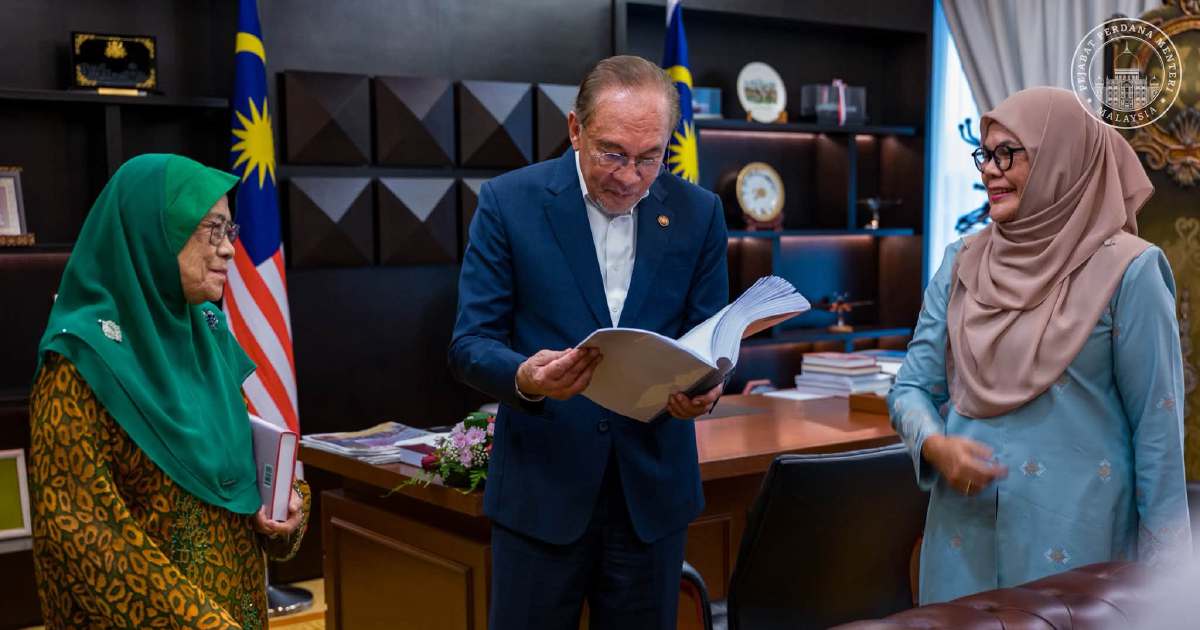
Prime Minister Datuk Seri Anwar Ibrahim has unveiled a new book compiled from his collected thoughts, experiences, and intellectual contributions, envisioning it as a resource that will guide Malaysia's future leaders and thinkers. Titled Gagasan Anwar Ibrahim Dalam Peradaban Budaya Bangsa, the publication represents an attempt to preserve and institutionalise the Prime Minister's worldview on governance and societal development beyond his tenure in office.
The compilation serves multiple purposes within Malaysia's contemporary political landscape. Anwar has expressed hope that the volume will function as an enduring intellectual anchor for subsequent generations, particularly those tasked with steering the nation through complex challenges of governance and social cohesion. By documenting his perspectives in structured form, the publication transforms what might otherwise remain scattered speeches and policy decisions into a coherent philosophical framework accessible to scholars, policymakers, and students of Malaysian governance.
The book's focus on nation-building reflects a deliberate strategy to frame Anwar's political legacy around constructive governance rather than purely partisan achievements. Nation-building as a concept encompasses infrastructure development, institutional strengthening, economic diversification, and the consolidation of democratic practices—all areas where Anwar has positioned himself as a progressive reformer. By anchoring his ideas within this broader national project, the Prime Minister is effectively linking his personal political trajectory to Malaysia's longer-term development narrative.
Character development emerges as the second pillar in Anwar's stated vision for the book's relevance. This emphasis on moral and ethical dimensions of leadership reflects a recurring theme in his public discourse, particularly following his return to high office. The inclusion of personal experiences—encompassing both his considerable achievements and his well-documented struggles—provides a humanising dimension that may resonate with readers seeking moral guidance amidst institutional uncertainty.
For Malaysian readers and policymakers, the publication arrives at a significant moment. The nation continues navigating political fragmentation, economic pressures, and questions about institutional legitimacy. A coherent articulation of ideas around governance and national character could provide ballast for institutions and offer clarity on the government's direction during periods when political uncertainty might otherwise create vacuum. The book potentially serves as a counterweight to criticism that Malaysia's current administration lacks a unifying vision beyond electoral coalition management.
The timing of such publications by sitting or recent heads of government frequently carries strategic significance. By establishing his intellectual legacy now rather than waiting until retirement, Anwar positions himself as actively shaping discourse rather than merely responding to events. This approach also preempts competing narratives about his political philosophy, anchoring interpretation firmly within the framework he has chosen.
In the Southeast Asian context, Anwar's intellectual contributions have long extended beyond Malaysian borders. His documented views on Islam and modernity, regional integration, and democratic governance have influenced thinking across ASEAN nations. A structured compilation of these ideas may enhance their accessibility to scholars and policymakers throughout the region, potentially amplifying Malaysia's soft power through intellectual exchange.
The book's reach among future generations depends significantly on how effectively it penetrates educational institutions and policymaking circles. If integrated into university curricula or referenced by development agencies, its influence could extend considerably beyond initial readership. Conversely, if it remains primarily a political memoir with limited institutional adoption, its impact may prove more circumscribed than Anwar's hopes suggest.
Critics may question whether the Prime Minister's personal reflections, however thoughtfully compiled, constitute the most reliable guide for nation-building in contexts that may differ substantially from those in which his ideas were originally formulated. Malaysia's future challenges—whether technological disruption, climate adaptation, or generational value shifts—may require frameworks extending beyond current articulations.
Nevertheless, the publication represents a significant moment in Malaysian political culture. Few serving prime ministers have taken such explicit steps to formally codify their governance philosophy for institutional reference. This suggests confidence in the durability of his intellectual contributions and a recognition that political leadership increasingly requires articulation of coherent vision beyond immediate policy announcements.
The book's reception will likely reveal much about current attitudes toward Anwar's political legacy. Widespread adoption and scholarly engagement would validate his hopes; limited circulation might suggest scepticism about whether accumulated experiences from previous decades remain sufficiently relevant to contemporary challenges.
For Malaysia's development trajectory, the true test will not be the book's initial visibility but whether its ideas genuinely inform policy decisions and shape how future administrators approach their responsibilities. Whether Gagasan Anwar Ibrahim Dalam Peradaban Budaya Bangsa becomes foundational reference material or curiosity piece for political historians will depend on how effectively its core propositions address the nation's evolving needs across coming decades.

