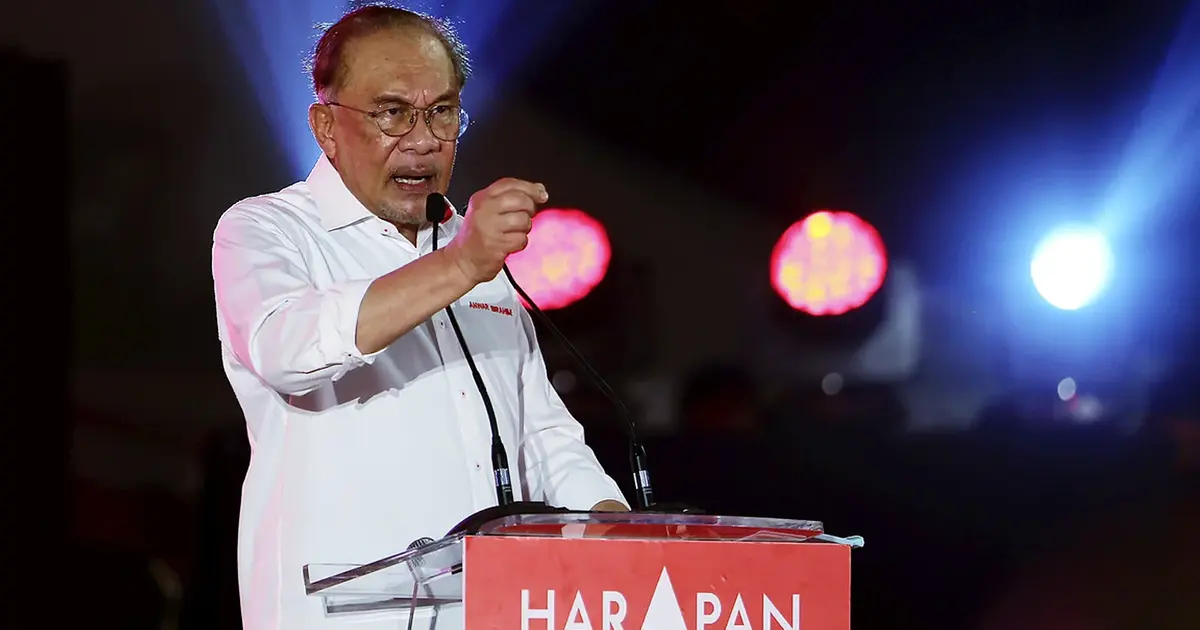
Prime Minister Anwar Ibrahim has issued a firm directive to political parties competing in the Negeri Sembilan state election, urging them to refrain from involving the state's royal institution in their campaign strategies. In his capacity as Pakatan Harapan chairman, Anwar underscored the necessity of keeping constitutional matters relating to the monarchy separate from electoral politics, a position reflective of longstanding conventions governing Malaysia's constitutional framework and respect for institutional boundaries.
The cautionary statement arrives at a pivotal moment in Negeri Sembilan's political calendar, with campaigns gathering momentum ahead of balloting. Anwar's intervention signals concern that contentious issues touching upon the state's royal establishment could become flashpoints during canvassing, potentially inflaming sensitivities around institutional authority and constitutional prerogatives. His warning implicitly acknowledges previous instances where royal matters have intersected with electoral discourse, creating tensions that transcend ordinary partisan disagreement.
Malaysia's constitutional monarchy occupies a distinctive position within the nation's political architecture. The institution commands deep reverence across Malaysian society, rooted in historical precedent and religious considerations that permeate public consciousness. Any deliberate attempt to entangle royal authority or prerogatives within electoral campaigns risks transgressing cultural and constitutional norms that have governed Malaysian political behaviour for decades. Anwar's intervention therefore represents an attempt to establish guardrails protecting institutional dignity from partisan exploitation.
For Negeri Sembilan specifically, the state's Duli Yang Maha Mulia (His Highness) holds constitutional significance beyond ceremonial functions. The Sultan participates in crucial aspects of state governance, including matters of executive authority, legislative assent, and constitutional interpretation. When royal institutions become campaign fodder, the lines separating institutional governance from partisan politics blur dangerously, potentially undermining public confidence in the monarchy's impartiality and constitutional role.
Anwar's position carries particular weight given Pakatan Harapan's broader reform agenda and its historical advocacy for democratic renewal. By explicitly instructing coalition partners to honour institutional boundaries, he projects an image of political maturity and constitutional respect that distinguishes his administration from predecessors. This stance also provides moral high ground, allowing PH to criticise opposition parties should they transgress similar boundaries during campaign activities.
The warning extends beyond Negeri Sembilan's immediate electoral context, touching upon broader questions of political culture in Malaysia. As the nation continues navigating democratic transitions and institutional reforms, maintaining clear separation between electoral competition and constitutional institutions becomes increasingly critical. Political parties that disregard such boundaries risk eroding institutional legitimacy and public trust in governance frameworks that have sustained Malaysian democracy.
Opposition parties receive implicit notice that any attempt to leverage royal institution matters for electoral advantage will provoke condemnation and potential counter-mobilisation. This pre-emptive positioning by the PH chairman suggests awareness that opponents might exploit grievances or controversies touching upon state-level royal prerogatives. By establishing the principle early, Anwar seeks to immunise the electoral process against such tactics before they materialise.
Regionally, Malaysia's experience with maintaining institutional separation from electoral politics offers lessons for neighbouring democracies grappling with similar challenges. Southeast Asian nations contain constitutional monarchies and institutional frameworks requiring comparable protection from partisan manipulation. Anwar's intervention, though aimed at domestic audiences, implicitly reaffirms Malaysia's commitment to institutional integrity as foundational to democratic stability.
The directive also reflects recognition that Negeri Sembilan's particular circumstances warrant careful handling. The state possesses distinctive characteristics, including its unique electoral system and the Duli Yang Maha Mulia's constitutional role. Any controversies or disputes affecting the monarchy's authority could generate broader implications for federal-state relations and constitutional interpretation that extend well beyond local electoral contests.
For voters, Anwar's statement provides assurance that the upcoming campaign will focus upon substantive policy questions, economic performance, and governance capacity rather than diversionary attacks upon constitutional institutions. This framing allows electorate to evaluate parties on merits and track records rather than emotional appeals connected to institutional matters properly insulated from political competition.
Compliance with Anwar's directive will test the maturity of Malaysia's political class. Parties demonstrating restraint strengthen institutional confidence and democratic norms, while those violating such boundaries invite justified criticism and potentially face electoral consequences among voters valuing institutional respect. The coming weeks will reveal whether all competing factions genuinely subscribe to these principles or view them merely as tactical conveniences.

