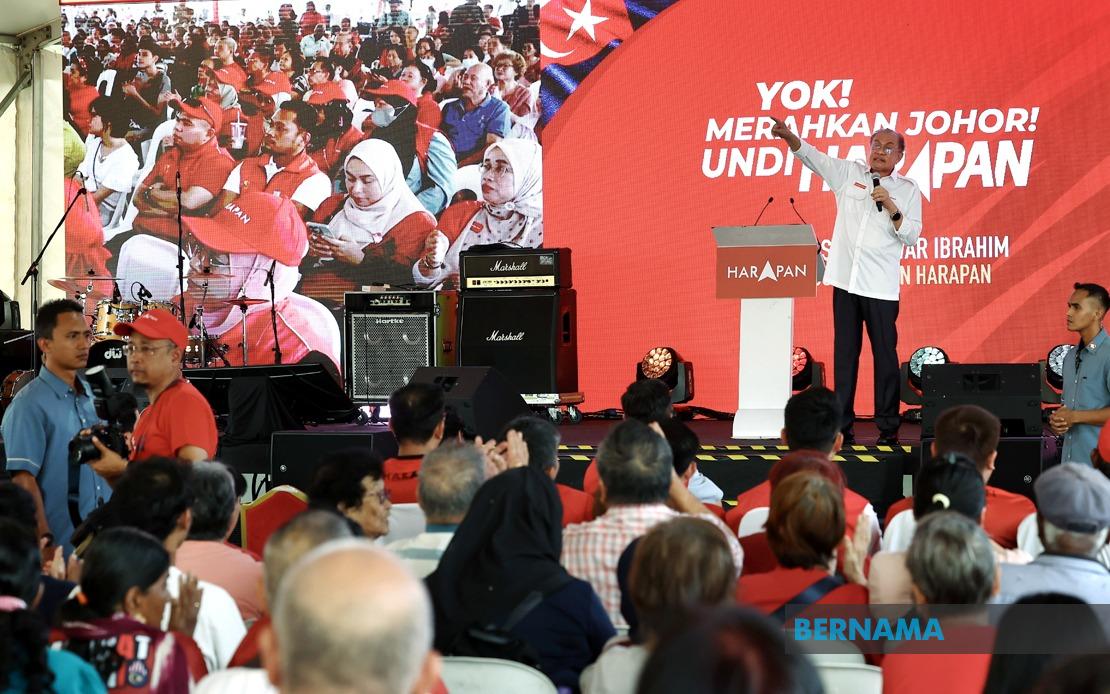
Prime Minister Datuk Seri Anwar Ibrahim has publicly urged all parties contesting in the Johor state election to refrain from leveraging the imprisonment of former Prime Minister Datuk Seri Najib Razak as a political campaigning tool, insisting instead that discourse focus on tangible governance priorities affecting ordinary Malaysians. Speaking at a gathering in Kulai, Anwar emphasised that Najib's current incarceration should remove him from the centre of electoral debate, particularly as the nation grapples with formidable financial burdens inherited from his administration.
The Prime Minister's intervention reflects an apparent shift in his approach toward the Najib question, one that has defined Malaysian politics since the 1MDB scandal first erupted in 2015. Rather than defend his government's handling of Najib's legal processes or justify the former premier's detention, Anwar sought to depoliticise the matter entirely, arguing that continued references to Najib serve no constructive purpose for voters. His statement carries particular weight given that opposition parties and some government allies have periodically invoked Najib's imprisonment as evidence of selective justice or as a rallying point for their respective bases.
Yet the substantive thrust of Anwar's remarks centred on the staggering financial legacy of the 1MDB scandal itself. The Prime Minister highlighted that the government remains encumbered by RM51 billion in debt directly attributable to the state fund's misappropriation, a sum representing resources that could have been channelled toward education, healthcare infrastructure, and social programmes. This framing reorients the conversation from personalities to the concrete costs of past malfeasance, suggesting that the 1MDB matter remains relevant not as a symbol of judicial processes but as an ongoing fiscal constraint on the nation's development agenda.
Anwar's intervention during the campaign event underscores growing recognition within the government coalition that repeated invocation of Najib risks overshadowing substantive policy discussions. In the context of a hotly contested Johor state election, where Pakatan Harapan fielded candidates such as Arthur Chiong Sen Sern for the Bukit Batu seat, the coalition's strategy appears aimed at steering discourse toward economic management and social welfare delivery. The Johor contest itself carries significant implications for federal political dynamics, as the state has traditionally been a stronghold for various coalitions and remains demographically and economically pivotal.
The gathering at which Anwar made his remarks included several ministerial figures and party officials, reflecting the high-stakes nature of the Johor campaign. Youth and Sports Minister Mohammed Taufiq Johari, Deputy Investment, Trade and Industry Minister Sim Tze Tzin, and PKR Youth chief Muhammad Kamil Abdul Munim's presence indicated a coordinated messaging effort across government portfolios. This kind of unified messaging suggests that party leadership had determined that continued emphasis on Najib's detention posed risks to the coalition's electoral positioning, particularly if opposition parties could characterise such references as opportunistic or vindictive.
The RM51 billion debt figure cited by Anwar serves as a powerful counterargument to opposition rhetoric that might seek to frame Najib's imprisonment as political persecution. By anchoring the discussion to the quantum of misappropriated funds and the consequent constraints on public spending, the Prime Minister effectively pivoted from defending juridical processes to highlighting economic consequences. This approach potentially appeals to voters concerned with immediate governance outcomes—school quality, hospital capacity, and welfare provisions—rather than those primarily motivated by accountability narratives.
For Malaysian voters, particularly those in Johor evaluating competing electoral offers, Anwar's intervention highlights a fundamental tension in contemporary politics. The 1MDB scandal represents both an accountability issue and a resource allocation issue; prosecuting former leaders addresses the former dimension, while the lingering debt addresses the latter. Anwar's suggestion that parties cease weaponising Najib's incarceration while simultaneously invoking the RM51 billion debt essentially argues that only one dimension merits continued political attention—the fiscal one.
The broader Southeast Asian context amplifies the significance of this message. Across the region, countries struggle with combating grand corruption while simultaneously managing the fiscal consequences of past malfeasance. Malaysia's approach—continuing to manage the 1MDB debt while requesting that Najib's imprisonment be depoliticised—offers a template, however contentious, for separating judicial from economic considerations. Observers in Thailand, the Philippines, and Indonesia, nations similarly grappling with corruption legacies, will note whether Malaysian voters and political actors accept this bifurcation.
For the government coalition, the strategy carries tactical advantages and risks in equal measure. Emphasising the ongoing fiscal burden of 1MDB demonstrates governmental seriousness regarding past misdeeds without requiring the coalition to continuously defend whether Najib's sentence represents justice or merely political convenience. Opposition parties, conversely, may interpret the call to depoliticise Najib's case as advantageous if they possess sympathisers within Najib's base, potentially allowing them to position themselves as defenders of fair treatment. The Johor election will reveal whether voters respond more persuasively to calls for economic redirection or continued emphasis on personal accountability.
Anwar's invocation of schools, hospitals, roads, and poverty alleviation as alternative uses for the misappropriated RM51 billion speaks directly to the daily concerns of Malaysian citizens already confronting cost-of-living pressures and perceived infrastructural deficits. By explicitly linking the 1MDB debt to tangible deprivation—to hospitals that cannot expand, schools that cannot improve, roads that deteriorate—the Prime Minister made an empirical claim that the fiscal consequences of past corruption remain measurable in present governmental capacity. This framing demands that voters assess not merely whether justice was served but whether their communities bear the costs of past negligence.
The call for parties to cease politicising Najib's imprisonment also reflects implicit recognition that the issue has become rhetorically exhausted in Malaysian discourse. Whether one believes Najib guilty or persecuted, imprisoned justly or unjustly, the matter has been litigated across courts, media, and public forums repeatedly since 2015. Anwar's intervention suggests that the government coalition judges further debate on this terrain as unproductive to its electoral interests. Whether opposition parties and sympathisers heed this appeal, or whether they continue to centre Najib in campaign messaging, will partially determine the ideological and informational landscape in which Johor voters make their electoral choices.

