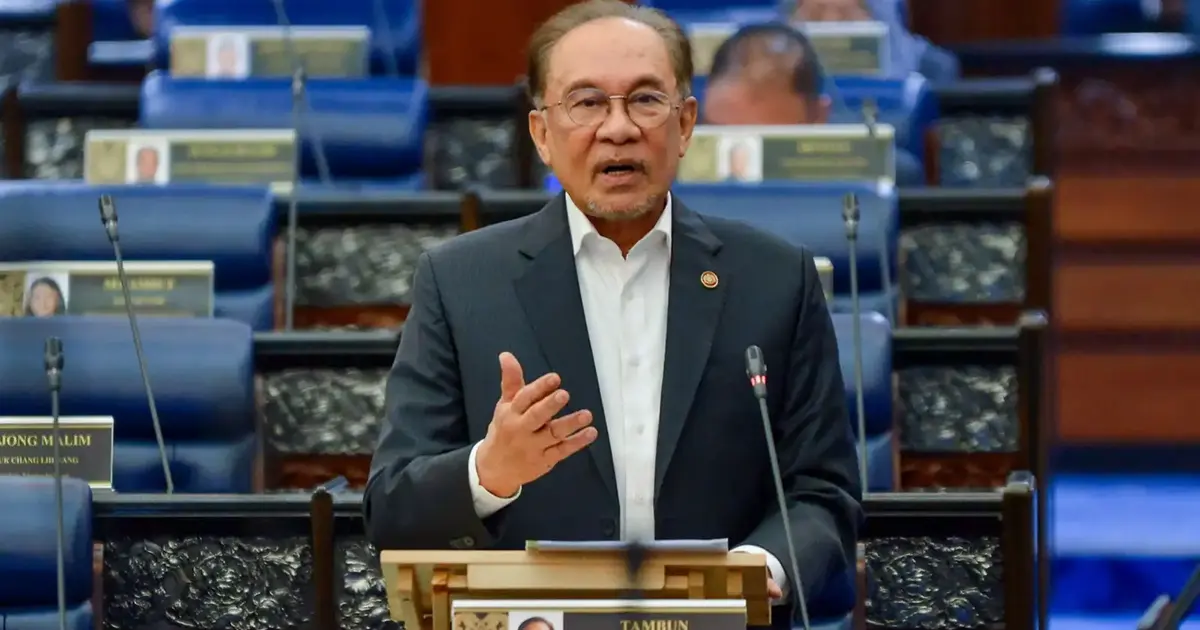
Prime Minister Anwar Ibrahim has reinforced his administration's commitment to completing its full mandate without interruption, pushing back once more against mounting calls for a premature dissolution of Parliament. Speaking to concerns that have periodically surfaced across the political landscape, Anwar argued that the electorate's priorities lie elsewhere—specifically in sustained economic performance and reliable governance rather than the disruption of frequent electoral contests.
The Prime Minister's latest statement reflects a broader strategy of emphasising continuity and delivery over political manoeuvring. His repeated rejection of snap election scenarios underscores the government's determination to maintain the current parliamentary term and pursue its legislative agenda without the uncertainty that early polls would introduce. This positioning becomes particularly significant given Malaysia's history of political churn, where frequent changes in government have historically unsettled investor confidence and disrupted long-term planning cycles.
Economic considerations appear central to Anwar's calculation. Malaysia, like much of Southeast Asia, faces a complex macroeconomic environment characterised by inflationary pressures, currency volatility, and competitive regional dynamics. A premature election campaign would inevitably draw government attention and resources away from critical policy implementation at a time when economic performance directly affects household incomes and business sentiment. The implicit message is that electoral stability translates to economic stability—a proposition with genuine merit in an era of global economic uncertainty.
The question of when elections should occur touches on deeper constitutional principles in Malaysia's Westminster-derived system. While early dissolution is technically possible, the expectation of a full parliamentary term has become increasingly entrenched in modern Malaysian political practice. Governments winning recent general elections have typically sought to maximise their allotted five-year periods, particularly when facing narrow parliamentary majorities that require careful management of legislative support.
Anwar's administration operates within such constraints. The coalition government requires the cooperation of multiple parties and independent legislators to maintain its parliamentary majority, making premature dissolution a risky proposition. An early election could fragment the coalition further, potentially benefiting opposition forces and creating uncertainty about the government's ability to continue. From this perspective, Anwar's insistence on completing the full term represents not merely political preference but practical necessity.
Public perception data in Malaysia has shown mixed results on early elections, though recent surveys suggest many voters express fatigue with constant campaigning cycles. Infrastructure projects, business expansion plans, and foreign direct investment decisions all benefit from the confidence that political continuity provides. Nations perceived as politically unstable face higher borrowing costs and reduced investor interest—dynamics that ultimately harm ordinary Malaysians through slower job creation and wage stagnation.
The economic sector has tangibly responded to periods of political uncertainty in Malaysia's recent past. The 2022-2023 period witnessed significant volatility in currency markets and equity valuations amid concerns about political stability. Conversely, periods of clear government mandates and strong parliamentary majorities have typically coincided with improved business confidence and portfolio inflows. These patterns suggest that Anwar's emphasis on stability resonates with measurable economic realities beyond mere political rhetoric.
Opposition figures and certain activist groups have nevertheless continued advocating for early elections, arguing that the government lacks a sufficiently strong popular mandate or that current policies merit immediate voter reconsideration. These arguments gain traction particularly when government initiatives prove unpopular or when economic conditions deteriorate. However, Anwar's consistent response frames such demands as divorced from practical governance requirements and ordinary Malaysians' expressed desires for steady stewardship.
The domestic political context further illuminates Anwar's stance. Malaysia's electoral system, which can produce outcomes where coalition mathematics matter as much as popular sentiment, incentivises governing parties to hold elections when positioned advantageously. Conversely, early dissolution when conditions favour opponents would prove strategically foolish. This calculation, though sometimes cynical, aligns pragmatically with institutional survival and resource allocation.
Regionally, Malaysia's neighbours demonstrate varied approaches to electoral timing. Singapore's fixed parliamentary terms contrast with Thailand's history of coups and disrupted elections, while Indonesia maintains a relatively stable five-year presidential cycle despite occasional friction. Malaysia's Westminster system occupies middle ground, permitting flexibility but increasingly expecting full terms. Anwar's position essentially advocates for the predictability that fixed terms provide without formal constitutional constraint.
Looking forward, the government faces the challenge of converting its stability argument into tangible policy successes. Infrastructure completion, unemployment reduction, wage growth, and business expansion must translate Anwar's theoretical stability benefits into concrete improvements visible to ordinary Malaysians. Failure to deliver measurably on economic metrics would undermine the core legitimacy of his argument for completing the full mandate, regardless of parliamentary mathematics.
The renewable energy transition, digital economy development, and skills modernisation represent areas where long-term planning horizons become essential. These initiatives require sustained government backing and cannot efficiently progress through constant electoral uncertainty. Anwar's insistence on completing the full mandate thus extends beyond political convenience—it addresses genuine requirements of contemporary economic governance in an interconnected world where investor patience remains finite and competitive pressure relentless.

