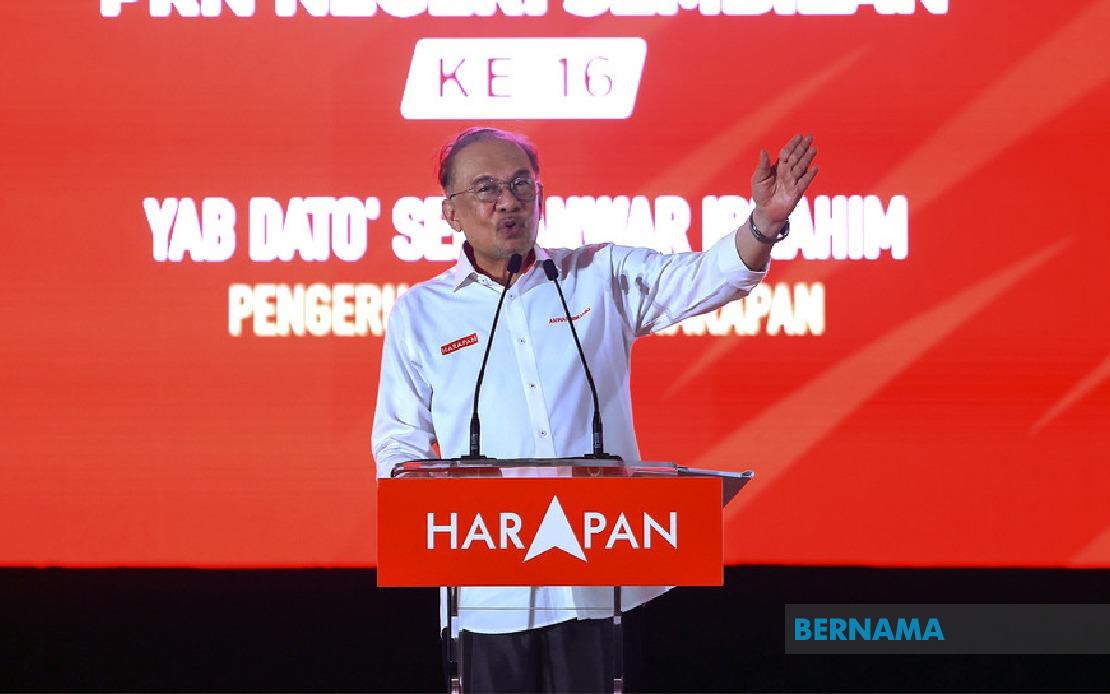
Prime Minister Datuk Seri Anwar Ibrahim has made a direct appeal to voters in Negeri Sembilan to maintain their backing for Pakatan Harapan in the state's 16th election, framing the vote as crucial to preserving the development trajectory the coalition has established in the state. In comments shared on social media, Anwar, who leads the PH coalition nationally, stressed that sustaining voter confidence in the coalition would be essential to preventing interruption of ongoing initiatives that he argues have benefited residents across the state.
The appeal underscores the political stakes in the Negeri Sembilan contest, where the ruling coalition faces electoral competition in a state that has been governed by PH leadership since 2018. Anwar specifically lauded Menteri Besar Datuk Seri Aminuddin Harun, known colloquially as Tok Min, highlighting what he described as six years of administrative conduct marked by integrity and responsibility. By elevating Aminuddin's personal stewardship, Anwar appears to be anchoring PH's campaign strategy around the administrator's tenure and track record rather than solely on broader coalition messaging.
The timing of Anwar's intervention reflects broader electoral realities in Malaysian state politics, where prime ministerial endorsements carry significant weight. For Pakatan Harapan, maintaining control of Negeri Sembilan carries symbolic importance as a demonstration of continued voter confidence in the coalition that came to power federally in 2022. A loss would represent a setback for the administration's narrative of political momentum and public mandate, particularly as it approaches the mid-point of the current federal parliamentary term.
According to Anwar, the collaborative framework between the state government in Seremban and the Federal Government in Kuala Lumpur has enabled the implementation of multiple development schemes that would not have been possible under divided governance. This assertion touches on a longstanding Malaysian political argument about the efficiency gains from unified control of state and federal resources. Whether voters find this argument persuasive will likely depend on their tangible experience with services and infrastructure in their constituencies, as well as their perception of how effectively these projects have been delivered.
The campaign message also implicitly acknowledges that development momentum can be disrupted if governance changes hands, a concern that may resonate particularly in constituencies where visible projects such as roads, schools, or health facilities remain ongoing. Anwar's framing of the election as a choice between continuation and disruption attempts to cast a vote against PH as a direct impediment to promised improvements in residents' daily lives. This approach seeks to elevate the election beyond typical partisan competition into a referendum on development delivery.
The electoral calendar for the Negeri Sembilan contest compresses decision-making for both voters and candidates. Nominations take place on Saturday, with early voting scheduled for July 28 and general polling on August 1. This compressed timeframe means campaigns will be relatively brief, potentially advantaging the incumbent administration with its existing machinery and public visibility over opposition parties that must organize rapidly. The election will determine the composition of the 36-seat state assembly and the direction of governance in a state of roughly one million people located strategically between Kuala Lumpur and Melaka.
From a broader Southeast Asian perspective, the Negeri Sembilan election provides a barometer of voter sentiment in Malaysia regarding the current federal administration's performance. As one of the smaller states by population but strategically significant as part of the Klang Valley metropolitan region, electoral trends here can signal shifting political currents that may have implications for future federal contests. Opposition parties will be testing their capacity to mount credible challenges to PH in traditional strongholds, while PH will be assessing whether its federal governance record translates into sustained state-level support.
The emphasis in Anwar's message on clean administration and stability reflects conscious positioning toward an electorate increasingly concerned with governance quality and anti-corruption measures. By anchoring the PH campaign to these themes rather than to divisive social or religious issues, the coalition appears to be pursuing a strategy of consolidating its existing base rather than attempting major ideological expansion. This may limit PH's ceiling for vote growth but could also provide defensive protection against erosion among voters prioritizing competent, uncorrupt governance over other considerations.
Aminuddin Harun's role as the focal point of PH's campaign adds a personal dimension to what might otherwise be abstract appeals for continuity. A respected administrator who has maintained relatively low controversy during his tenure, Aminuddin provides a contrasting figure to the national political turbulence that has characterized Malaysian politics in recent years. His perceived steadiness and absence of major scandals become campaign assets in a state where voters may be weary of the partisan conflicts that dominate national discourse.
The development narrative that Anwar champions assumes that voters prioritize economic and infrastructure advancement over other political considerations. This assumption may hold true in constituencies experiencing visible improvement in public services or benefiting from new infrastructure investment, but could ring hollow in areas where improvement has been slow or where residents perceive that promised projects have been delayed or scaled back. The coming weeks will test whether Anwar's appeal for continuity resonates sufficiently to secure the mandate he seeks for the coalition.

