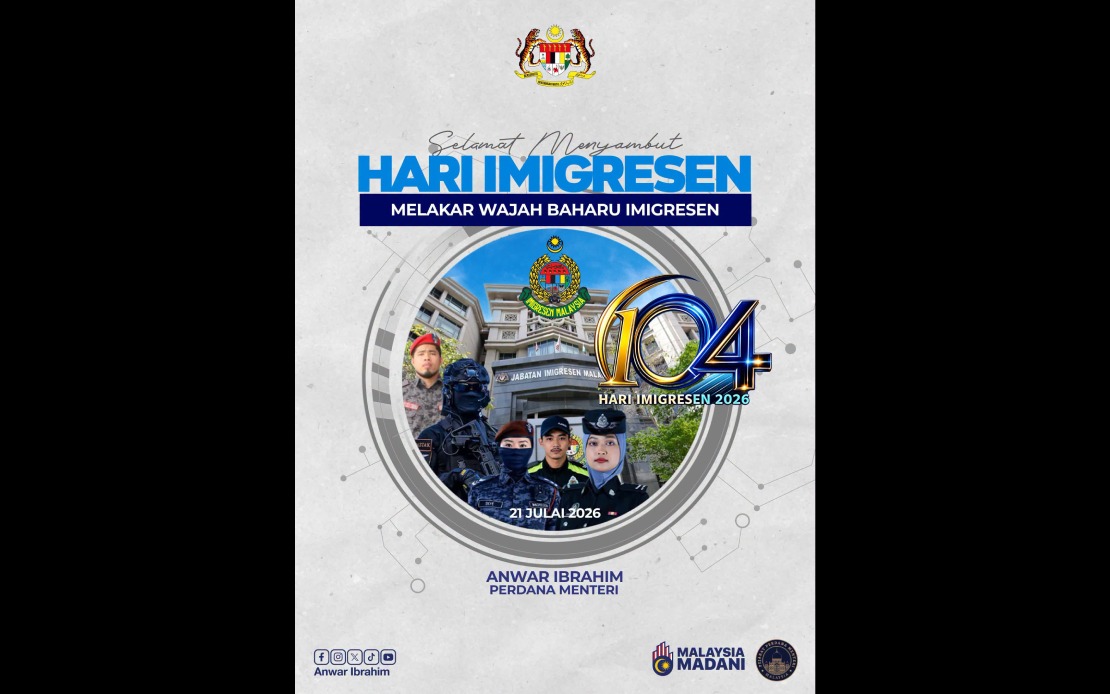
Prime Minister Datuk Seri Anwar Ibrahim has made a strong appeal to the Immigration Department to prioritise ethical conduct and resist all forms of misconduct, addressing the agency's personnel directly during Immigration Day celebrations on July 21. In remarks posted on social media, Anwar underscored that officials must discharge their duties with unwavering commitment to integrity while actively resisting corrupt practices that undermine public trust and institutional credibility.
The call represents a broader push by the government to strengthen governance within frontline agencies that interface directly with the public. Immigration officials occupy a critical position in Malaysia's administrative apparatus, tasked with managing borders, processing travel documents, and enforcing visa regulations. The integrity of this workforce directly affects Malaysia's international reputation and the confidence of both citizens and foreign visitors in the nation's institutional systems.
Beyond the emphasis on rejecting irregularities, Anwar stressed that Immigration Department personnel must balance procedural rigour with genuine compassion when engaging with the public. This dual mandate—maintaining strict regulatory standards while delivering services with courtesy and efficiency—reflects the government's vision of modernising public administration. The Prime Minister's message suggests that effective immigration management requires more than mere compliance; it demands a service orientation that recognises the human dimensions of border administration and document processing.
The 2026 Immigration Day theme, "Charting a New Face for Immigration," signals an intention to reshape how the department operates and presents itself. This branding effort aligns with Anwar's implicit acknowledgment that immigration agencies in Southeast Asia face persistent challenges related to corruption, human trafficking facilitation, and bribery schemes. By publicly invoking the theme and calling for renewed integrity, the Prime Minister is signalling government awareness of these vulnerabilities and commitment to reform.
Corruption within immigration systems poses particular risks for developing economies like Malaysia. Illicit networks exploit vulnerabilities in border control to facilitate smuggling, human trafficking, and organised crime. When immigration officials accept bribes or overlook irregularities, they expose the nation to security threats while damaging Malaysia's standing as a credible regional partner. This is especially significant given Malaysia's role as a transit point for regional travel and trade flows.
The emphasis on professional conduct also carries implications for Malaysia's tourism and investment sectors. International businesses and travellers depend on efficient, reliable immigration procedures. When the system suffers from corruption or inconsistent application of rules, it creates uncertainty that deters foreign investment and complicates tourism operations. Countries with reputations for fair, transparent border administration typically enjoy competitive advantages in attracting international talent and capital.
Anwar's appeal occurs within a broader Southeast Asian context where multiple governments have launched anti-corruption campaigns targeting public agencies. The region has witnessed various high-profile cases involving immigration officials facilitating illegal activities, highlighting systemic vulnerabilities. Malaysia's experience with such cases suggests that rhetoric alone proves insufficient; institutional reforms, enhanced oversight mechanisms, and meaningful consequences for wrongdoing must accompany exhortations to virtue.
The government's framing of Immigration Day as an opportunity for renewal reflects understanding that public agencies require periodic affirmation of their foundational purposes and values. By directing attention to the department on a designated occasion, the administration reinforces that immigration functions transcend routine document processing; they represent Malaysia's commitment to sovereignty protection and efficient governance. This symbolic dimension complements practical anti-corruption measures by embedding ethical expectations within institutional culture.
For Malaysian readers and businesses, the Prime Minister's emphasis carries practical significance. Citizens requiring passport services, visa extensions, or border clearances depend on officials who perform their duties fairly and transparently. Similarly, companies engaged in hiring foreign workers or facilitating international assignments depend on predictable, uncorrupted immigration administration. When integrity weakens, transaction costs rise for everyone as individuals and organisations must navigate uncertainty or engage in informal arrangements.
The reference to serving the public and elevating Malaysia's international standing broadens the significance beyond domestic administration. Immigration agencies represent the nation's face at borders and airports, where first impressions form. Foreign visitors' experiences with Malaysian immigration officials influence their perceptions of the country's professionalism, efficiency, and trustworthiness. By holding the department to rigorous standards, the government reinforces its international image as a well-administered nation capable of managing complex regulatory systems fairly.
Moving forward, the effectiveness of the Prime Minister's appeal will depend on substantive follow-up. Exhortations to integrity require complementary investments in training, competitive remuneration to reduce corruption incentives, independent oversight bodies, and transparent performance metrics. Regional observers will scrutinise whether Malaysia implements institutional changes that transform rhetoric into measurable improvements in departmental conduct and efficiency.
The timing of Anwar's message—coinciding with a formally designated Immigration Day—suggests that addressing corruption within immigration services ranks among government priorities. This focus acknowledges that public trust in institutions strengthens when officials demonstrate genuine commitment to serving citizens fairly. By publicly challenging his own appointees to uphold the highest standards, the Prime Minister signals that accountability extends throughout government and that no agency escapes expectations of professional conduct.

