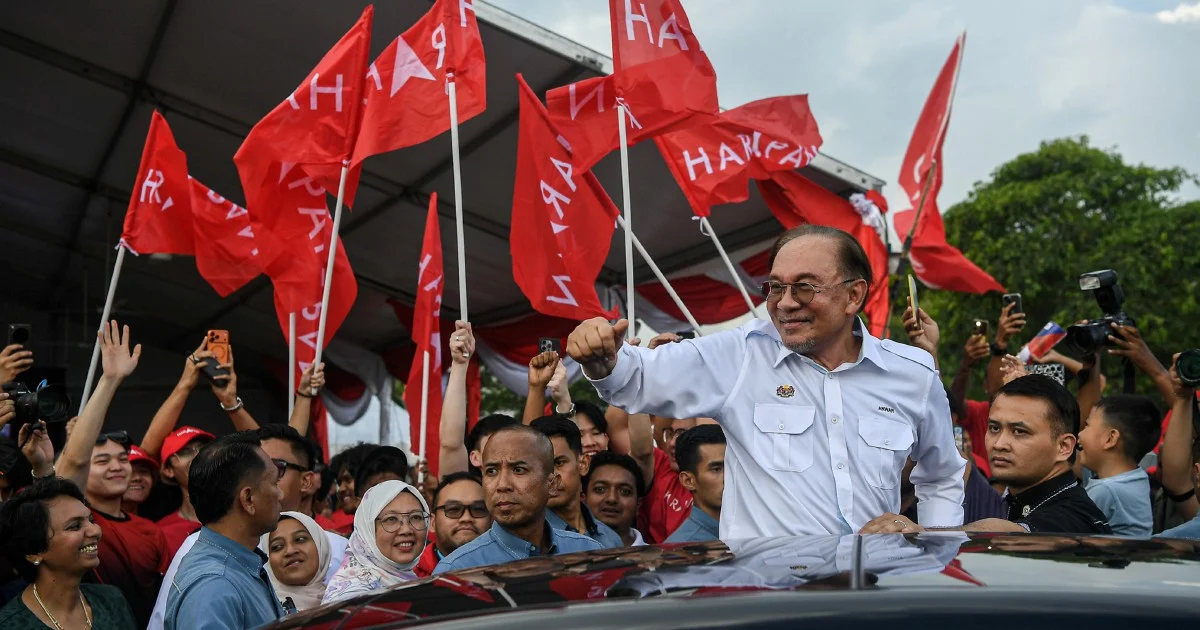
Pakatan Harapan chairman Datuk Seri Anwar Ibrahim delivered a pointed rebuke to rival politicians in Segamat, criticising those unwilling to share platforms with the Democratic Action Party as acting inappropriately and undermining the democratic process. The remark underscores ongoing tensions within Malaysia's fragmented political landscape, where DAP's prominent role in the ruling coalition continues to draw opposition from traditionalist quarters and competing factions seeking to exploit religious and communal sensitivities for electoral advantage.
Anwar's intervention signals that the PH coalition leadership views coordinated attacks on DAP as counterproductive to national governance and detrimental to the coalition's broader reform agenda. By framing the issue in terms of respecting voter choices, the PH chairman attempted to elevate the discussion beyond partisan squabbling, suggesting that those elected in the 2022 general election received a mandate that included DAP's participation in government. This framing challenges opponents to acknowledge the legitimacy of electoral outcomes rather than perpetually questioning them through character assassination or organisational ostracism.
The timing of Anwar's comments in Segamat, a constituency with a mixed demographic composition, appears deliberate. The town sits in Johor, a state where BN has consolidated influence and where religious and communal messaging carries particular resonance among voters. By addressing the matter in this setting, Anwar demonstrated awareness that PH's coalition strategy must survive and thrive in precisely such heartland areas rather than remaining confined to urban strongholds where it commands comfortable majorities.
DAP's position within PH has remained contentious since the coalition's formation. Critics from various quarters—including some BN politicians, PAS, and fringe conservative movements—have sought to characterise the party as a threat to Malay-Muslim interests or as harbinger of secular governance that would undermine Islamic principles in Malaysia's constitutional framework. These attacks intensified following the 2022 election, when DAP emerged as PH's strongest performing component, winning 40 parliamentary seats and consolidating authority in key states including Penang, Selangor, and Melaka.
For Malaysia's democratic maturation, Anwar's argument carries significant weight. Refusing to share platforms with coalition partners or governmental colleagues fundamentally undermines the institutional credibility of cabinet-level decision-making. When opposition politicians decline even to acknowledge legitimacy of their opponents' participation in government, they implicitly challenge the constitutional order itself and suggest that some communities possess an inherent right to veto other communities' political representation regardless of electoral outcomes. This logic, taken to its conclusion, would render Malaysia's parliamentary system dysfunctional and encourage future governments to exclude parties representing particular demographics.
The controversy also reflects deeper structural questions about Malaysian coalition politics and whether genuine partnership across communal lines remains achievable. The long-standing arrangement that reserves the prime ministership for Bumiputra politicians, coupled with conventions regarding Defence and Home Affairs portfolios, was intended to assuage majority-community anxieties while enabling minority communities to participate meaningfully in government. Yet resistance to DAP's presence suggests these assurances may prove insufficient for some constituencies, who view any significant role for a non-Bumiputra party as inherently threatening regardless of safeguards.
Regional implications deserve consideration as well. Southeast Asian democracies increasingly grapple with questions of inclusive governance and whether plural societies can construct functioning coalitions across deep identity lines. Malaysia's experience—whether PH can maintain cohesion and demonstrate effective administration despite communal tensions—provides a test case for democratic resilience in religiously and ethnically diverse societies. Authoritarian competitors in the region closely observe whether democratic systems successfully build legitimacy through inclusion or fragment under pressure from purist movements demanding exclusion.
Anwar's intervention also reflects internal PH dynamics and his personal authority within the coalition. As premier and PH chairman, he must maintain coalition discipline while navigating the competing demands of each member party. DAP, as the coalition's strongest performer, expects protection from what it perceives as coordinated vilification; simultaneously, other components worry about being sidelined or about PH's electoral prospects in traditional heartlands if DAP appears too prominent. Anwar's criticism of those refusing platforms with DAP signals he will actively defend the coalition's integrity and counter attempts to undermine it through sectarian messaging.
Forward momentum for PH likely depends on the coalition's ability to demonstrate that Malay-Muslim interests receive adequate protection and respect within a multiracial partnership. This requires not merely formal positions and parliamentary representation, but visible, sustained investment in policies addressing Bumiputra concerns, rural development, Islamic affairs, and education. Without tangible deliverables alongside institutional participation, arguments about respecting electoral mandates will sound hollow to communities harbouring genuine anxieties about their future status.
The broader challenge facing Malaysian politics remains whether competing coalitions can establish a baseline of institutional respect and democratic norms, even during fierce electoral competition. Anwar's call for politicians to accept their rivals' legitimacy and share platforms represents a modest but essential foundation for functional governance. Whether this message resonates beyond PH's core constituency will substantially influence Malaysia's political trajectory over the coming years.

